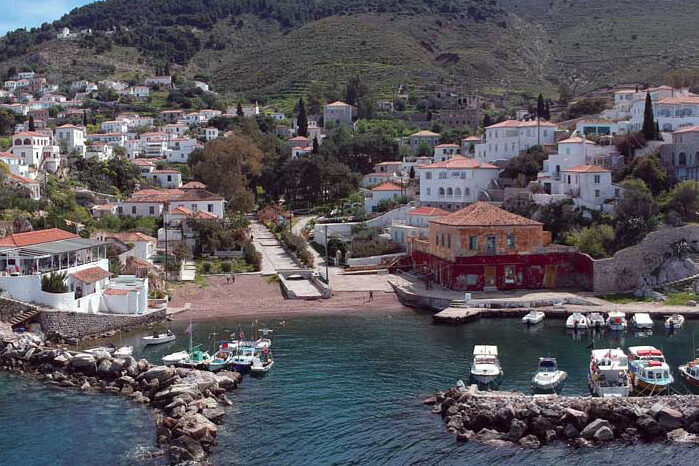


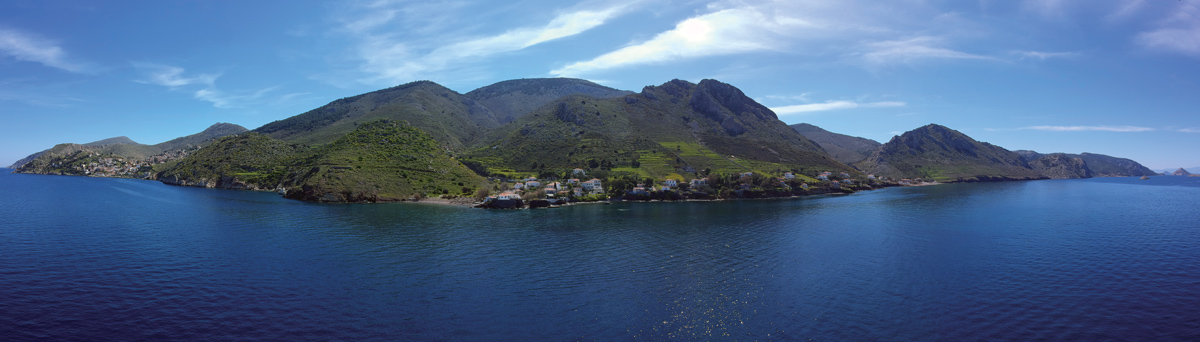
Ýdra island from NW (in front of Vlychó settlement)
The waters between Hydra and the Argolid coast, stretching from the small islands of Tselevinia to Ermioni and including the island of Dokos, form one of the most historic maritime passages of the Argolic Gulf. This narrow sea corridor lies directly along the natural sailing route between the Saronic Gulf and the southern Aegean, and for thousands of years it has been used by ships travelling between the Peloponnese, the Cyclades and the eastern Mediterranean. Even today, the passage remains a familiar route for coastal navigation.
Archaeological evidence shows that the island of Dokos was inhabited already during the Early Bronze Age (3rd millennium BC). In the waters nearby, archaeologists discovered one of the oldest known shipwrecks in the world, dating to around 2200 BC, confirming that maritime trade routes passed through this channel more than four thousand years ago. In antiquity the opposite mainland belonged to the territory of Hermione, an important Argolid city whose harbour served local trade and communication with the Saronic islands.
The island of Hydra, known in antiquity as Hydrea, remained relatively sparsely populated through most ancient and medieval times, mainly because of its rugged terrain and limited agricultural land. During the Byzantine and early Ottoman periods, small communities survived on the nearby mainland while the islands were used intermittently by fishermen and shepherds. The sheltered waters between Hydra, Dokos and the Argolid coast nevertheless continued to serve as a useful coastal route for vessels navigating between the Peloponnese and the Aegean.
The region gained great historical importance during the 18th and early 19th centuries, when Hydra developed into one of the most powerful maritime communities of Greece. Hydriot shipowners built a large merchant fleet trading throughout the Mediterranean and the Black Sea, and the island became one of the leading naval forces of the Greek War of Independence in 1821. Commanders such as Admiral Andreas Miaoulis led Hydriot ships in many naval engagements against the Ottoman fleet. Although Hydra’s maritime dominance declined after the creation of the modern Greek state, the surrounding waters still preserve the character of a historic seafaring landscape linking the islands and the Argolid coast.