

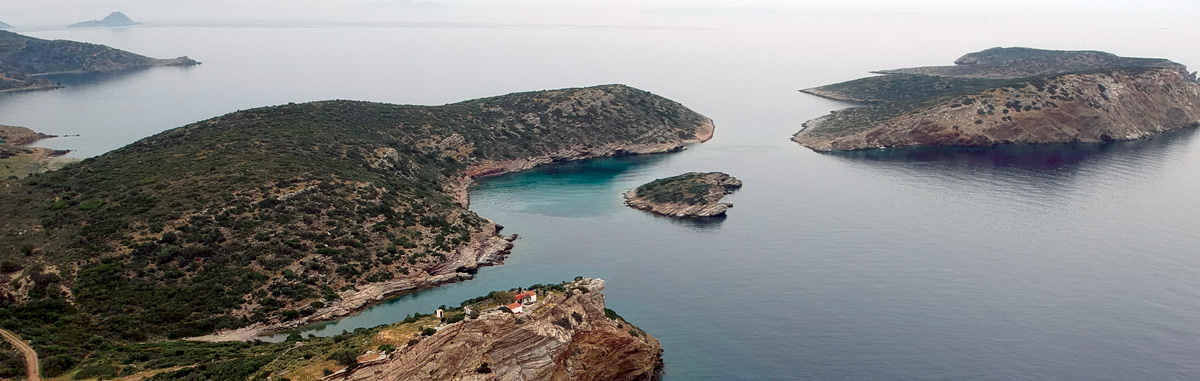
Opposite Cape Skyllaion, the easternmost point of the Peloponnese, lie two small islets: Spathi Island and Skili Island. Since the 16th century, these islets have been collectively known as Tselevinia, a name that most likely derives from Arvanite words. According to the prevailing interpretation, the name comes from “tselie” (watch out) and “venie” (they are coming). It is believed that Arvanite inhabitants of the region maintained a lookout on Cape Skyllaion and, when Ottoman or pirate vessels approached, they warned the surrounding settlements by shouting “tselie – venie”.
The wider area has been inhabited since prehistoric times and in antiquity was known as Skyllaion, while its inhabitants were called Skyllaeis. According to Greek mythology, the region took its name from Skylla, daughter of Nisos, king of Megara, whose body was washed ashore here under unknown circumstances. Although ancient habitation in the area is certain, archaeological excavations have ceased, probably due to lack of funding, leaving much of the history of the ancient Skyllaeis still unknown.
Remains of medieval fortifications are also found in the area. Near the small Byzantine chapel dedicated to the Virgin Mary stand the ruins of a Venetian castle. Only fragments of the outer walls and enclosure survive today, while ceramic finds dating from the 13th–14th centuries AD indicate activity during that period. Since the castle does not appear on nautical charts of the 17th and 18th centuries, it is assumed that its life was relatively short and that it was destroyed before the end of the 15th century.
Sights
Cape Skyllaion
The easternmost point of the Peloponnese rises directly opposite the Tselevinia islets and served since antiquity as an important observation point for maritime traffic. From here the inhabitants of the region maintained a lookout over the Argolic and Saronic Gulfs, warning nearby settlements of approaching pirate or enemy ships.
Venetian Castle of Tselevinia
Near the cape lie the remains of a small Venetian fortress, of which only fragments of the outer walls and enclosure survive today. Ceramic finds dating from the 13th–14th centuries AD indicate that a small fortified station once controlled the surrounding sea routes.
Chapel of Panagia
Within the area of the old fortress stands the small Byzantine chapel dedicated to the Virgin Mary, which survives to this day. The chapel forms the only preserved building in the area and reflects the small but historically significant human presence at the cape.