

Porto Koufo
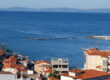
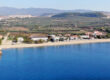
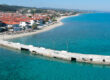
The bay of Koufo, today known as Porto Koufo, owes its historical importance primarily to its exceptionally sheltered natural harbour, one of the safest anchorages in northern Greece. Almost landlocked and protected from every wind, it was known in antiquity as kophos limen—the “silent or deaf harbour”—a name that reflects how little wave or wind noise reaches its interior. Classical authors such as Thucydides mention the harbour, confirming that it was already recognised and used in the 5th century BC as a refuge for ships navigating the northern Aegean.
Although Koufo itself never developed into a major ancient city, it lay within the sphere of influence of ancient Torone, one of Sithonia’s most important poleis, founded by Chalcidian settlers in the late 8th century BC. In this context, the bay functioned as a strategic maritime adjunct to Torone’s economic and military activity, offering a secure anchorage close to shipping routes, fisheries, and coastal trade. Its role was practical rather than monumental, which explains the absence of large-scale ruins despite its long-standing maritime use.
In modern times, Koufo regained strategic significance during World War II, when German forces exploited the bay’s depth, concealment, and narrow entrance as a protected anchorage and support point for naval operations in the Aegean. Traces of wartime activity are still remembered locally, adding a 20th-century layer to a place whose importance has always derived from geography rather than urban development. From antiquity to the present, Koufo remains a harbour defined by natural design and enduring maritime value.