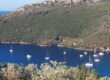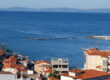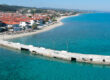


Gerakini anchorage
The area of Nikiti, on the western side of Sithonia, shows continuous human presence from antiquity to the present day, functioning historically as an intermediate zone between the hinterland of Chalkidiki and the Thermaic–Toroneos Gulf. Although it never developed into a major ancient urban centre, its position gave it a lasting agricultural, religious, and commercial role, reflected most clearly during the Early Christian and Byzantine periods.
During Late Antiquity (4th–6th century AD), the region experienced a phase of relative prosperity, documented by the establishment of important Early Christian monuments. The most notable is the Early Christian Basilica of Sofronios, located east of modern Nikiti and dated to the late 4th or early 5th century AD. The monument displays high architectural quality, with features such as a synthronon, marble architectural members, and decorated floor surfaces, indicating a well-organised Christian community with links to the major centres of Macedonia.
In the Middle and Late Byzantine periods, the wider Nikiti area became part of a network of rural settlements and monastic estates, closely connected with the Athonite peninsula. Large tracts of land functioned as metochia of Mount Athos monasteries, supporting cereal cultivation, olive groves, and vineyards, while also controlling coastal routes. The calm and easily navigable waters of the Toroneos Gulf facilitated the transport of agricultural products towards Thessaloniki.
Under Ottoman rule, Nikiti and the surrounding villages retained the character of small, compact farming communities. Present-day Old Nikiti, with its stone-built houses and dense layout, is a direct descendant of this period and preserves the image of a settlement adapted both to cultivation and defence. Its distance from the coastline was deliberate, reflecting long-standing concerns about piracy and coastal raids.
Metamorfosi and the coastal zone of Psakoudia complete the historical landscape as areas more closely associated with monastic landholding and later settlement. Metamorfosi functioned as a metochi of the Dionysiou Monastery of Mount Athos and acquired a permanent residential character mainly in the 20th century, when refugees from Asia Minor settled there, adding an additional historical layer to the region.
Gerakini and the History of Mining Activity
Gerakini represents a distinct case within Chalkidiki, as its modern history is inseparably linked to the industrial exploitation of magnesite. Although the wider area was inhabited from antiquity, its real development began in the early 20th century, when the rich magnesite deposits of western Chalkidiki were identified and systematically exploited.
Organised magnesite mining began in AD 1914, and Gerakini quickly evolved into a major industrial and port centre. The establishment and expansion of the modern magnesite company in the mid-20th century shaped not only the local economy but also the social structure of the settlement. Processing, storage, and loading facilities were constructed, and the small harbour acquired a strictly functional character, serving the export of raw materials.
Gerakini is one of the few places in northern Greece where the coastal landscape still bears clear traces of industrial history. Older facilities, loading piers, and the spatial organisation of the settlement reflect a different relationship between people and the sea — not touristic, but productive. At the same time, mining activity influenced the wider region, providing employment and connecting Chalkidiki to international commercial networks.
Sightseeing
Old Nikiti stands out as one of the best-preserved traditional settlement ensembles in Chalkidiki, with stone-built houses, narrow lanes, and a strong sense of historical continuity. Just outside the village, the archaeological site of the Basilica of Sofronios offers one of the most substantial Early Christian monuments in the area.
The coastal stretch from Nikiti to Psakoudia features long beaches with calm waters, while Metamorfosi functions as a quiet intermediate stop with easy access both to the sea and the inland areas. In Gerakini, interest focuses primarily on the man-made landscape and the understanding of industrial heritage rather than on conventional archaeological monuments.
Flavours
Local gastronomy is rooted in Macedonian rural traditions, with a strong presence of olive oil, vegetables, and seafood. In Nikiti, notable products include locally produced olives, honey, and simple seasonal dishes closely connected to village life.
Along the coast, seaside tavernas serve fresh fish and shellfish from the Toroneos Gulf, while in Gerakini the cuisine reflects the character of a working settlement, with an emphasis on hearty, unpretentious dishes linked to local production and the sea.