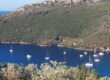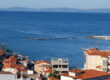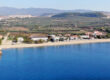


Pier in Pefkochori
Southern Kassandra, as the natural maritime extremity of ancient Pallene, was never a random or marginal landscape. Its geography—low-lying coasts, sandy coves, wetlands, and points offering uninterrupted visibility across the Toroneos Gulf—favoured early human activity, primarily of a seasonal nature. The presence of wetland formations, such as modern Glarokavos, points to areas suitable for fishing, gathering, and safe anchorage from prehistoric times.
Although no major prehistoric settlements have been identified at the extreme southern end of the peninsula, continuous human use of the landscape is considered likely, closely linked to the sea and its natural resources.
Archaic and Classical periods – Pallene and its cities
During the Archaic and Classical periods, Kassandra was known as Pallene, one of the most developed peninsulas of Chalkidiki. In its southern and south-western sectors, powerful urban centres such as ancient Mende and Skione exerted direct influence over the hinterland of today’s southern Kassandra. The area functioned as a maritime outpost, integrated into networks of trade, religion, and strategic control.
At Cape Posidi, the Sanctuary of Poseidon developed into one of the most important coastal sanctuaries of Macedonia, closely associated with Mende. The choice of location was deliberate: the cape dominates key northern Aegean sea routes, giving the sanctuary a wider, almost pan-Hellenic significance for sailors and merchants.
The area of Paliouri and the tradition of Therambos
In the interior of southern Kassandra, near modern Paliouri, local historical tradition places the ancient city of Therambos. The name is mentioned by Herodotus, in the context of Xerxes’ campaign, when the cities of Pallene were compelled to contribute to the Persian forces. The precise location of Therambos has not been archaeologically confirmed, yet the persistence of the tradition suggests that the area was neither marginal nor uninhabited, but integrated into the network of ancient communities across the peninsula.
Paliouri thus appears to continue a long-standing relationship between people and land, based on agriculture but always oriented towards the southern coastline.
Hellenistic and Roman times – Continuity without prominence
During the Hellenistic and Roman periods, southern Kassandra does not display major urban growth, yet it was not abandoned. The region functioned as an agricultural and maritime hinterland of stronger centres, while the Sanctuary of Poseidon at Posidi retained its importance for centuries.
The coves and low-lying shores, from Skione to the modern coasts of Glarokavos and Agios Nikolaos, were used as natural anchorages, reinforcing the character of southern Kassandra as a corridor and maritime passage rather than an isolated territory.
Byzantine period – A Christian landscape of small-scale settlement
In Byzantine times, the character of the area shifted: urban concentration declined, giving way to a network of small settlements, agricultural installations, and chapels. Southern Kassandra became part of the wider ecclesiastical landscape of Chalkidiki, without developing strong administrative centres.
Agios Nikolaos, dedicated to the patron saint of sailors, is a characteristic example of Byzantine and post-Byzantine religious geography. Small coastal chapels functioned both as places of worship and as orientation points in a world where the sea remained the primary route of communication.
Ottoman period and the Greek War of Independence
Under Ottoman rule, southern Kassandra retained its agricultural and peripheral character, with populations concentrated inland, particularly around settlements such as Paliouri. The coastline was used seasonally, mainly for fishing and transport.
Kassandra as a whole took part in the events of the Greek War of Independence of AD 1821, with severe consequences for the population. Although fighting did not focus specifically on the extreme southern tip, destruction and population displacement affected southern Kassandra as well, leading to a prolonged period of demographic decline.
Modern era – From survival to rediscovery
In modern times, the area was gradually resettled. Paliouri became established as the principal settlement of southern Kassandra, while the coastal zones remained sparsely developed until the 20th century. Glarokavos, with its distinctive wetland character, is a notable example of a natural landscape that remained largely intact until the onset of modern tourism.
Cape Posidi, with its 20th-century lighthouse, continues the long tradition of the site as a point of orientation and maritime reference, symbolically linking antiquity with modern navigation.