

At the south-western edge of Aitoloakarnania, where the Acheloos River reaches the Ionian Sea, land and water have always been in motion. The river, once the natural boundary between ancient Aetolia and Acarnania, carried silt down from the Pindus mountains for centuries, creating marshes, lagoons, low shores and new land. Ancient writers already observed this land-making power, noting how the Acheloos gradually altered the form of the nearby Echinades Islands.
In Greek mythology, the Acheloos was not merely a river, but a divine force of fertility and water. His famous struggle with Herakles for Deianeira, during which he changed into a serpent and a bull, suits this landscape perfectly: rich, shifting and never entirely fixed. At the river mouth, myth and geography seem to meet naturally, as fresh water, mud, reedbeds and sea form one of western Greece’s most distinctive coastal environments.
Off the estuary rises Oxeia, the southernmost and most imposing of the Echinades. Its name means “sharp” or “pointed”, a fitting description of its steep, mountainous profile as it rises abruptly from the sea. For sailors, it is a powerful landmark on the Ionian approach, standing within a sea corridor that historically linked Kefalonia, Ithaca, Acarnania and the Gulf of Patras.
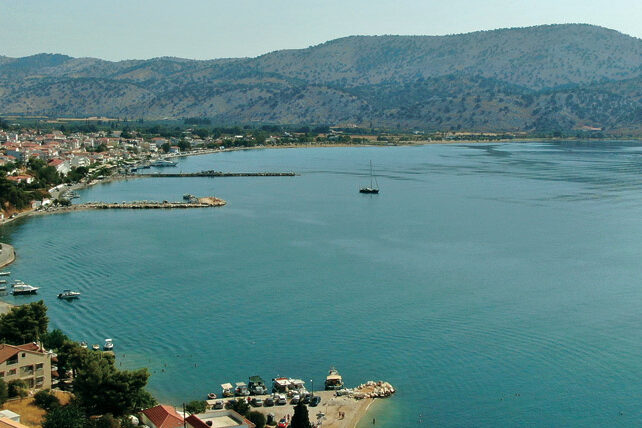
Moving towards Astakos, the low deltaic coast gradually gives way to the rougher shores of Acarnania. Ancient Acarnania was a land of mountains, small cities, fortified hills and natural harbours, more closely tied to the sea than to broad plains. The deep bay of Astakos was one of its finest natural openings to the Ionian. Ancient Astacus, known from the Classical period, was involved in the political and military struggles of western Greece, including the wider events of the Peloponnesian War.
The name Astakos, meaning “lobster”, preserves a strongly maritime flavour. In medieval and early modern times the area was also known as Dragamesti, a name that reflects the layered history of western Greece. Under Byzantine, Frankish, Venetian and Ottoman influence, this coast often stood away from the main centres of power, yet remained connected to the sea routes, conflicts and exchanges of the Ionian world.