

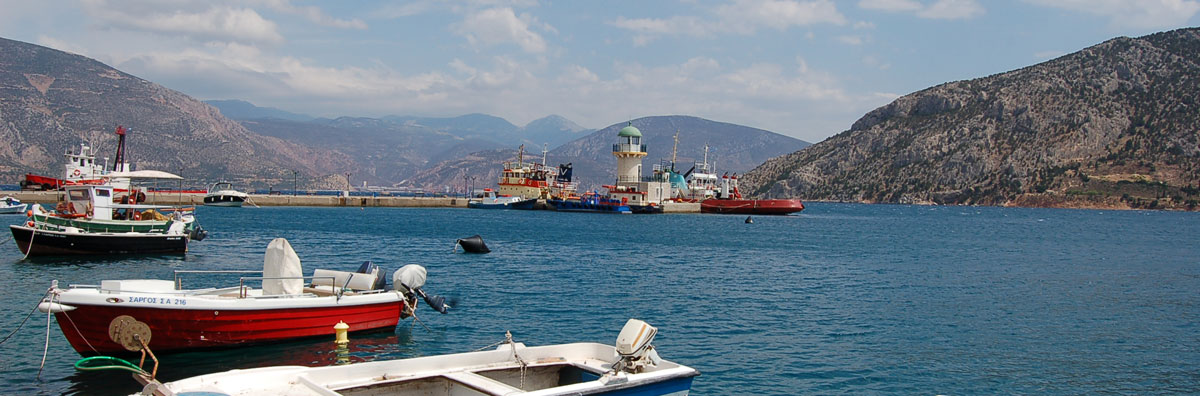
View of the harbour, Antikyra
Tucked into a wide bay on the northern shore of the Corinthian Gulf, Antikyra has always stood at the intersection of myth, medicine, and maritime trade. The modern visitor finds a quiet coastal town, surrounded by olive groves and the shadowy slopes of Mount Helicon. Yet beneath this serenity lies a story that stretches back to the heroic age of Greece — a place known to Homer, to physicians, to Byzantine chroniclers, and to travelers of every age.
Ancient Origins – The City of Helicon and the Power of Hellebore
Antikyra first appears in history in the Homeric era, when the surrounding region of Phocis was a patchwork of small independent cities. Ancient sources suggest that the original settlement may have been a Mycenaean harbor, serving as the maritime outlet for the inland cities of the Helicon region. By the Classical period, Antikyra had become famous across Greece for a very particular reason: its potent black hellebore, a medicinal plant that grew on the slopes of Helicon and Parnassus.
This plant, used to treat madness and melancholy, gave rise to the proverbial saying “to go to Antikyra,” meaning “to seek a cure for insanity.” Writers such as Theophrastus, Dioscorides, and Pliny mention Antikyra’s hellebore as the strongest in the Greek world, capable of purging both the body and the mind. Physicians traveled from afar to obtain it, while merchants exported it throughout the Mediterranean.
But Antikyra was more than a pharmacy of antiquity — it was also a strategic harbor. During the Persian Wars, the Phocians used the port to resist Xerxes’ advance, and later, in the Sacred Wars (4th century BCE), it was repeatedly occupied and destroyed. Philip II of Macedon captured and razed it in 346 BCE, punishing the Phocians for their impiety toward Delphi. Yet the resilient city rose again, rebuilt by its inhabitants and strengthened during the Hellenistic age.
Roman Period – Prosperity under the Eagle
Under Roman rule, Antikyra flourished anew as part of the province of Achaia. Its natural harbor made it a stopover point for ships traveling between Corinth and the western Greek coasts. Archaeological finds — coins, mosaics, baths, and temples — reveal a lively civic life. Roman Antikyra boasted shrines to Apollo and Poseidon, and public buildings decorated with fine marble from nearby quarries. The therapeutic fame of hellebore endured into the Roman era, and Roman physicians continued to prescribe it for both body and soul. The Latin poet Juvenal even jokes that “three doses from Antikyra” were enough to cure the madness of contemporary politics — proof that the town’s reputation survived well into Imperial times.
Byzantine and Medieval Periods – Faith and Fortifications
In the Byzantine era, Antikyra entered a quieter but enduring phase. The bay remained important as a naval shelter, and the surrounding hills became home to small monastic communities. The nearby slopes of Helicon, long sacred to the Muses, now echoed with Christian hymns instead of pagan songs. Archaeologists have identified remains of early Christian basilicas and Byzantine pottery across the modern town, attesting to continuous habitation.
During the Frankish period that followed the Fourth Crusade (13th century), the Gulf of Corinth became a contested frontier between Byzantines, Franks, and later Catalans. Antikyra’s position drew the attention of Venetian and Ottoman fleets alike. Its harbor served as a minor naval outpost, often changing hands as the tides of empire shifted. In medieval charts it appears as “Anticira” or “Antichira,” a name familiar to seafarers who sailed between Patras and Corinth.
Ottoman and Modern Times – From Ruin to Revival
By the 15th century, Antikyra, like much of central Greece, fell under Ottoman rule. The settlement shrank, but never disappeared. Fishermen and farmers continued to inhabit the bay, preserving the ancient name through centuries of change. When the Greek War of Independence broke out in 1821, the region of Phocis rose in revolt, and Antikyra served as a supply port for local insurgents. Its harbor provided safe anchorage for the small Greek fleet that operated in the Gulf.
In the late 19th century, Antikyra began to revive as part of the newly independent Greek state. The discovery of ancient ruins — inscriptions, columns, and tombs — drew the attention of archaeologists and travelers. Excavations in the 20th century uncovered parts of the ancient acropolis and harbor installations, confirming the city’s importance in antiquity.
The greatest transformation came in the 20th century, with the construction of the Aluminium of Greece plant nearby in the 1960s. The industrial complex at Agios Nikolaos brought employment and prosperity to the region, linking Antikyra once again to the sea as an export harbor. Despite modernization, the town retained its traditional charm — its narrow waterfront streets, its fishing boats, and its calm gulf ringed by hills.
Today – A Harbor of Calm and Memory
Today’s Antikyra is both a working harbor and a destination for those seeking the quiet beauty of central Greece. Visitors can stroll along the seaside promenade, explore nearby coves, or climb toward the remains of the ancient acropolis overlooking the bay. The nearby mountain routes lead to the mythical Helicon and to the monasteries of Distomo and Osios Loukas, creating a spiritual and historical itinerary through the heart of Boeotia and Phocis.
Few places in Greece carry such continuity of life — from the days of Homer to the modern age. And even though hellebore is no longer harvested here, the town retains its ancient reputation as a place of calm and healing.
Sights
Antikyra Waterfront
Antikyra is a small seaside town on the northern shore of the Corinthian Gulf, built around a naturally sheltered bay opposite the coast of Phocis. Its waterfront promenade with cafés and tavernas offers pleasant walks with views across the gulf.
Ancient Antikyra
The area has been inhabited since antiquity, and ancient Antikyra was widely known for the medicinal plant hellebore, which was used in ancient medicine as a remedy for various illnesses. Although few archaeological remains are visible today, the town’s history remains closely linked to ancient trade and navigation in the Corinthian Gulf.
Monastery of Agios Nikolaos near Distomo
A short distance inland stands the historic Monastery of Agios Nikolaos, an important Byzantine monastery set in the mountains of Boeotia. The monastery is known for its frescoes and its peaceful setting within the surrounding landscape.
Distomo and the Memorial Museum
Nearby Distomo is known for the tragic massacre of 1944 during the Second World War. The Memorial Museum and the hilltop mausoleum commemorate one of the most significant events of modern Greek history.
Beaches of Antikyra Bay
The bay includes several small and quiet beaches with clear waters, ideal for swimming. The surrounding scenery offers fine views toward the mountains of Phocis across the gulf.
Flavours
Fresh Fish from the Corinthian Gulf
Local tavernas serve fresh fish and seafood, usually grilled and accompanied by salads and local wine.
Grilled or Marinated Octopus
A favourite seafood meze is octopus, either grilled over charcoal or marinated with vinegar and olive oil.
Boeotian Olives and Olive Oil
The inland areas of Boeotia produce excellent olives and olive oil, staples of the regional cuisine.
Traditional Roumeli Pies
Visitors often encounter homemade pies, filled with cheese or wild greens and prepared with thin pastry.
Honey and Walnut Desserts
Traditional desserts such as walnut cake, spoon sweets, and honey-based sweets are commonly offered in local cafés and tavernas.