

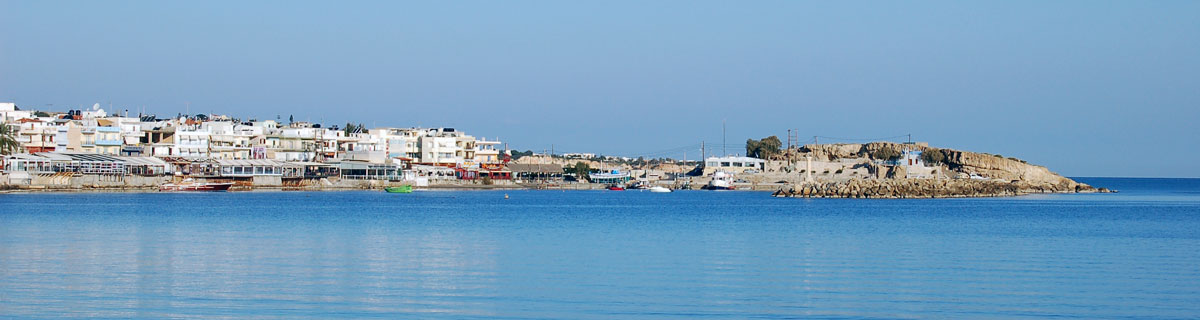
Chersonisos harbour and city
The modern town of Hersonissos (also written Chersonisos; from the Greek, meaning “peninsula”) occupies the site of an ancient coastal city that flourished in the Hellenistic and Roman periods. Its history is closely tied to maritime trade, religious cult activity, and later, shifting settlement patterns between coast and inland due to security concerns.
Antiquity – The City of Chersonesos
Ancient Chersonesos developed as a significant harbour town on Crete’s north coast. Archaeological evidence places its main period of prosperity between the 4th century BC and the 3rd century AD.
The city maintained an organised harbour, remains of which are still visible today beneath and around the modern waterfront. Submerged structures, including sections of moles and harbour installations, indicate deliberate maritime infrastructure rather than a simple anchorage.
Chersonesos became particularly important during the Roman period (1st century BC – 4th century AD). The town expanded, and several Roman buildings, mosaics, baths, and villas have been excavated. Its position along north-coast sea routes linking western Crete, Knossos, and eastern ports made it part of a broader commercial network.
A major sanctuary dedicated to Britomartis (a Cretan goddess later associated with Artemis) has been identified in the area, suggesting the town was not only commercial but also a religious centre.
Early Christian & Byzantine Period (4th–9th century AD)
Hersonissos became an important Early Christian episcopal seat. The archaeological zone includes remains of several Early Christian basilicas dating from the 5th–6th centuries AD, some featuring mosaic floors.
These basilicas demonstrate that the city remained active and structured during the early Byzantine period. The number and scale of churches indicate both population continuity and ecclesiastical importance.
However, during the period of Arab raids and instability (7th–9th centuries AD), many coastal settlements in Crete declined or were abandoned due to piracy and insecurity. Like other north-coast towns, Hersonissos appears to have experienced contraction.
Medieval Shift Inland
During the later Byzantine and Venetian periods, settlement focus shifted inland to what is today known as Old Hersonissos (Ano Hersonissos). This movement followed a wider Cretan pattern: coastal communities relocated slightly inland for protection from piracy and seaborne attack.
The inland village retains traditional architecture and reflects this defensive adaptation phase of Cretan settlement history.
Under Venetian rule (1204–1669 AD), the wider region formed part of the administrative territory of Candia (modern Heraklion). Although Hersonissos did not develop into a major fortified centre like Spinalonga or Heraklion, the north coast remained strategically monitored due to its exposure.
Ottoman Period (1669–1898 AD)
Following the Ottoman conquest of Crete in 1669 AD, the inland settlement pattern continued. Agricultural production (olive cultivation, cereals, livestock) shaped the local economy. As with much of Crete, demographic and property changes occurred during this period, but Hersonissos did not emerge as a primary administrative centre.
Modern Era – 20th Century Transformation
The decisive transformation of Hersonissos occurred in the second half of the 20th century AD. With the growth of tourism in Crete from the 1960s onward, the coastal zone was gradually reoccupied and developed.
Modern Hersonissos is therefore a return to the coast, echoing its ancient harbour identity but under entirely different economic conditions. Tourism infrastructure now dominates the waterfront, yet beneath it lie layers of Roman harbour works, Early Christian basilicas, and Hellenistic foundations.
Sightseeing
- Roman Harbour Remains: Submerged and visible sections of ancient harbour moles along the modern seafront.
- Early Christian Basilicas: Archaeological remains of multiple 5th–6th century AD churches with mosaic traces.
- Sanctuary of Britomartis: Evidence of the town’s religious significance in antiquity.
- Ano Hersonissos (Old Village): Inland settlement reflecting the medieval defensive shift away from exposed coastline.
- Lychnostatis Open-Air Museum: A modern cultural site illustrating traditional Cretan rural life.
Flavours
- Olive oil and olives: Core agricultural products of the region.
- Cretan cheeses (mizithra, graviera): Reflecting upland pastoral traditions.
- Raki (tsikoudia): Traditional distilled spirit, central to local hospitality.
- Honey and herbs: Products of the semi-mountainous hinterland.