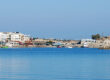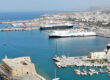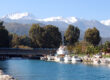


On the northern coast of Crete, midway between Chania and Rethymno, Georgioupoli lies where fertile plain meets open sea and mountain rivers descend from the White Mountains (Lefka Ori) to the Bay of Almyros. Behind today’s relaxed seaside town stretches an older geography of wetlands, dunes, fields and natural passages — a landscape that made the area both strategic and habitable from early times. The coastline here feels like a threshold: part harbour, part frontier, part fertile hinterland — a place shaped equally by land and sea.
Prehistoric and Minoan Period
Long before the modern settlement took form, the wider region of Apokoronas was already integrated into the island’s prehistoric life. Small rural communities cultivated the land while maintaining contact with the sea. The coastal position near present-day Georgioupoli is associated by scholars with the ancient harbour known as Amphimalla (or Amphimalion), believed to have occupied the Bay of Almyros.
During the Minoan era, the importance of this site was not that of a grand urban centre but of a maritime station — a safe anchorage and point of exchange linking coastal navigation routes with inland settlements. The northern shore of Crete functioned as a chain of such stopping points, allowing trade, communication and movement along the island’s length.
Classical and Hellenistic Times: The Harbour of Lappa
In historical antiquity, prominence shifted inland to the city of Lappa, located at modern Argyroupoli. Lappa developed into a significant city-state, and the coastal zone near Georgioupoli served as its harbour outlet. This arrangement — fortified settlement inland, port on the coast — was characteristic of Crete, offering protection while maintaining maritime access.
The harbour connected Lappa to the wider Mediterranean world, reinforcing the region’s commercial vitality and political autonomy. Agricultural products from the fertile hinterland could move outward, while goods, ideas and influences arrived by sea.
Roman Period: Stability and Integration
Following the Roman conquest of Crete in 67 BC, the island entered a period of administrative reorganisation and economic integration within the Roman Empire. Lappa suffered destruction during the Roman campaigns but was later restored and granted privileges under Emperor Augustus, reflecting its political alliances during the Roman civil wars.
For the coastal zone near Georgioupoli, Roman rule meant greater stability and incorporation into a unified economic system. Roads linked inland settlements to maritime points, facilitating transport and communication. The coastline remained a functional maritime interface, supporting both trade and local livelihoods.
Early Byzantine Era and Coastal Insecurity
In the Early Byzantine centuries, Crete formed part of the Eastern Roman (Byzantine) world, yet the northern coast became increasingly vulnerable to raids and maritime instability. Coastal settlements were often exposed, and populations at times retreated inland for safety. The shoreline retained its value but required vigilance — a place of opportunity and risk.
This dynamic — prosperity balanced against exposure — would characterise much of the region’s later history. The sea brought wealth, but also uncertainty.
Venetian Rule: Watchpoints and Maritime Control
After AD 1204, Crete passed into Venetian control. The Republic of Venice organised the island strategically, recognising the importance of the northern coastline for monitoring shipping lanes between Chania and Rethymno. In the Bay of Almyros, the Venetians are believed to have constructed small fortifications and watchpoints, sometimes referred to as Kastellakia or Paleokastro, as well as a structure known historically as the “Castello dell’ Almiro”.
These were not vast castles but elements in a broader defensive network — designed for observation, signalling and protection against piracy. The bay thus acquired a role in maritime surveillance and coastal defence, reinforcing its long-standing connection to sea routes.
Ottoman Period: Rural Landscape and Revolt
Following the Ottoman conquest of Crete in the 17th century AD, the wider Apokoronas region became primarily rural, characterised by dispersed settlements, agricultural activity and mixed cultural influences. Venetian architectural traces remained visible in villages, while Ottoman administration reshaped landholding and governance.
Throughout the 18th and 19th centuries, Crete experienced repeated uprisings against Ottoman rule, culminating in the Great Cretan Revolt of AD 1866–1869. Although modern Georgioupoli had not yet taken its present form, the surrounding area shared in the broader atmosphere of political unrest and transformation. It was an era marked by local resistance and national aspiration, setting the stage for fundamental change.
Late 19th Century: From Almyroupoli to Georgioupoli
The modern settlement of Georgioupoli effectively emerged in the late 19th century. Originally a marshy coastal area influenced by the Almyros River, the zone gradually underwent drainage and agricultural development. A small coastal settlement formed, initially known as Almyroupoli, named after the bay and river.
Soon afterwards, the village was renamed Georgioupoli in honour of Prince George of Greece, who served as High Commissioner of Crete during the transitional period preceding union with Greece. The renaming reflected the political evolution of the island during the era of the Cretan State, leading ultimately to the union of Crete with Greece in AD 1913.
Thus, the town’s modern name encapsulates a turning point: the shift from Ottoman province to autonomous polity and finally to incorporation into the modern Greek state. Georgioupoli became not merely a settlement, but a symbol of political transition and new beginnings.
20th Century: Agriculture, Access and Tourism
Throughout the 20th century, Georgioupoli evolved steadily. The fertile plain supported agriculture and livestock, while the long sandy beach and convenient position along the northern coastal road encouraged gradual tourist development, particularly from the mid-20th century onwards.
Despite growth, the area retained its close relationship with nature. Rivers continue to meet the sea at the edge of the town, and nearby Lake Kournas — the only natural freshwater lake on Crete — enhances the region’s environmental diversity. Georgioupoli today functions both as a seaside destination and as a gateway to inland villages, mountain landscapes and historical sites.
The Chapel on the Mole: Faith and the Sea
At the end of the breakwater, on a small rocky islet, stands the white chapel dedicated to Saint Nicholas, protector of sailors. It has become the visual emblem of Georgioupoli — modest in scale yet powerful in symbolism. Reached by walking along the stone mole, it evokes the enduring connection between the community and the sea.
Whatever changes have occurred — drainage works, roads, tourism — the chapel remains a reminder that this stretch of coast has always been a maritime horizon and a place of expectation: for fishermen returning home, for travellers approaching land, and for visitors arriving today.
Sightseeing
- Lake Kournas – A rare freshwater lake framed by hills, ideal for gentle exploration and appreciation of Crete’s natural diversity.
- Argyroupoli (ancient Lappa) – A village layered with Roman, Byzantine and Venetian traces, where springs, stone houses and shaded tavernas create a strong sense of historical continuity.
- Georgioupoli Beach – A long sweep of sand offering open horizons, changing light and expansive views across the northern Cretan Sea.
- Chapel of Saint Nicholas – A short walk along the mole leads to this striking seaside chapel, symbolising the town’s enduring maritime character.
- Apokoronas Villages – Traditional inland settlements near the foothills of the White Mountains, ideal for discovering rural architecture, local produce and authentic Cretan life.
Flavours
- Tsikoudia (raki) – The island’s traditional distilled spirit, served as a gesture of hospitality and shared conversation.
- Graviera and myzithra cheeses – Distinctive local cheeses used in pies and savoury dishes, reflecting pastoral traditions.
- Olive oil and thyme honey – Foundational elements of Cretan cuisine, offering depth of flavour and regional identity.
- Small Cretan pies (kalitsounia) – Savoury or sweet pastries expressing the agricultural richness of Apokoronas.