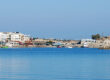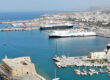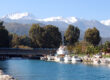


Rethymno Fortezza
Set between the massifs of Psiloritis and the White Mountains, Rethymno occupies a natural amphitheatre facing the Cretan Sea. Its position midway along the north coast made it both a maritime crossroads and a frontier between east and west Crete. Though today admired for its elegant Venetian façades and lively harbour, the town rests upon layers of occupation that stretch back more than three millennia.
Ancient and Classical Period (c. 3000 BC – 67 BC)
The wider region of Rethymno was inhabited from Minoan times, with significant centres at Zominthos on the slopes of Psiloritis and at Eleutherna inland. During the Late Minoan period (c. 1600–1100 BC), coastal settlements developed modest anchorages, linking the fertile hinterland with maritime trade routes across the Aegean.
In the Classical and Hellenistic periods, the nearby city of Rithymna (Ρίθυμνα) flourished as an independent polis. It minted its own coins in the 4th and 3rd centuries BC—often depicting dolphins or Apollo—evidence of both economic vitality and maritime identity. Rithymna’s harbour, though small, connected it to Rhodes, the Cyclades and mainland Greece.
In 67 BC, Crete fell to the Romans under Quintus Caecilius Metellus. Rithymna retained local importance within the Roman province of Creta et Cyrenaica, benefiting from improved infrastructure and integration into wider Mediterranean trade networks.
Roman and Early Byzantine Era (67 BC – AD 824)
Under Roman rule, the region prospered agriculturally, producing olive oil, wine and grain. Villas and rural estates dotted the countryside, particularly around Eleutherna. Christianity spread gradually during the early centuries AD, and by the Early Byzantine period Rethymno had become the seat of a bishopric, signalling its growing ecclesiastical importance.
However, Crete’s exposed coastline rendered it vulnerable. In AD 824, Arab forces from Al-Andalus conquered the island, establishing the Emirate of Crete with its capital at Chandax (modern Heraklion). Rethymno, like other coastal settlements, entered a period of strategic uncertainty and partial decline.
Byzantine Reconquest and Medieval Transition (AD 961 – 1204)
In AD 961, the Byzantine general Nikephoros Phokas recaptured Crete, restoring imperial authority. Coastal defences were reorganised, and Rethymno regained administrative significance. The Byzantines strengthened fortifications and revived ecclesiastical institutions, laying foundations for later urban development.
Following the Fourth Crusade in AD 1204, Crete was sold to Venice. By 1211, Venetian authority was firmly established, inaugurating one of the most transformative chapters in Rethymno’s history.
Venetian Rethymno (1204 – 1646)
The Venetian period shaped the town’s enduring character. Known as Rettimo, it became one of the island’s three principal cities alongside Candia (Heraklion) and Chania. Commerce in wine, oil and agricultural produce flourished, and a new urban elite—comprising Venetian nobles and Cretan notables—emerged.
The catastrophic Ottoman assault on Cyprus in 1570 exposed Crete’s vulnerability. In response, Venice undertook massive defensive works. The hill of Paleokastro above the town was crowned with the imposing Fortezza, completed in the 1580s—today one of the best-preserved Renaissance fortresses in Greece. Within its walls stood administrative buildings, barracks and the cathedral of San Nicolo.
The town below developed elegant loggias, mansions and fountains. The Rimondi Fountain (1626), still flowing today, symbolises the prosperity and civic pride of late Venetian Rethymno. Narrow streets, arcaded façades and carved stone portals reflect a remarkable fusion of Italian Renaissance aesthetics and Cretan craftsmanship.
Intellectually, this was also a golden age. Rethymno participated in the flourishing of Cretan Renaissance literature, contributing to a broader cultural flowering that produced works such as Erotokritos.
Yet prosperity was fragile. In 1646, during the long Cretan War between Venice and the Ottoman Empire, Ottoman forces captured Rethymno after a brief siege. Venetian rule ended, and a new era began.
Ottoman Period (1646 – 1898)
Under Ottoman administration, Rethymno—now Resmo—retained its urban importance but underwent demographic and architectural change. Mosques replaced churches; minarets punctuated the skyline. The Neratzes Mosque (originally a Venetian church) exemplifies the period’s layered transformations.
The town became a centre of mixed Christian and Muslim population, reflecting the island’s complex social fabric. While trade continued, Crete experienced periodic unrest, including revolts in the 18th and 19th centuries. The broader Cretan struggle for autonomy and eventual union with Greece profoundly affected Rethymno’s inhabitants.
In 1898, following international intervention, the autonomous Cretan State was established under Prince George of Greece. In 1913, Crete formally united with Greece—an event of immense national and local significance.
The Second World War and Modern Era
Rethymno again became a battlefield in May 1941 during the Battle of Crete. Allied and Greek forces defended the nearby airfield against German paratroopers in fierce fighting. The occupation that followed brought hardship and resistance activity in the surrounding mountains.
Post-war decades saw gradual economic recovery, with tourism emerging as a major driver. Unlike more heavily modernised centres, Rethymno preserved much of its old town fabric. Restoration efforts from the late 20th century onwards have enhanced its status as one of Crete’s most atmospheric historic towns.
Today, Rethymno is both a lively university city and a guardian of layered architectural heritage, where Venetian loggias stand beside Ottoman minarets and Byzantine echoes survive in chapels and icons.
Sightseeing
- Fortezza – The vast 16th-century Venetian citadel dominates the skyline and offers commanding views over sea and mountains. Its bastions and vaulted chambers reveal Renaissance military engineering adapted to gunpowder warfare.
- Old Town – A dense network of alleys, Renaissance portals and wooden balconies, reflecting centuries of Venetian and Ottoman coexistence.
- Rimondi Fountain – Built in 1626, this ornate public fountain continues to supply water, embodying civic ambition and continuity.
- Venetian Harbour and Lighthouse – A picturesque basin that once sheltered merchant galleys and now hosts fishing boats and small craft.
- Arkadi Monastery (inland) – A powerful symbol of Cretan resistance, associated with the 1866 uprising against Ottoman rule.
Flavours
Rethymno’s cuisine bridges mountain and sea, reflecting both agricultural abundance and maritime exchange.
- Tsikoudia – Distilled from grape pomace after the autumn harvest. The clear spirit is traditionally produced in village kazania, where slow copper-pot distillation yields a strong yet aromatic drink shared as a gesture of hospitality.
- Cretan Graviera – A hard yellow cheese made primarily from sheep’s milk, matured for several months and valued for its nutty sweetness.
- Antikristo Lamb – A traditional shepherd’s method of roasting meat slowly around an open fire, allowing heat to cook the flesh indirectly and evenly.
- Kalitsounia – Small pastries filled with soft cheese or wild greens, linking everyday cuisine with seasonal rural rhythms.
- Olive Oil and Wine – Produced in the hinterland valleys, sustaining the region’s economy since antiquity.