

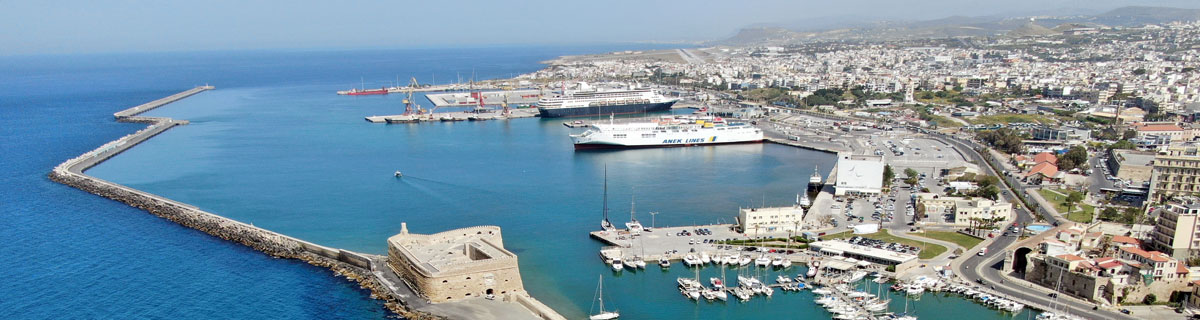
Irakleio harbour
Heraklion, the present-day capital of Crete, is a city that condenses more than four millennia of history into one harbour and a few kilometres of land. From Minoan Knossos to the Venetian fortifications, and from Ottoman unrest to the Battle of Crete in 1941, the city has continuously served as a strategic and administrative centre of the Eastern Mediterranean.
Minoan Period – The Harbour of Knossos (c. 2000–1450 BC)
The history of the area essentially begins with the flourishing of Knossos, one of the most important palace centres of the Minoan world. The site of present-day Heraklion was not then an autonomous city, but functioned as the port of Knossos, its maritime outlet to the Aegean and the Eastern Mediterranean. From here, pottery, metals and precious goods were traded, integrating Crete into a far-reaching commercial network.
After the collapse of the Minoan system around 1450 BC, probably due to natural disasters and Mycenaean expansion, the region entered a new phase. The memory of Minoan power, however, remained closely tied to the identity of central Crete.
Archaic and Classical Antiquity – The City of Herakleia (7th–4th century BC)
During the Archaic period, the city of Herakleia emerged, named after the hero Heracles. It never attained the power of other Cretan centres such as Knossos or Gortyn, yet it maintained its role as a harbour settlement.
In the Hellenistic era, Knossos once again strengthened its presence in the area, using the harbour as a commercial and military hub. The geographical position of Heraklion—roughly in the centre of Crete’s northern coast—made it a natural point of control over maritime routes.
Roman and Early Byzantine Period (67 BC–AD 824)
In 67 BC, Crete was conquered by the Romans. The administrative capital was transferred to Gortyn, but Heraklion retained its importance as a harbour. During the early Christian centuries, bishoprics and ecclesiastical structures developed, integrating the area into the network of the Byzantine Empire.
In AD 824, Crete was seized by Andalusian Arabs. They founded the city of Chandax (from the Arabic word for moat), fortified with a deep ditch and strong walls. Chandax became the capital of the Emirate of Crete and a centre of pirate activity, causing serious concern to Byzantium.
Second Byzantine Period (AD 961–1204)
In AD 961, the general Nikephoros Phokas reconquered Crete for Byzantium. Chandax was further strengthened and reorganised as an administrative and military centre. The city remained significant until the Fourth Crusade.
Venetian Period – The “Kingdom of Candia” (1204–1669)
After 1204, Crete passed to the Most Serene Republic of Venice. Heraklion was renamed Candia and developed into the most important city of the island. The Venetians constructed the imposing city walls, among the strongest in the Mediterranean, and the fortress of Koules at the entrance to the harbour.
During the 16th and 17th centuries, Candia became a thriving administrative and intellectual centre. The Cretan Renaissance flourished, with leading figures such as Domenikos Theotokopoulos (El Greco).
The siege of Candia by the Ottomans (1648–1669) was one of the longest in European history. After 21 years, the city finally surrendered in 1669.
Ottoman Period (1669–1898)
Under Ottoman rule, Heraklion—then known as the Great Castle—remained an administrative centre. Many churches were converted into mosques, and the urban fabric adapted to new realities.
In the 19th century, the city was at the heart of the Cretan revolutions. In 1898, following international intervention, the Cretan State was established as an autonomous polity under the suzerainty of the Sultan. In 1913, Crete was formally united with Greece.
20th Century – The Battle of Crete and the Modern City
During the Second World War, Heraklion suffered heavy damage in the Battle of Crete (May 1941). The airport and harbour were primary targets of German forces.
In the post-war decades, the city expanded rapidly. Today it is the largest urban centre in Crete, home to a major university, research institutions, and one of the most important archaeological museums in Greece.
Sightseeing
Koules Fortress (Rocca al Mare)
Standing at the entrance of the old harbour, Koules Fortress is the most recognisable landmark of Heraklion. Built by the Venetians in the early 16th century, it replaced earlier defensive structures and controlled access to the port. Its thick stone walls, cannon embrasures and vaulted chambers reflect the strategic importance of Candia during the height of Venetian maritime power. From its upper platform, the visitor gains a clear understanding of the harbour’s defensive layout and the city’s enduring relationship with the sea.
The Venetian Walls and Bastions
Encircling the old town are the imposing Venetian fortifications, constructed mainly in the 16th century. Designed according to the most advanced military engineering principles of their time, the walls include massive bastions such as Martinengo, where the tomb traditionally attributed to Nikos Kazantzakis is located. Walking along the ramparts offers both historical insight and panoramic views over the modern city and coastline. These fortifications were central to the 21-year Siege of Candia (1648–1669), one of the longest sieges in European history.
Heraklion Archaeological Museum
The Heraklion Archaeological Museum is among the most significant museums in Greece and essential for understanding Crete’s prehistoric civilisation. Its collections span from the Neolithic period to Roman times, with unparalleled exhibits from Minoan Crete, including frescoes, ritual objects, sealstones and the famous Phaistos Disc. A visit here provides the necessary context before exploring Knossos and other archaeological sites of the region.
Knossos
Located a few kilometres south of the city, Knossos is the most important palace complex of Minoan Crete. First developed around 2000 BC and rebuilt after destruction around 1700 BC, the palace functioned as a political, economic and possibly religious centre. The architectural complexity of its courtyards, storerooms and ceremonial spaces inspired the later myth of the Labyrinth and the Minotaur. For the historically minded visitor, Knossos is indispensable to understanding the origins of urban life in the Aegean.
Loggia and Morosini Fountain (Lions’ Square)
In the heart of the old town stands the Venetian Loggia, once a meeting place for Venetian nobility and today part of the city’s municipal buildings. Nearby, in Lions’ Square, the Morosini Fountain (1628) symbolises the prosperity of Venetian Candia. Supplied by an advanced aqueduct system, it once provided fresh water to the city and remains a focal point of urban life.
Churches and Ottoman Remains
The Cathedral of Agios Minas, one of the largest in Greece, reflects 19th-century Orthodox revival following Ottoman rule. Nearby stands the Church of Agios Titos, originally Byzantine, later Venetian Catholic, then Ottoman mosque, and again Orthodox church—an architectural testament to the island’s layered history. Surviving Ottoman fountains and former mosques, such as the Vezir Mosque (now a conservatory), reveal the multicultural past of the city.
Archanes and the Wine Villages
A short drive inland leads to Archanes, a traditional settlement closely linked to Minoan and later viticultural history. The surrounding vineyards of Peza and Archanes form one of Crete’s most important wine-producing regions. Visiting these villages connects the archaeological past with the island’s living agricultural traditions.
Monastery of Paliani and the Messara Plain
To the south lies the fertile Messara Plain, dotted with archaeological remains and Byzantine chapels. The Monastery of Paliani, one of the oldest in Crete, is associated with early Christian tradition and rural monastic life. The landscape itself, open and productive, explains much of Heraklion’s historical prosperity.
Why Visit
Heraklion offers a rare continuity of four thousand years of urban and maritime history within a compact geographical area. A sailor may moor beneath Venetian walls; a visitor may walk from Ottoman fountains to Minoan artefacts in a single morning. Combined with its gastronomy, wine culture and access to both mountains and sea, Heraklion stands not merely as a transit hub, but as a destination that embodies the historical and cultural depth of central Crete.
Flavours
Heraklion is not merely an administrative and historical centre; it is the place where the flavours of the whole island converge. The fertile plain of Messara, the vineyards of Peza and Archanes, the flocks of Mount Psiloritis, and the shores of the Cretan Sea have long supplied the city with raw ingredients that shape one of the most authentic expressions of the Cretan diet.
Raki (Tsikoudia) – The Spirit of Companionship
Raki — known as tsikoudia in western Crete — is the traditional distilled spirit of central Crete. It is produced from grape pomace (the residue of grapes after pressing for wine), which undergoes fermentation and is then distilled in copper stills.
The process begins after the grape harvest, usually in October. The pomace is left to ferment naturally in containers. It is then transferred to the still, where it is slowly heated. Alcohol vapours condense through cooling and are collected as a clear distillate. The first flow (“protoraki”) is stronger; what follows is the “heart” of the distillation, considered the finest part.
Raki is not merely a drink; it is a social institution. It accompanies agreements, weddings and baptisms, as well as everyday gatherings. In the villages of Heraklion’s hinterland, the distillation season remains a collective celebration.
Gamopilafo – The Dish of Honour
Gamopilafo (literally “wedding pilaf”) is perhaps the most emblematic festive dish of the region. Its name derives from its role at weddings, symbolising abundance and blessing.
It is prepared with broth from goat or lamb (in the past also rooster), simmered for hours. Rice is cooked in this rich stock until it absorbs the aromas and fats of the meat. The result is a dish modest in appearance yet deeply rich in flavour. It is often finished with lemon juice or staka, giving it a creamy texture.
In the wider Heraklion area, gamopilafo remains central to major social gatherings.
Chochlioi – Snails of the Land
Snails (chochlioi) are closely associated with the agricultural landscape of Crete. They are collected mainly after the first autumn rains and are considered highly nutritious.
The most characteristic recipe is chochlioi boubouristoi: the snails are fried in olive oil with rosemary and deglazed with vinegar. The result is crisp on the outside and tender within. They are also cooked stewed with tomato or with cracked wheat pasta.
This dish reveals the deep relationship between Cretan cuisine, the land, and the self-sufficiency of the countryside.
Meat and the Mountain Tradition
The hinterland of Heraklion, particularly the slopes of Psiloritis and the Asterousia range, preserves a strong pastoral tradition. Antikristo—lamb slow-roasted opposite an open fire—is a ritual of outdoor cooking. The meat is simply salted and cooked slowly, allowing the fat to melt naturally.
Other traditional preparations include oftó (oven-roasted meat) and apaki (smoked pork).
Cereals, Pulses and Simplicity
Dakos—barley rusk topped with tomato, mizithra cheese and olive oil—is an iconic example of Mediterranean frugality. Barley, resilient to Crete’s dry conditions, was a staple grain of the region.
Broad beans, chickpeas and lentils completed the diet, especially during fasting periods.
Cheeses and Dairy
Mizithra (fresh or dried), anthotyro and graviera are widely produced in the hinterland of the prefecture. Staka—a preparation from milk fat—is used in pilafs, eggs and even with snails. Dairy products form a core element of the pastoral identity of the region.
Wine – The Vineyards of Heraklion
The area of Archanes–Peza is one of Crete’s most important wine-producing zones. Varieties such as Vidiano, Kotsifali and Mandilari have been cultivated since antiquity. The viticultural tradition of central Crete dates back to the Minoan era, as evidenced by wine presses and storage pithoi.
Sweets and Celebrations
Xerotigana—fried strips of dough with honey and walnuts—are mainly prepared at weddings. Kalitsounia, filled with mizithra or wild greens, are found throughout the prefecture. Thyme honey and almonds complete the sweet tradition.
Gastronomy as Cultural Identity
In Heraklion, flavour is not mere consumption; it is an expression of history and society. From Minoan wine presses to modern wineries, from raki distillation gatherings to wedding feasts with gamopilafo, the city acts as a crossroads where agricultural production, mountain pastoralism and maritime trade merge into a unified gastronomic landscape.
For the visitor arriving by sea, the local cuisine forms an essential part of the experience. Here, hospitality offered with a glass of raki is not simply a custom—it is a living promise of continuity in a tradition that has endured for centuries.