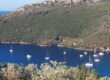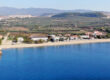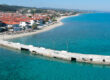


Neos Marmaras harbour
The area of Neos Marmaras, on the south-western coast of Sithonia, occupies a gently curved shoreline on the Toronean Gulf, backed by wooded hills and inland valleys. While today it appears as a modern seaside town, its landscape reflects a much older pattern of human use, shaped by agriculture, pastoralism, and monastic landholding rather than continuous urban life. Its apparent lack of ancient ruins is itself historically meaningful, revealing how the area functioned for centuries as a peripheral but productive zone rather than a political centre.
Antiquity – Between Sea Routes and Hinterland
In antiquity (5th–4th century BC), southern Sithonia lay outside the core zones of Classical urban development. Major city-states such as Torone, Singos, and Olynthos were located further north, while the Neos Marmaras coastline formed part of a maritime corridor linking settlements along the Toronean Gulf.
Archaeological evidence in the wider area suggests:
- Seasonal exploitation of land for grazing and timber
- Small-scale agricultural use
- Occasional coastal anchorages serving passing vessels
There is no evidence of a major ancient city at Neos Marmaras itself. Instead, the area functioned as supporting territory, supplying resources to larger centres and to ships navigating between Chalkidiki and the northern Aegean. This pattern of peripheral use would continue, with variations, well into the medieval period.
Byzantine Period – Monastic Expansion and Land Control
From the Byzantine era (9th–14th century AD), Sithonia increasingly came under the influence of Mount Athos, whose monasteries expanded their landholdings across the peninsula. The land around present-day Neos Marmaras belonged mainly to the Monastery of Grigoriou, forming part of its extensive estates.
During this period:
- The coast was not permanently settled
- and was used for farming, olive cultivation, grazing, and timber
- Small structures such as storehouses, shepherd huts, and seasonal dwellings existed, but without forming villages
This system reflects a broader Byzantine practice, in which monasteries controlled vast rural territories worked by lay populations living inland, away from exposed coastlines.
Ottoman Period – Inland Life and Coastal Avoidance
After the Ottoman conquest in the 15th century AD, the pattern remained largely unchanged. Mount Athos retained its privileged and semi-autonomous status, and its estates in Sithonia continued to function as agricultural and pastoral zones.
The coast near Neos Marmaras was:
- Avoided for permanent settlement, mainly due to piracy
- Used seasonally by fishermen, shepherds, and monks
- Economically tied to inland villages rather than maritime trade
It is during this period that Parthenonas emerged as the principal settlement of the area.
Parthenonas – The Historic Heart of the Region
Foundation and Early Development
Parthenonas is one of the most historically important villages of Sithonia. It was likely founded in the late Byzantine or early Ottoman period (15th–16th century AD), at a strategic inland location on the slopes of Mount Itamos.
The choice of site was deliberate:
- Elevated position with wide visibility
- Distance from the coast for protection against piracy
- Proximity to fertile land and forest resources
From its beginnings, Parthenonas developed as a self-sufficient agrarian and pastoral village, closely linked to Athonite estates but socially and economically autonomous.
Life in the Ottoman Era
By the 18th and 19th centuries, Parthenonas had become a prosperous and well-organised community. Its inhabitants were:
- Farmers cultivating olives, cereals, and vines
- Shepherds managing flocks in the surrounding hills
- Woodcutters and craftsmen exploiting Sithonia’s forests
The village featured:
- Stone houses with defensive layouts
- Churches and communal buildings
- A strong sense of local identity and self-governance
Parthenonas was part of the network of inland Chalkidiki villages that maintained Greek language, Orthodox faith, and communal institutions throughout Ottoman rule.
Decline and Partial Abandonment
The turning point came in the early to mid-20th century. As piracy declined and coastal life became safer, economic opportunities shifted toward:
- Fishing
- Trade
- Later, tourism
After AD 1922, the foundation of Neos Marmaras on the coast accelerated this shift. Gradually, the inhabitants of Parthenonas:
- Moved downhill toward the sea
- Abandoned agriculture-based livelihoods
- Left many stone houses empty
By the 1960s, Parthenonas was largely abandoned, becoming one of the most striking examples of a deserted inland village in Halkidiki.
Restoration and Modern Role
From the late 20th century onwards, Parthenonas experienced partial revival:
- Restoration of selected houses
- Creation of a folklore museum
- Development as a heritage and viewpoint village
Today, Parthenonas stands as:
- A living historical monument
- A key reference point for understanding Sithonia’s inland past
- The cultural counterweight to modern Neos Marmaras
Neos Marmaras – Refugee Foundation and Modern Growth
Neos Marmaras was founded in AD 1922–1924, following the Asia Minor Catastrophe. Its first residents were Greek refugees from Marmara (Marmaras) in Asia Minor, who settled on former monastic land.
These settlers:
- Introduced fishing and coastal livelihoods
- Created a permanent seaside settlement where none had existed before
- Preserved a strong collective memory tied to their lost homeland
Initially a small fishing and agricultural village, Neos Marmaras expanded steadily after the 1960s, when improved road access and the development of Porto Carras transformed the area into an international tourist destination.