

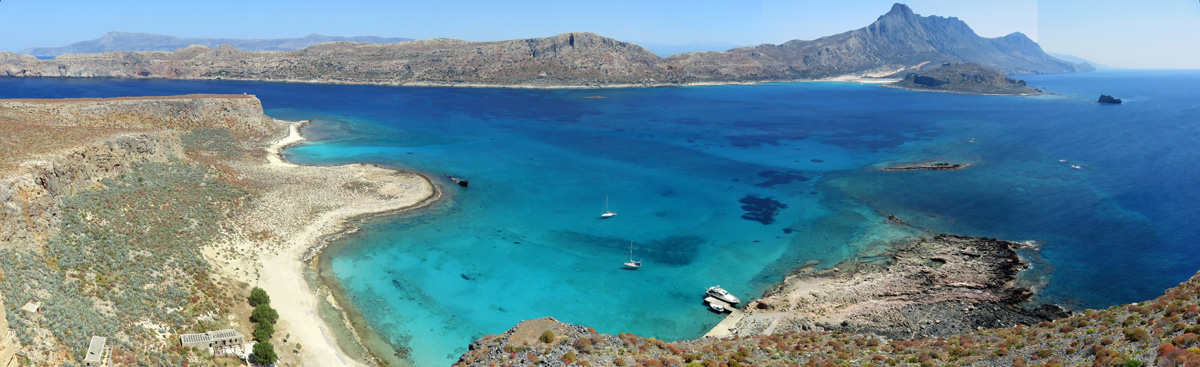
Western Crete, stretching from the great natural harbour of Souda westwards to Kissamos, Gramvousa and the Libyan-facing shores beyond, possesses a character distinct from the administrative gravity of Heraklion. Here, mountains press closer to the sea, plains narrow, and harbours become gateways not only to trade but to exile, resistance and maritime independence. Western Crete has long stood at the island’s frontier — outward-looking toward the Peloponnese and the Ionian Sea, yet fiercely protective of its autonomy.
Prehistory and the Minoan West (7000 – 1100 BC)
Neolithic settlements appeared early in the fertile basin of modern Chania, where water sources and arable land offered favourable conditions. By the Bronze Age, the city of Kydonia — beneath present-day Chania — emerged as the principal western Minoan centre.
While Knossos dominated central Crete, Kydonia functioned as a significant regional power, maintaining maritime links across the Aegean and towards mainland Greece. Excavations beneath modern Chania reveal continuous occupation from the Minoan era onward — a rare phenomenon on the island.
Further west, the port of Phalasarna became one of the most important natural harbours of ancient Crete. Its sheltered basin and strategic position made it both a commercial station and, at times, a base for privateering activity during later Classical and Hellenistic periods.
The collapse of the Minoan palatial system around 1450 BC, followed by Mycenaean influence, reshaped western Crete as it did the rest of the island. Yet Kydonia endured, transitioning into the post-palatial world.
Dorian Cities and Maritime Rivalries (c. 1100 – 69 BC)
With the arrival of Dorian settlers, western Crete evolved into a constellation of fortified city-states. Kydonia, Polyrrhenia (inland near modern Kissamos) and Phalasarna were among the most influential.
Phalasarna, in particular, gained prominence during the Hellenistic period. Its harbour installations — partially visible today — testify to advanced engineering. Classical sources mention its naval strength and its involvement in regional rivalries.
Western Crete’s position made it a crossroads between the Peloponnese, the Cyclades and the Libyan coast. Trade, migration and occasional conflict were constants of this maritime zone.
Roman and Early Byzantine West (69 BC – 824 AD)
Following Roman conquest in 69 BC, western Crete integrated into imperial trade networks. Roads connected inland settlements to coastal ports, facilitating the export of olive oil and agricultural produce.
Kydonia prospered as a Roman municipium. Villas and bath complexes emerged, and Christianity gradually spread throughout the region during the early centuries AD.
By the Early Byzantine period, western coastal settlements were fortified against seaborne threats. Earthquakes periodically damaged urban centres, but occupation persisted.
Arab Interlude and Byzantine Restoration (824 – 1204 AD)
The Arab seizure of Crete in 824 AD affected western cities differently from Chandax in the north-central region. While the emirate’s administrative heart lay in Heraklion, western Crete remained strategically important for maritime control.
In 961 AD, when Nikephoros Phokas reconquered the island, fortifications were reinforced across the west. The mountainous interior — particularly the Lefka Ori (White Mountains) — provided refuge and defensive depth.
Venetian La Canea and the Western Fortresses (1204 – 1669 AD)
Under Venetian rule, Chania — renamed La Canea — became the administrative centre of western Crete. The Venetians rebuilt and expanded its harbour, constructed arsenals and encircled the city with strong defensive walls.
he harbour, protected by the Firka Fortress, evolved into one of the most picturesque and functional ports of the eastern Mediterranean. Inland, castles such as Gramvousa and fortifications at Kissamos guarded maritime approaches.
Western Crete experienced repeated uprisings during Venetian domination. The mountainous terrain facilitated guerrilla resistance, while coastal strongholds allowed Venice to maintain naval supremacy. Despite tension, western Crete participated in the broader cultural flowering of the Cretan Renaissance, though less intensely than Candia.
Ottoman Rule and the Spirit of Resistance (1669 – 1898 AD)
After the fall of Candia in 1669 AD, western Crete came under Ottoman administration. Chania became the capital of the island for a period during Ottoman rule.
Mosques, fountains and administrative buildings altered the skyline, yet Venetian walls remained the dominant defensive feature.
Western Crete — particularly the region of Sfakia just south of the White Mountains — became synonymous with resistance. Although technically part of southern Crete geographically, its influence radiated northwards. During the uprisings of 1821, 1866–69 and 1897, fighters from western districts played decisive roles.
In 1898 AD, with the withdrawal of Ottoman forces, Chania briefly served as the seat of the new autonomous Cretan State. It was here, at the Fortress of Firka, that the Greek flag was raised in 1913 AD, marking union with Greece.
The Second World War (1941 AD)
Western Crete became a principal theatre of the Battle of Crete. The German airborne assault targeted the airfield at Maleme, west of Chania. Control of this airfield proved decisive in the outcome of the campaign.
The resistance of Greek troops, Allied forces and civilians was fierce. Reprisals followed the occupation, with villages suffering destruction in retaliation for partisan activity. Western Crete’s mountainous terrain again served as refuge and base for resistance networks.
Today, western Crete balances agricultural production — especially olive oil and citrus — with tourism centred around Chania, Balos Lagoon and the dramatic Samaria Gorge. Its harbours retain both aesthetic beauty and nautical relevance, while archaeological remains at Phalasarna and Polyrrhenia remind visitors of ancient maritime ambition.
Chania
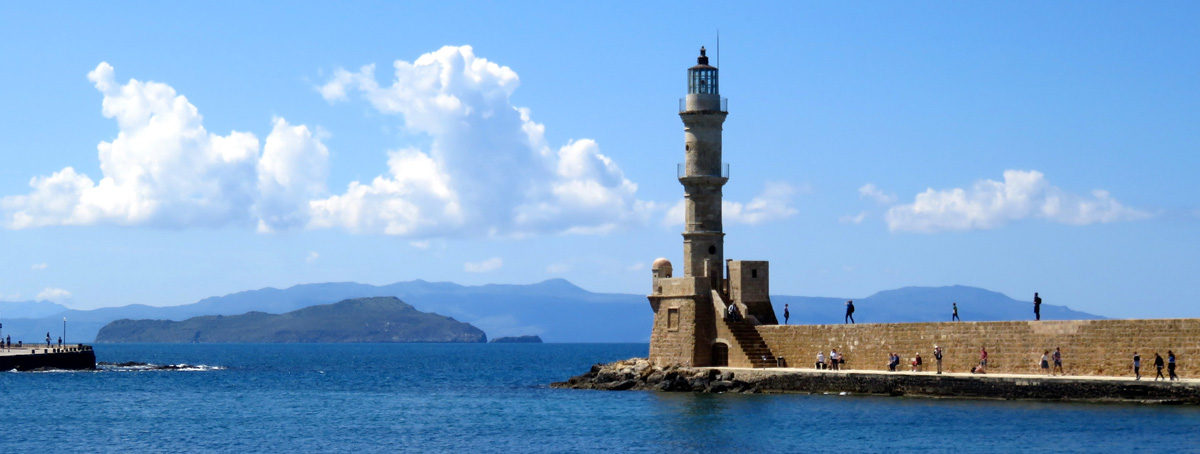
Chania, ancient Kydonia, is among the oldest continuously inhabited cities in Europe. Its Venetian harbour, framed by the Firka Fortress and the restored lighthouse, defines the city’s identity. Layers of Minoan foundations, Byzantine churches, Venetian mansions and Ottoman mosques coexist within narrow streets. During the Autonomous Cretan State (1898–1913), Chania served as political centre and later witnessed the symbolic union with Greece. Today it combines historic depth with vibrant civic life.
Kissamos
Kissamos, near ancient Polyrrhenia and Phalasarna, has long functioned as western Crete’s maritime outlet. While quieter than Chania, it occupies a strategic position facing the Peloponnese. Archaeological remains attest to Roman and Hellenistic activity, and its surrounding fertile plains sustain olive cultivation and viticulture.
Gavdos Island
South of Crete, Gavdos marks the southernmost point of Europe. Identified in antiquity as Ogygia — the legendary island of Calypso in Homeric tradition — it has been inhabited intermittently since prehistoric times. Remote yet strategically positioned along sea routes between Crete and North Africa, Gavdos today remains sparsely populated, valued for its isolation, clear waters and elemental landscape.
Palaiochora
Situated on Crete’s south-western coast, Palaiochora developed near the site of ancient Kalamydi and beneath the ruins of a Venetian fortress. Historically a modest harbour settlement, it has evolved into a tranquil seaside town connecting western Crete to the Libyan Sea. Its position made it a secondary refuge during periods of unrest, and today it retains a relaxed maritime character.
Flavours of Western Crete
Sfakian Pie of the White Mountains
A thin handmade pastry filled with fresh mizithra cheese and cooked on a griddle, usually drizzled with thyme honey. It originated in the mountainous district of Sfakia, where self-sufficiency shaped daily life. Its simplicity reflects the austere resilience of western Crete.
Apaki of Chania
Pork marinated in vinegar and smoked with aromatic herbs such as savoury and sage. Traditionally prepared to preserve meat through winter months. Today it remains a signature meze of Chania and surrounding upland villages.
Staka & Stakovoutyro
A rich dairy product derived from sheep’s milk cream, intensely flavoured and distinctive. Staka is often used in the ceremonial dish gamopilafo. It represents the strong pastoral heritage of the White Mountains.
Gamopilafo (Wedding Pilaf)
Rice cooked in meat broth and enriched with staka. Served at weddings and major celebrations as a symbol of honour and hospitality. Its texture is creamy and its flavour deep yet refined.
Graviera of Western Crete
A firm sheep’s milk cheese with balanced sweetness and aromatic depth. Produced in mountain dairies of the White Mountains and naturally matured. It is central to both everyday and festive meals.
Boubouristi Snails
Snails fried with olive oil, rosemary and vinegar. Gathered after the first autumn rains, they represent a long-standing rural practice. The dish combines frugality with strong regional identity.
Citrus of the Chania Plain
The fertile plains around Chania produce high-quality oranges, mandarins and lemons. Mild climate and water availability favour cultivation. Citrus fruits play both nutritional and economic roles in the region.
Extra Virgin Olive Oil of Kissamos
Kissamos is known for aromatic, low-acidity olive oil. Ancient olive groves stretch across semi-mountainous slopes. Olive oil forms the foundation of western Cretan cuisine.
Seafood of Kissamos and Falassarna
The western coastline provides fresh fish, octopus and shellfish. Preparation remains intentionally simple — grilled with olive oil and lemon. The sea complements the mountain-based gastronomy of the region.
Tsikoudia Distillation Gatherings
Autumn grape distillation — the kazaniá — is a communal event in western Cretan villages. Families and friends gather around the still to celebrate harvest. The spirit accompanies hospitality and social life.