

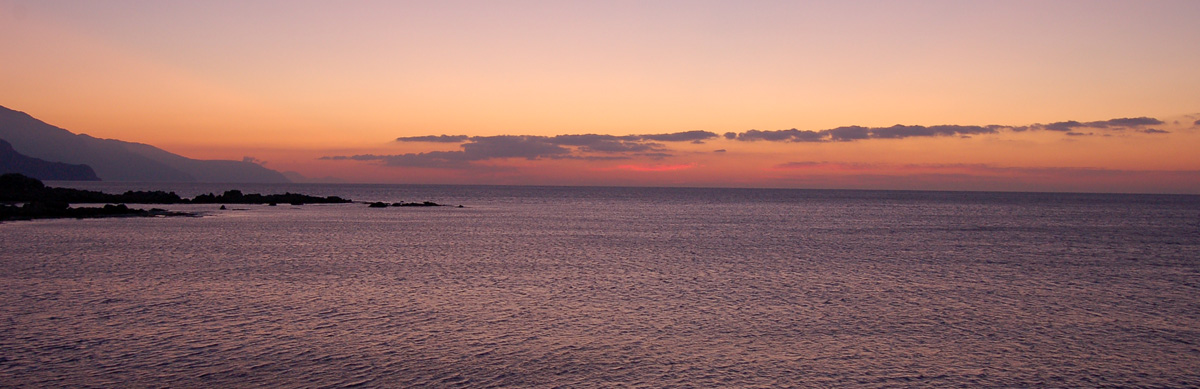
Southern Crete presents a landscape of dramatic contrasts. Sheer mountains descend abruptly toward the Libyan Sea; narrow plains appear suddenly between gorges; harbours are few, exposed and elemental. Unlike the northern coast, open to the Aegean and to sustained maritime exchange, the southern littoral has historically been more isolated — yet no less significant. It has served as refuge, corridor of resistance, agricultural hinterland and, at times, discreet maritime gateway between Crete, North Africa and the wider Mediterranean.
Prehistoric Settlement and the Bronze Age Hinterland (7000 – 1100 BC)
Archaeological evidence confirms early habitation along parts of the southern coast from the Neolithic period. Small coastal communities relied on fishing and limited agriculture, while inland valleys supported more stable settlement.
During the Minoan era (c. 2800–1100 BC), southern Crete did not host the great palatial complexes of Knossos or Phaistos (the latter situated slightly inland but influencing the southern plain of Messara). Instead, it functioned as an agricultural hinterland and secondary maritime outlet. Harbours such as Kommos, near Phaistos, facilitated trade across the Libyan Sea.
Although less monumental than the northern centres, southern Crete participated fully in the island’s Bronze Age networks. After the destruction of the palaces around 1450 BC, settlements became more dispersed, and the mountainous terrain offered security during uncertain times.
Classical and Hellenistic Southern Crete (c. 1100 – 69 BC)
In the Dorian and Classical periods, southern Crete remained less urbanised than the north. Nevertheless, important inland centres such as Gortyna — though geographically central-southern rather than coastal — exerted strong influence over adjacent territories.
The fertile Messara plain sustained agricultural production, while smaller coastal settlements provided modest anchorages for local trade. The south-facing orientation meant contact not only with other Cretan ports but occasionally with Cyrenaica (modern Libya) and Egypt.
The Roman conquest of Crete in 69 BC elevated Gortyna to the status of provincial capital. Although situated inland, its administrative and economic reach extended toward the southern coastline.
Under Roman rule, roads linked Gortyna to ports along the Libyan Sea. Agricultural estates flourished, producing olive oil, wine and grain for export. Public buildings, theatres and basilicas reflected Roman urban sophistication. Christianity spread early in southern Crete. Gortyna became an important episcopal centre during the early Byzantine period, reinforcing the region’s spiritual significance.
Byzantine Fortification and the Arab Period (330 – 961 AD)
During the Early Byzantine era, southern coastal settlements were fortified against maritime raids. Earthquakes periodically reshaped the landscape, contributing to the decline of some Roman urban centres.
The Arab conquest of Crete in 824 AD affected the south differently from Chandax in the north. While the emirate’s administrative focus remained elsewhere, southern anchorages likely served smaller-scale maritime functions within broader trade and raiding networks.
Following the Byzantine reconquest in 961 AD, fortifications were strengthened and monastic life expanded, particularly in remote valleys and mountainous districts.
Venetian Watchtowers and Mountain Autonomy (1204 – 1669 AD)
Under Venetian rule, southern Crete remained peripheral to the principal urban centres of Candia and Chania. Yet its strategic value was not ignored. Watchtowers and small fortifications were constructed to monitor sea lanes and guard against corsair activity.
The mountainous district of Sfakia developed a reputation for relative autonomy. Its rugged terrain limited effective control from coastal authorities, fostering strong local identity.
Agriculture — olives, cereals and pastoralism — sustained the region, while small harbours facilitated limited trade.
Ottoman Era and the Stronghold of Sfakia (1669 – 1898 AD)
With the Ottoman conquest in 1669 AD, southern Crete became a landscape of recurrent resistance. The mountains of Sfakia emerged as a symbol of defiance. Ottoman authority struggled to impose lasting control over the region’s interior.
During the Greek War of Independence in 1821 AD, Sfakian fighters were among the first to rise. Though ultimate liberation did not immediately follow, the spirit of resistance endured throughout the 19th century.
The Great Revolt of 1866–69 and later uprisings saw southern districts actively engaged. Mountain refuges, difficult terrain and maritime escape routes toward the Peloponnese and beyond made southern Crete both battleground and sanctuary.
Union, War and Agricultural Transformation (1913 AD – Present)
After union with Greece in 1913 AD, southern Crete remained largely agricultural and relatively isolated.
During the Battle of Crete (1941 AD) and subsequent occupation, southern shores played a discreet yet vital role. From remote coves, Allied soldiers and resistance fighters were evacuated by submarine or small craft toward Egypt. The Libyan-facing coast once again functioned as a maritime corridor in times of crisis.
In the post-war decades, southern Crete underwent significant agricultural transformation — particularly around Ierapetra, where greenhouse cultivation developed on a large scale. Today the region produces vegetables and early-season crops for both domestic and European markets.
Tourism has grown more cautiously here than on the northern coast. Visitors are drawn to gorges, remote beaches and the austere beauty of the Libyan Sea.
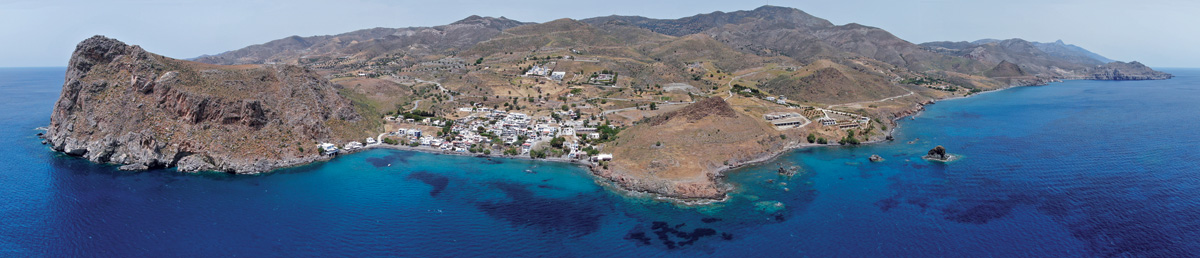
The mountainuity of coastal S Crete (Lentas)
Sfakia
Sfakia is less a single town than a district shaped by mountains and sea. Historically semi-autonomous, it became synonymous with resistance during Ottoman rule and later revolts. Its natural harbours, though small and exposed, offered access to the Libyan Sea and escape routes in times of upheaval. Today Sfakia retains a rugged character, its identity closely tied to independence and ancestral memory.
Ierapetra
Ierapetra, built near ancient Hierapytna, occupies the southernmost city position in Greece. Under Roman rule, Hierapytna prospered as a maritime and commercial centre. Venetian and Ottoman structures still punctuate the townscape. In modern times, Ierapetra has become an agricultural powerhouse, with extensive greenhouse cultivation supplying produce across Europe. Its harbour continues to connect southern Crete with the wider Mediterranean.
Flavours of Southern Crete
Sfakian Pie
A thin handmade pastry filled with fresh mizithra cheese and cooked on a flat griddle, typically drizzled with thyme honey. It is the emblematic dish of Sfakia and reflects the region’s pastoral heritage. Simple in ingredients, yet perfectly balanced in flavour.
Antikristo (Mountain-Style Roasted Meat)
Lamb or goat slowly roasted around an open fire, placed “opposite” the flames. This method dates back centuries to shepherd traditions and requires little more than salt and patience. The result is pure, elemental flavour.
Anthotyro of the Highlands
A fresh, soft cheese made from sheep and goat milk, mild and slightly sweet. Produced in small pastoral units, it is consumed fresh or lightly matured. It accompanies pies, salads and everyday meals.
Messara Olive Oil
The Messara plain produces olive oil of notable intensity and aromatic depth. Olive cultivation here traces back to the Minoan era. The oil forms the backbone of southern Cretan cooking and cultural continuity.
Thyme Honey of the Libyan Coast
Collected from arid slopes rich in wild thyme and Mediterranean herbs, this honey is known for its rich fragrance and clear amber colour. It pairs naturally with cheese and pastries. Beekeeping remains a vital rural activity.
Goat and Lamb of the Mountains
Free-range herds graze on aromatic herbs across the southern highlands, giving the meat distinctive character. It is typically grilled or simply cooked with olive oil and lemon. The dish reflects the enduring bond between land and community.
Southern Cretan Snails
Gathered after seasonal rains and cooked with olive oil, vinegar or rosemary. The practice has been part of rural life for generations. The dish exemplifies resourcefulness and local identity.
Hondros and Traditional Soups
Hondros, sun-dried cracked wheat, is simmered with vegetables or sour milk. It served as a staple food for farming families, especially during winter. Its simplicity mirrors the austere nature of southern Cretan life.
Greenhouse Produce of Ierapetra
Thanks to its mild microclimate, Ierapetra has become a major centre of greenhouse cultivation. Tomatoes, cucumbers and early vegetables are exported throughout Europe. This modern agricultural development continues the region’s long-standing productive tradition.