


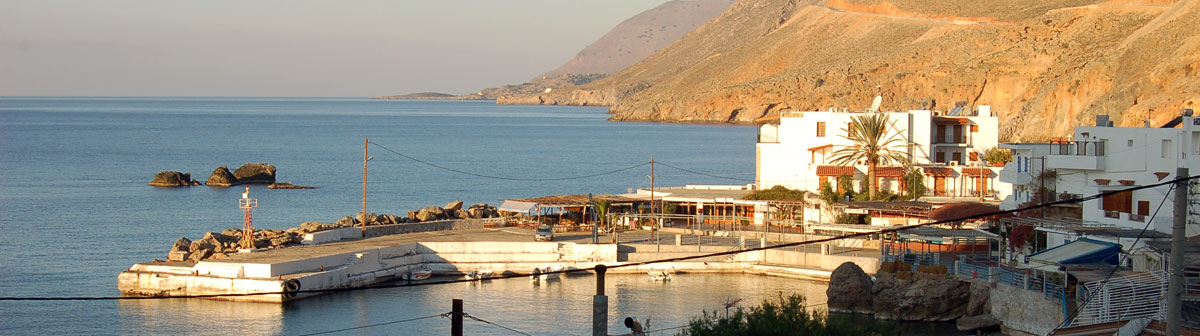
Sfakia harbour
Sfakia occupies the southern slopes of the Lefka Ori (White Mountains), where steep ridges and deep gorges descend abruptly towards the Libyan Sea. This geomorphology decisively shaped settlement patterns and political organisation. Archaeological evidence indicates human presence from the Minoan period (2nd millennium BC), particularly at coastal sites and along natural mountain passes that controlled inland movement.
During the Roman period (67 BC – 4th century AD), southern Crete maintained small harbours engaged in maritime exchange with North Africa and the eastern Mediterranean. The Samaria Gorge functioned as a natural corridor between the uplands and the coast, and in periods of instability it provided refuge to local populations.
Arab Conquest and Byzantine Reconquest (AD 824–1204)
Following the Arab conquest of Crete in AD 824, the mountainous interior of Sfakia was never fully subdued. The terrain restricted sustained military control and allowed local communities to retain a degree of autonomy. In AD 961, when Nikephoros Phokas reconquered Crete for the Byzantine Empire, the upland settlements were reintegrated into imperial administration. However, the combination of altitude, limited arable land and relative isolation reinforced a tradition of local cohesion and self-reliance that would characterise the region in later centuries.
Venetian Rule (AD 1204–1669)
After 1204 AD, Crete fell under Venetian rule. Repeated uprisings were recorded in Sfakia during the 13th and 14th centuries, demonstrating the difficulty of imposing control in the region. To control the southern coast and combat piracy, the Venetians built Fragokastello between 1371 and 1374 AD on the southern coast of Sfakia, in a position that controlled the coastal corridor between eastern and western Crete. Its official name was Castle of Saint Nicholas (Castel San Niccolò), but the local name “Fragokastello” prevailed, referring to the “Franks,” i.e., the Latin conquerors. Its construction had a clear military purpose: to curb piracy in the Libyan Sea and to monitor the frequent uprisings of the Sfakians against Venetian rule.
Architecturally, the structure represents a typical example of late medieval Venetian military design in Crete. It has a rectangular ground plan with four corner towers and crenellated walls. Its location on relatively flat coastal ground, rather than on an elevated defensive position, indicates that it was intended primarily for surveillance and control of the shoreline rather than as a long-term refuge during extended sieges. Despite its construction, Venetian authority over the mountainous interior of Sfakia remained limited.
Frangokastello became associated with a major episode of the Greek War of Independence. On 17 May AD 1828, the Greek commander Hatzimichalis Dalianis occupied the fortress with Cretan and Epirote fighters in an attempt to establish a revolutionary stronghold in western Crete. Ottoman forces counter-attacked, resulting in heavy casualties among the defenders and the death of Dalianis. This battle later gave rise to the legend of the “Drosoulites”, a phenomenon traditionally described as the appearance of shadowy figures near the anniversary of the battle and now generally attributed to particular atmospheric conditions in the area.
Ottoman Period and the Revolt of 1770
With the fall of Chandaka in 1669 AD, Crete became part of the Ottoman Empire. Sfakia never submitted, and because of its difficult and inaccessible location, the Turks never sent an army there. For this reason, most of the revolts in Crete started there. However, the most famous is the revolt of 1770 AD, when Ioannis Vlachos (Daskalogiannis) from Anopolis led an armed uprising during the Russo-Turkish War.
Ioannis Vlachos (Daskalogiannis) was born in Anopolis, Sfakia, in the early 18th century and came from a wealthy family of merchants and sailors. The nickname “Daskalogiannis” is attributed to the fact that he was educated for the standards of the time, knew foreign languages, and had commercial contacts outside Crete. His financial standing and prestige in the local community made him a natural leader at a time of growing tension between the Christian populations and the Ottoman administration.
The 1770 uprising took place in the context of the Russo-Turkish War (1768–1774). Russian envoys encouraged revolutionary movements in Greece, promising military support. In Sfakia, Daskalogiannis gathered about 2,000 armed men, mainly from the mountain communities, and in March 1770 he declared the revolution. Initially, there were local successes, but the expected Russian aid never reached Crete. The Ottoman forces responded with extensive suppression operations.
Anopolis and other villages in Sfakia were destroyed, while a large number of residents were killed or captured. Daskalogiannis, seeking to limit reprisals, surrendered to the Ottoman authorities. He was transferred to Heraklion (Chandaka), where he was executed in a particularly cruel manner in 1771. The 1770 uprising had no immediate political impact, but it was an important precursor to the later Cretan revolts of the 19th century and reinforced Sfakia’s reputation as a center of organized resistance in Crete.
The Battle of Crete and Sfakia (May–June AD 1941)
On 20 May AD 1941, German airborne forces launched a large-scale invasion of Crete. Following intense fighting at Maleme, Rethymno and Heraklion, Allied defensive positions collapsed, and a general withdrawal towards the south coast began. Thousands of British, Australian and New Zealand troops crossed the White Mountains on foot, moving through high passes and gorges towards the Sfakia coastline.
Between 28 May and 1 June AD 1941, the evacuation of Allied forces was carried out from the coastal area of Chora Sfakion. Royal Navy vessels approached mainly at night in order to reduce exposure to German air attacks. Despite sustained aerial bombardment, approximately 15,000–16,000 troops were successfully evacuated to Egypt. Several thousand others were left behind and subsequently taken prisoner when the evacuation concluded.
After the German occupation of the area, reprisals were imposed on local communities accused of assisting Allied soldiers. Executions of civilians, destruction of property and burning of villages were recorded in parts of western Crete, including the wider Sfakia region. Throughout the occupation, the mountainous south remained a zone of resistance activity and a refuge for escaped prisoners and resistance fighters.
Sightseeing
Chora Sfakion
Chora Sfakion serves as the administrative and maritime centre of the region. Its harbour played a decisive role during the Battle of Crete in AD 1941, when it was used as a principal evacuation point for Allied forces. Today it functions as the main departure point for coastal connections to Loutro and Agia Roumeli.
Loutro
Loutro is built on the site of ancient Phoenix, within a naturally sheltered bay that was used as an anchorage from antiquity. The absence of road access has preserved its small scale and traditional character.
Imbros Gorge
Imbros Gorge forms a natural passage linking the Askifou plateau with the south coast. Historically it was used for the movement of populations and military units, while today it is an established walking route.
Aradena Gorge
Aradena Gorge historically connected upland settlements with the coastal zone. The modern bridge spanning the gorge has made the site more widely known, without diminishing its geomorphological significance.
Samaria Gorge
Samaria Gorge is one of the longest gorges in Europe and has been protected as a National Park since 1962. Historically it functioned as a natural refuge during periods of conflict and instability.
Flavours
Sfakian pie
Sfakian pie is prepared with thin handmade pastry filled with fresh mizithra cheese. It is traditionally served with thyme honey and is a distinctive local speciality.
Antikristo
Antikristo is a traditional method of roasting goat or lamb over an open fire, with the meat placed opposite the flames. The technique is closely associated with the shepherding practices of the White Mountains.
Graviera cheese
Cretan graviera is a hard cheese made from sheep’s or mixed sheep and goat’s milk, produced mainly in upland areas. It forms a staple of the local diet and is an important regional product.
Dakos
Dakos consists of a barley rusk topped with tomato, olive oil and cheese. It represents a characteristic example of simple, rural Cretan cuisine.


