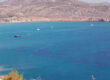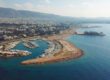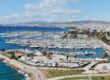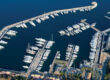


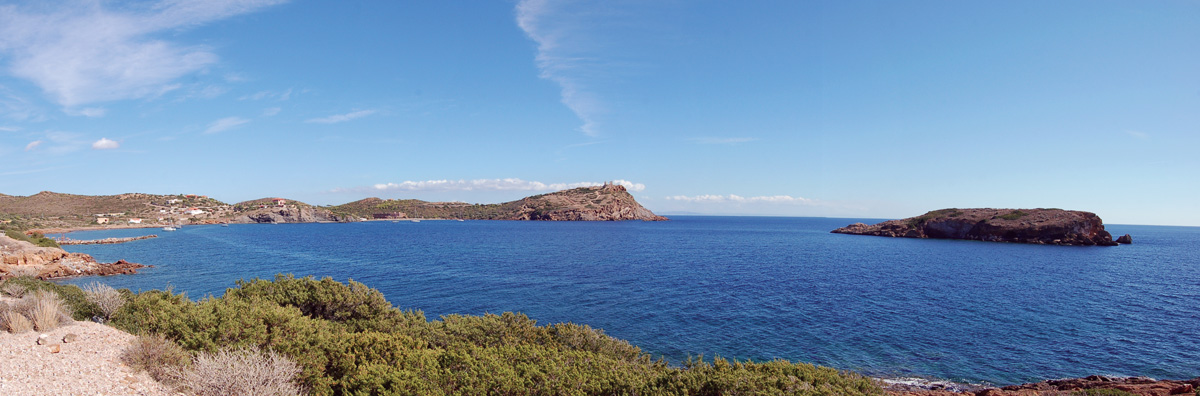
At the southernmost tip of the Attica peninsula, where the land stretches dramatically into the Aegean Sea, rises the striking Cape Sounio, one of the most recognisable maritime landmarks in Greece. The bay of Sounio forms the southernmost inlet of Attica and occupies a geographically strategic position at the meeting point between the Aegean Sea and the Saronic Gulf. The headland on the eastern side of the bay marks the eastern boundary of the Saronic Gulf and the southern end of a coastline roughly 70 kilometres long beginning at Phaleron. In antiquity this coastline was known as the “Coast of Apollo”, dotted with sanctuaries and small harbours connected with the maritime life of ancient Athens.
From early times Sounio was closely associated with the naval power of Athens. Its bay offered a sheltered anchorage for ships patrolling the entrance of the Saronic Gulf and the sea routes leading toward the Cyclades. In antiquity the harbour was regularly used by the Athenian fleet, whose presence here ensured control of merchant and military traffic heading towards Piraeus. The headland itself was fortified, while on a lower terrace stood a sanctuary dedicated to Athena Sounias, the protective goddess of the Athenians and their sailors.
The area is also linked with the famous myth of King Aegeus, father of Theseus. According to legend, when Theseus returned from Crete after slaying the Minotaur, he forgot to replace the black sails of his ship with white ones, as he had promised his father. Aegeus, waiting at Sounio and watching the horizon, believed his son had died and leapt from the cliffs into the sea, thus giving his name to the Aegean Sea. This myth emphasises the ancient significance of Sounio as a watchpoint over the sea routes.
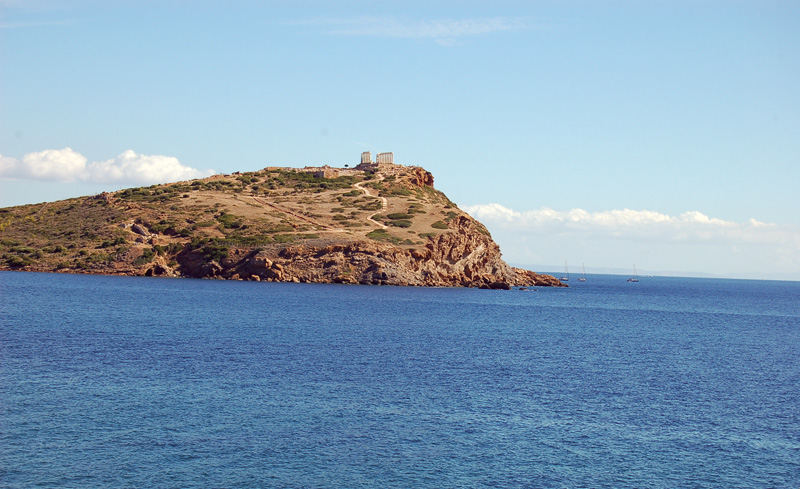
Dominating the highest point of the cape, about 60 metres above the sea, stands the magnificent Temple of Poseidon, one of the most celebrated monuments of Classical Greece. Construction began around 490 BC, possibly after the Battle of Marathon, though the first temple was destroyed during the Persian invasion of 480 BC. The present Doric temple, built from the white marble of nearby Agrileza, was erected around 440 BC during the age of Pericles by an unknown architect. Dedicated to Poseidon, god of the sea, the temple symbolised both religious devotion and the maritime supremacy of Athens.
The Temple of Poseidon also forms part of a remarkable geometrical triangle of Attic sanctuaries, together with the Temple of Aphaia on Aegina and the Temple of Hephaestus in the Theseion of Athens. The distances between these sanctuaries are nearly identical, approximately 44–45 kilometres, forming an almost perfect isosceles triangle. This intriguing relationship has long fascinated historians and archaeologists, suggesting a possible intentional placement of sacred sites within the landscape of ancient Attica.
During the Hellenistic and Roman periods, Sounio continued to function both as a sanctuary and as a strategic observation point controlling the sea routes of southern Attica. Roman travellers admired the Temple of Poseidon, which stood dramatically above the sea and served as a landmark for sailors approaching Athens. The surrounding area remained inhabited, while the sea lanes around the cape preserved the commercial importance of Attica.
In Byzantine times, Sounio gradually lost much of its former prominence, though the cape continued to serve as a natural navigational point for seafarers. The ruins of the ancient temples were often used as sources of building material, while small rural settlements appeared in the wider region of Lavreotiki.
During the Frankish and Venetian periods (13th–17th century AD), Sounio frequently appeared on Mediterranean nautical charts as Capo Colonne, meaning “Cape of the Columns”. The name referred to the striking marble columns of the temple, visible from far out at sea. For centuries, Mediterranean sailors relied on the cape as a natural navigational landmark.
Under Ottoman rule, the area remained sparsely populated, though sailors still recognised Sounio as an important reference point along the Attic coast. After the establishment of the modern Greek state in the 19th century AD, archaeological interest in the site grew rapidly. Restoration and conservation works on the temple began in AD 1890, and today 19 columns of the Temple of Poseidon remain standing, forming one of the most iconic monuments in Greece.
The surrounding landscape is also of considerable natural importance. In AD 1974, the wider region was declared the Sounio National Park, recognised for its geological, palaeontological and historical value. Today visitors can explore beautiful forest trails through pine-covered hills, leading to ancient mining sites, archaeological remains and small coves overlooking the Aegean Sea.
Sights & Flavours
Temple of Poseidon at Cape Sounio
Standing about 60 metres above the sea on the summit of the cape, the Doric Temple of Poseidon (5th century BC) is one of the most iconic landmarks of Greece. The view over the Aegean is breathtaking, and the sunset from this point is considered among the finest in the country. For centuries sailors recognised Sounio from the marble columns of the temple visible from far offshore.
Ancient Mines of Laurion
Lavreotiki was one of the most important mining regions of the ancient Greek world. Silver and lead extracted here financed the Athenian fleet and helped support the rise of Classical Athens during the 5th century BC. Remains of ancient mining galleries, ore-washing installations and later industrial structures from the 19th century can still be seen across the landscape.
Lavrio – Historic Port of Attica
Lavrio is a lively small town and an important harbour on the southeastern coast of Attica. Its port today serves ferry routes to the Cyclades, while the town preserves remarkable buildings from its industrial past. The Lavrio Technological and Cultural Park now occupies former mining facilities.
Sounio National Park
The wider area around the cape forms a protected natural landscape of pine forests, low hills and ancient paths. The Sounio National Park combines important archaeological remains with geological and palaeontological interest. It is an excellent place for walking, with panoramic views across the Aegean and the secluded coves of the Lavreotiki coast.
Fresh Fish and Seafood of the Saronic Gulf
Local tavernas are renowned for their fresh fish and seafood from the Saronic Gulf. Grilled sea bream and sea bass, squid, prawns and octopus are among the most popular dishes served along the coast. These are best enjoyed with a glass of local white wine or a traditional ouzo beside the sea.
Attic Wines and Local Produce
Attica has a long winemaking tradition, with the Savatiano grape as its most characteristic variety, often used for the production of retsina. Visitors can also enjoy olives, local honey, fresh vegetables and traditional dishes of the Attic countryside. The flavours of the region reflect a simple Mediterranean cuisine closely connected with the land and sea.