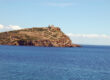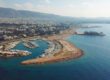


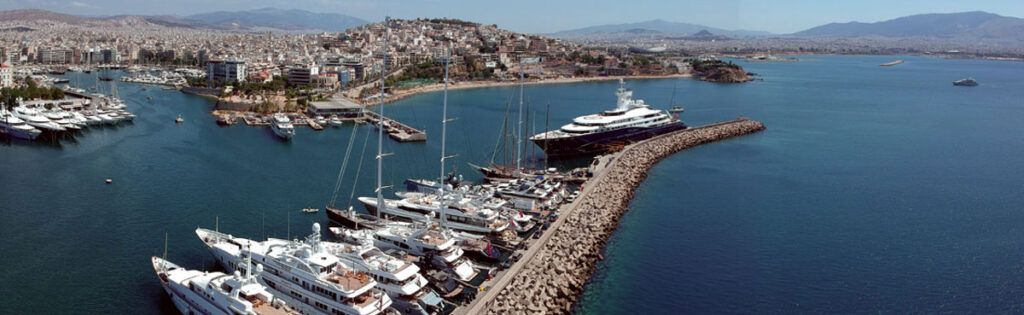
Piraeus, the largest port of Greece and one of the most important harbours of the Mediterranean, stands as the most significant historical landmark along the eastern coast of the Saronic Gulf. Thousands of years ago the area was not connected to mainland Attica but formed a small island, with the earliest settlement developing on the hill of Munychia (today the hill of Profitis Ilias). The island was separated from the Attic mainland roughly at the location of modern Neo Faliro. Over time, sediment deposits from the Kifisos River gradually filled the water channel, first forming marshland and eventually solid ground that connected Piraeus with Attica. The name of the city derives from the Greek verb “peraio”, meaning “to cross over”.
Until the 5th century BC, Piraeus was a relatively small and insignificant settlement. Its destiny changed dramatically during the time of Themistocles, who recognised the exceptional strategic value of its three natural harbours: the Central Harbour (Kantharos), Zea (Pasalimani) and Munychia (Mikrolimano). Under his leadership Piraeus was developed into the main naval port of Athens and organised as a major maritime centre.
Following the Greek victory over the Persians in the Battle of Salamis in 480 BC, the city entered a period of rapid development. Strong fortifications and defensive walls were constructed, and the city was planned according to the Hippodamian grid system, introduced by the urban planner Hippodamus of Miletus. During this period Piraeus became one of the greatest naval and commercial centres of the ancient world, with ship sheds, warehouses and marketplaces serving the powerful Athenian fleet and Mediterranean trade.
The prosperity of Piraeus continued until the period of Roman rule (2nd century AD). During the following centuries, particularly in the Byzantine era, the area suffered repeated attacks from Goths and pirates, leading to gradual decline and depopulation.
In the 13th century AD, the port began to be referred to by Western sailors as “Porto Leone.” The name came from a large marble lion statue, about three metres high, which stood at the entrance of the harbour and served for centuries as a symbol of the city. In AD 1687, the statue was removed by the Venetian admiral Francesco Morosini and taken to Venice as war booty. Today it stands at the Venetian Arsenal (Arsenale).
During the Ottoman period, Piraeus was almost deserted, inhabited only by a few residents and monks of the Monastery of Saint Spyridon, which was later destroyed during the conflicts of the Greek War of Independence. The area was liberated in AD 1827, but the real development of the modern city began after AD 1835, when Athens was established as the capital of the newly formed Greek state.
From the mid-19th century onwards Piraeus rapidly developed into the largest port of Greece, serving as the country’s main maritime and commercial gateway. Today it is a vibrant modern city with strong shipping activity, busy commercial districts and lively waterfront neighbourhoods that reflect its long maritime history.
Sights
Zea Harbour (Pasalimani)
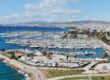
Zea Harbour, once the naval harbour of ancient Athens, is today a beautiful marina surrounded by cafés and restaurants.
Mikrolimano
The picturesque harbour of Mikrolimano corresponds to the ancient port of Munychia and is now one of the most popular seaside districts of Piraeus.
Archaeological Museum of Piraeus
The museum houses important artefacts from the ancient city, including the famous bronze statues of Piraeus.
Munychia Hill (Profitis Ilias)
Munychia Hill offers panoramic views of the harbour and the Saronic Gulf and marks the location of the earliest settlement in the area.
Flavours
Seafood of Mikrolimano
Mikrolimano is famous for its traditional seafood tavernas serving fresh fish, squid, prawns and grilled octopus.
Piraeus Meze Cuisine
Local tavernas offer a variety of seafood meze such as shrimp saganaki, steamed mussels and fried small fish.
Seafront Cafés and Desserts
Cafés and pastry shops along the harbour provide coffee, ice cream and traditional Greek sweets overlooking the busy port.