

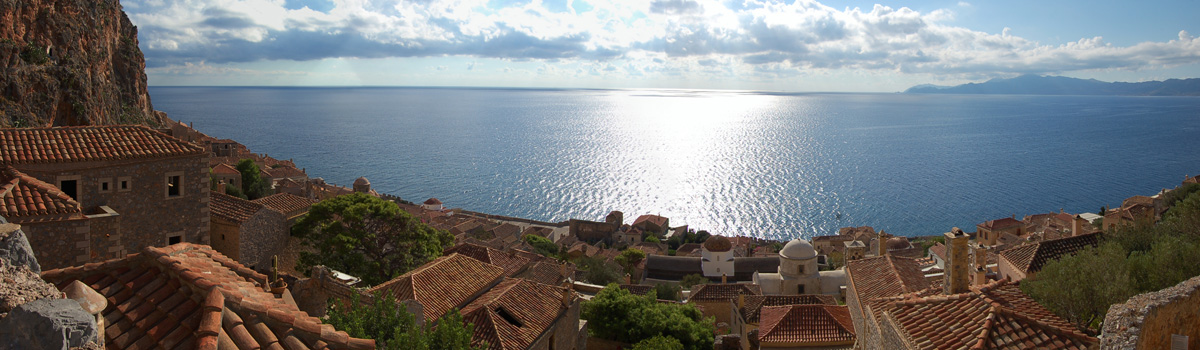
Monemvasia, from the Greek words meaning “single entrance”, takes its name from the narrow access linking the fortified town to the mainland. In antiquity, the site was known as Akra Minoa, possibly reflecting early maritime activity associated with the Minoans or its position at the limits of their influence.
The dramatic rock formation took its present shape following strong seismic activity during the 4th century AD, which separated it from the mainland. During the 6th and 7th centuries AD, Monemvasia developed as a refuge for local populations fleeing Slavic incursions, and was organised into a fortified settlement with the Upper Town on the summit and the Lower Town at the base.
Owing to its strategic location and naturally defensible setting, Monemvasia became one of the most important centres of the Byzantine world, combining military strength with economic prosperity. Its wealth was closely linked to the production and trade of the renowned sweet wine Malvasia, which achieved widespread fame across Europe between the 13th and 17th centuries.
In the centuries that followed, the city became a contested stronghold. It was taken by the Franks after a prolonged siege in the late 13th century, and later passed between Venetian and Ottoman control. After the fall of Constantinople in AD 1453, Monemvasia came under Western protection and was eventually taken by the Venetians in AD 1464, before being ceded to the Ottomans in AD 1540. The following centuries saw alternating periods of prosperity and decline, often accompanied by population movements.
During the Greek War of Independence, Monemvasia was among the first major fortresses to be liberated after a siege, and subsequently became part of the modern Greek state. Today, it remains one of the best-preserved medieval fortified towns in Greece.
Sights
Monemvasia Castle
One of the most impressive and well-preserved fortified complexes in Greece, featuring walls, gates, and cobbled streets of medieval character.
Upper Town and Hagia Sophia
At the summit of the rock stands the church of Hagia Sophia (12th century), offering panoramic views over the Aegean.
Lower Town – Elkomenos Christos
The historic church of Christ Elkomenos, continuously active since Byzantine times.
Panagia Chrysafitissa
A 17th-century church closely associated with local religious traditions.
House of Yannis Ritsos
The residence of the notable Greek poet, located within the castle town.
Epidaurus Limera (wider area)
Ancient remains of a coastal city linked to the maritime activity of the region.
Flavours
Malvasia Wine
The famous sweet wine of Monemvasia, historically one of the most important export products of the region.
Laconian Cuisine
Simple dishes based on local ingredients, with emphasis on olive oil and traditional recipes.
Fresh Seafood
Locally sourced fish and seafood prepared in traditional ways.
Local Sweets
Desserts based on honey and almonds, typical of the region.