


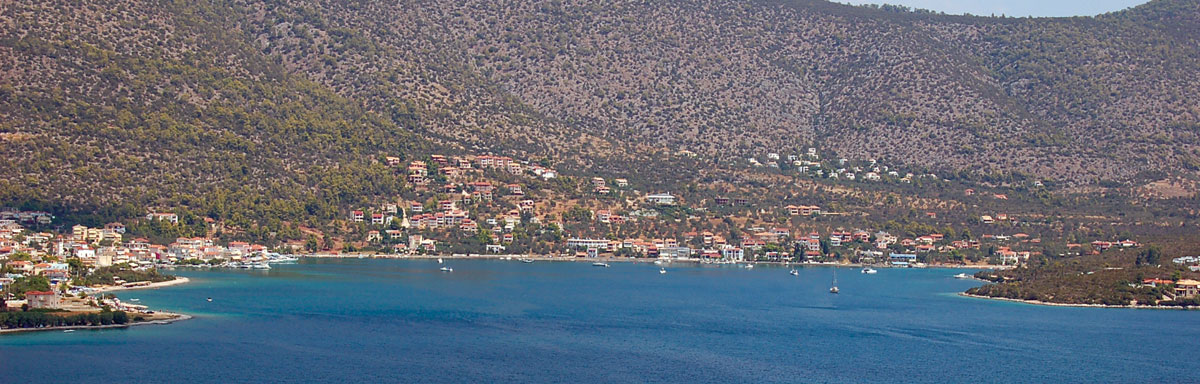
Korfos is a small and well-sheltered bay on the south-eastern coast of Corinthia, serving as the seaside harbour of the mountain village of Sofiko. Today it is a quiet holiday destination with natural beauty and modest tourism development, while still preserving the character of a traditional fishing village.
The name Korfos most likely derives from the geographical shape of the place. In Greek toponymy the word often describes a deep and protected coastal inlet, an appropriate description of the naturally sheltered bay that forms the harbour of the village.
Prehistoric Period
The wider area around Korfos appears to have been inhabited since very early times. Along the coastline between Sofiko Bay and Cape Treli, archaeologists have identified the remains of an extensive Mycenaean coastal settlement, part of which now lies underwater. The discoveries so far date between the 3rd and 2nd millennia BC, suggesting the existence of an organised settlement that probably included a small harbour.
Byzantine Period
During the Byzantine era the region is associated with Saint Luke of Steiri, one of the most revered hermits of the 10th century AD. About one kilometre inland, opposite the small island of Petronisi, stand the remains of the Monastery of Panagia of Steiri, founded in the 10th century. Saint Luke lived there for a period, becoming widely known for his charitable, healing and prophetic abilities. The surviving wall paintings in the chapel date from 1668 and were created by the painter Theodoulos Kakkavas.
Modern Period
The modern settlement of Korfos was established by inhabitants of Sofiko, who for centuries were involved in the production and trade of pine resin from the surrounding forests. In order to transport and sell their products more easily, some gradually settled along the coast and created the small harbour village of Korfos.
Later the inhabitants turned mainly to fishing, and until a few decades ago Korfos remained a typical small fishing village of the Saronic Gulf. Today it has around 400 permanent residents, with tourism facilities, holiday houses and a pleasant waterfront life that remains relaxed and authentic.
Sights
Korfos Bay
One of the most sheltered natural bays in the area, surrounded by pine-covered hillsides. The small harbour and the peaceful atmosphere make it particularly attractive for visiting yachts.
Petronisi Islet
The small island at the entrance of the bay forms a distinctive landmark of the Korfos coastline and adds to the picturesque character of the harbour.
Panagia of Steiri Monastery
About one kilometre inland lie the remains of the Byzantine monastery. Despite its ruined condition, the chapel still preserves interesting 17th-century frescoes and is linked with the life of Saint Luke.
Sofiko Village
The mountain village above Korfos is one of the most traditional settlements of the region, featuring stone houses, historic churches and wide views towards the Saronic Gulf.
Flavours
Fresh fish and seafood
The village’s fishing heritage lives on in the waterfront tavernas serving fresh fish, squid and prawns from the Saronic Gulf.
Seafood meze
Dishes such as grilled octopus, fried anchovies and calamari are typical favourites in the seaside restaurants.
Pine honey and forest products
The surrounding pine forests produce aromatic pine honey, one of the characteristic products of the region.
Traditional Peloponnesian cooking
Small local tavernas often offer homemade dishes based on seasonal ingredients, reflecting the flavours of rural Peloponnesian cuisine.

