


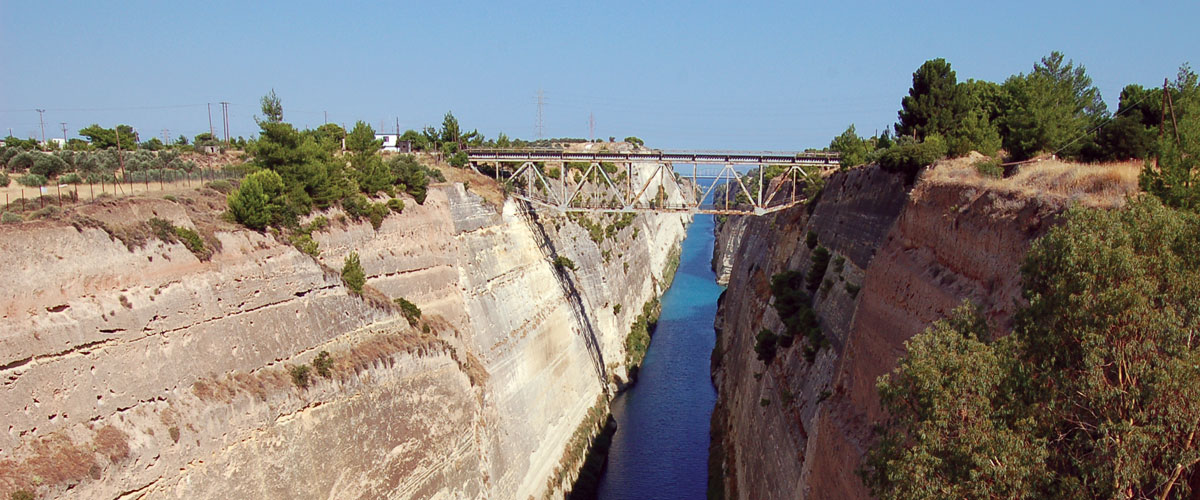
The Corinth Canal is one of the most impressive engineering works of modern Greece, linking the Gulf of Corinth with the Saronic Gulf and effectively separating the Peloponnese from mainland Greece. The idea of cutting through the Isthmus is extremely ancient and took more than 2,500 years to become reality.
Archaic Period
The first recorded attempt to connect the two seas is attributed to Periander, the tyrant of Corinth and one of the Seven Sages of Ancient Greece, around 620 BC. The difficulty of transporting goods and ships across the Isthmus inspired the idea of creating a maritime passage.
Instead of digging a canal, Periander constructed the Diolkos, a paved trackway on which ships were hauled across the Isthmus on wooden sledges greased with fat. The tolls paid by merchants became one of the main sources of wealth for ancient Corinth. Sections of the Diolkos can still be seen near the modern canal.
Hellenistic Period
Three centuries later, in 307 BC, Demetrius Poliorcetes considered digging the canal again. Egyptian engineers reportedly warned him that the sea levels of the two gulfs were different and that cutting the Isthmus might cause catastrophic flooding, so the project was abandoned.
Roman Period
During Roman times the idea resurfaced several times. Julius Caesar and later Caligula considered the project but never began construction.
The first serious attempt was made by Emperor Nero in AD 66. Thousands of workers, including about 6,000 captured pirates, were assigned to dig along the canal line. Nero himself ceremonially struck the first blow with a golden pickaxe. The project stopped soon afterwards when he returned to Rome to face political unrest, and following his death the works were abandoned.
Medieval and Venetian Period
During the Byzantine era, shifting trade routes reduced the strategic importance of the Peloponnese, and there was little economic incentive to resume the project.
Later, during Venetian rule, attempts were again made to excavate the Isthmus from the Corinthian side, but the short duration of Venetian control and technical difficulties led to another abandonment of the plan.
Modern Greece
After Greek independence, Ioannis Kapodistrias, the first governor of Greece, considered the project in 1830. However, the estimated cost of about 40 million francs was far beyond the means of the newly established state.
Construction finally began on 23 April 1882, under the supervision of Ferdinand de Lesseps, the engineer associated with the construction of the Suez Canal. After eight years the works stopped due to financial difficulties.
The project was eventually completed by the Greek Corinth Canal Company, supported by the banker Andreas Syngros. With about 2,500 workers and the most advanced machinery of the period, the canal was completed and inaugurated on 25 July 1893.
Today the canal, approximately 6.3 kilometres long, is one of the most recognisable engineering landmarks of Greece, with ships passing between sheer rock walls rising up to 80 metres high.
Sights
Corinth Canal
A dramatic narrow passage linking two seas, with steep rock walls and impressive views from the bridges above.
Ancient Diolkos
Remains of the ancient paved trackway used to transport ships across the Isthmus, once a vital commercial route of antiquity.
Isthmus of Corinth
The narrow land bridge connecting the Peloponnese with mainland Greece, a place of great historical and strategic importance since ancient times.
Flavours
Fresh fish from two seas
Local tavernas serve fresh fish and seafood from both the Saronic and Corinthian gulfs.
Corinthian wines
The region produces quality Greek wines, ideal companions to seafood dishes.
Corinthian currants
A famous agricultural product of the area, once a major export of Greece in international trade.

