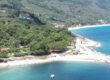


View of the harbour in Damouchari
The history of Mouresi and its small harbor Damouchari forms one of the most characteristic mountain–sea pairings in East Pelion. For centuries the village on the high, forested slopes supplied the maritime cove below, while the cove sustained the village by linking it to wider trade networks. Their stories are inseparable: Damouchari rarely appears in the sources as an autonomous settlement, but always as the seaport of Mouresi, a lifeline for commerce, communication and security along a difficult and storm-beaten coastline.
Early Phases: Coastal Settlement and Fortified Presence
Historical traces suggest that the earliest nucleus of the wider Mouresi community lay closer to the sea, in the vicinity of Damouchari. Remains of old houses and fragments of masonry near the cape imply a pre-Ottoman fortified post, probably Byzantine in its initial phase, guarding a natural inlet that served as a rare refuge on Pelion’s exposed eastern flank. The rugged geography—steep slopes plunging into a restless Aegean—made sheltered landing places scarce. Damouchari, with its naturally enclosed dual coves, was a precious exception.
As in many Pelion villages, piracy and coastal insecurity during late Byzantine and Frankish times gradually pushed populations uphill. Mouresi’s inhabitants moved higher into the forested terraces, creating the dispersed settlement pattern visible today. The coastal zone, however, retained military and logistical significance.
Venetian Interest and the Emergence of the Harbor
During the period of Venetian influence in the Aegean, Damouchari acquired a more defined maritime role. The ruins of a small Venetian fortification on the southern headland—low walls and foundations still visible—testify to its use as a lookout and protective station. The Venetians needed intermediate posts on the long maritime axis connecting Euboea, the Sporades, and northern Aegean trade routes. Damouchari was not a major Venetian base, but a secondary fortified outpost, useful for monitoring pirate activity and offering a controlled anchorage to Venetian or allied vessels.
This is the point at which Damouchari’s identity as the “Mouresi harbour” begins to crystallize. Even after Venetian control waned, the architectural footprint of their tenure—warehouses, defensive walls, stone-built coastal structures—continued to shape the site’s function.
Ottoman Era: Commercial Lifeline of East Pelion
With the consolidation of Ottoman administration, the Pelion villages enjoyed relative autonomy and economic growth. The mountainous interior produced silk, wool, timber, and agricultural goods; yet the difficulties of overland transport toward Volos (before the later 19th-century roads) meant that Mouresi and its neighboring settlements relied heavily on the sea.
Damouchari thus became a principal commercial outlet for the eastern Pelion slope. Merchant caiques transported local products southward to Euboea and northward to Thessaly and Macedonia, while imported materials—salt, grain, tools, textiles—arrived through the same route. In the 18th and 19th centuries, Damouchari hosted:
- A customs post, supervising local trade.
- Stone warehouses, some of which survive today as foundations or reconstructed structures.
- Small inns and merchant houses, serving sailors, pack-animal drivers and traders moving goods up to Mouresi.
The harbor’s importance increased during times of unrest elsewhere along the Aegean shore, because its sheltered coves offered safe anchorage in severe weather. Many ships from Zagora, Pouri, and even Skiathos or Alonissos sought refuge here when exposed to northerly storms.
Meanwhile, Mouresi itself developed into a stable, semi-wealthy mountain community, known for its terraced agriculture, chestnut groves, clergy schools, and well-maintained stone paths (kalderimia) connecting it to its satellite hamlets. Its prosperity, while modest compared to the larger Pelion centers such as Zagora, was directly tied to the opportunities offered by its maritime outlet at Damouchari.
19th to Early 20th Century: Transformation and Decline of the Old Harbour Role
As the 19th century progressed, Pelion underwent major structural changes:
- Improvement of inland routes and, eventually, motor roads diminished the necessity for maritime transport between Mouresi and the outside world.
- The rise of Volos as a major port and urban hub centralized trade flows that previously traveled through smaller coastal coves.
- The commercial caique networks declined with the advent of steamships and more modern freight systems.
Consequently, Damouchari’s commercial function gradually shrank. The customs office closed, the warehouses lost their original purpose, and the cove transitioned from an economic hub into a small maritime hamlet inhabited seasonally by fishermen and families with ancestral ties to the area.
Mouresi followed the typical Pelion pattern of the early 20th century: slight population decline, restructuring of agricultural life, and an increasing focus on education, small craftsmanship, and later tourism.
Mid- to Late 20th Century: Preservation of a Rare Coastal Settlement
Damouchari is unique among the east Pelion coves because it retained its traditional spatial identity. Where other landing points became modern beaches or fishing spots, Damouchari preserved:
- Its two natural harbours (south and north).
- The stone-built coastal spine, partly derived from Venetian and Ottoman-period structures.
- The tight cluster of houses mirroring the older pattern of warehouse–dwelling–chapel relations.
During the 1960s–1980s, as tourism spread through Pelion, Damouchari’s relative isolation kept it from overdevelopment. At the same time, Mouresi remained an authentic mountain village, expanding slowly without losing the linear paths and terraces that marked its pre-modern life.
21st Century: Cultural Revival and Global Visibility
The early 2000s brought renewed attention to Damouchari. Its intact architecture, dramatic cliffs, and secluded coves attracted location scouts for the film industry. Most notably, in 2007, significant scenes of the international musical film “Mamma Mia!” were shot here, using the natural harbor as a key backdrop. The film’s release brought a sudden wave of visibility, transforming Damouchari into a recognizable name on the global tourist map—though still far from mass tourism due to the limited space and controlled development.