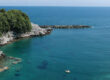


The 14 km long beach of Agiokambos
Prehistory and Early Settlements
Although modern Agiokambos is a 20th-century creation, the eastern Thessalian coastline has been inhabited since very early times. On the slopes of Mavrovouni and around the former Lake Karla, important prehistoric sites have been identified, such as the Neolithic settlement of Palioskala, organised with stone enclosures and a central building during the late 5th–4th millennium BC. The presence of these communities shows that the wider area was already densely networked long before the emergence of historical Magnesian cities.
The steep contact between mountain and sea, the sheltered coves, and the availability of timber and marine resources encouraged the development of coastal landing sites along the eastern Thessalian shore from very early periods.
Ancient Meliboea – The City of Homer
At the heart of the historical narrative stands Meliboea, the ancient city that most modern archaeological evidence places on the acropolis of Skiathas, directly above the present small harbour of Agiokambos.
The Homeric reference and Philoctetes
Meliboea is explicitly mentioned in the Iliad’s Catalogue of Ships among the cities that sent vessels under Philoctetes to Troy. This connection gives the area significant mythic weight, indicating that in the period when the epic tradition was formed, Meliboea was viewed as:
- a maritime city with naval capabilities,
- part of the eastern Thessalian contingent,
- linked with the heroic world of Philoctetes.
This Homeric reference remains the strongest literary testimony to the ancient importance of the site.
Economic prominence – the famed ‘Meliboean purple’
The city was renowned for its purple dye, produced from murex shells gathered along the rocky coast. The ‘Meliboean purple’ is cited by later writers as a prestigious luxury pigment, proving that the city, though small, held considerable commercial significance in the wider Aegean.
The coastline of Agiokambos–Velika, with its natural rocky shelves, provides an ideal habitat for murex, supporting both the literary tradition and the archaeological understanding.
The harbour and trading networks
Meliboea’s harbour served as:
- a point for the export of high-quality timber from the forested slopes of Mount Ossa,
- an intermediate station on the maritime route linking Magnesia, Pieria, and the Thermopylae corridor,
- a gateway connecting the Thessalian hinterland to the Aegean.
The small inlet of today’s Agiokambos displays precisely the topographical qualities expected of an ancient natural harbour used for trade and local navigation.
The acropolis on Skiathas
Modern investigations by the Ephorate of Antiquities of Larissa have revealed:
- segments of ancient fortification walls,
- Classical and Hellenistic pottery,
- remains of a cult sanctuary on the summit,
- a Byzantine tower built over earlier stone foundations.
The continuous reuse of the hill demonstrates its strategic value from antiquity into Byzantine times. The ridge linking Skiathas, Velika, and Ano Sotiritsa functioned as a defensive chain, controlling the main coastal passage.
Hellenistic and Roman Periods
During the Hellenistic period, the city appears to have remained inhabited and fortified, preserving its acropolis and maintaining its maritime functions. Ceramic evidence and structural remains point to continued occupation, while the flow of timber and purple dye likely persisted as stable economic activities.
In Roman times, although written references lessen, the entire coastline functioned as a naval and transit station. The presence of a Roman bath complex at Neromyloi, near Agia, suggests Roman supervision and sustained local activity in the broader region.
Early Byzantium – The Fort of Velika
North of Velika, on a commanding hill above the coast, stand the remains of an extensive Byzantine fortress:
- walls enclosing approximately 21 stremmata,
- five towers,
- two identified gates,
- stretches of older defensive phases incorporated into the structure.
This fortification, likely of Justinianic date, is regarded by several scholars as the late-antique successor of ancient Meliboea: the same strategic position, serving the same defensive purpose, but rebuilt on a new architectural plan.
Together with the acropolis of Skiathas, the Velika fortress formed a coastal defensive system protecting the eastern Thessalian shoreline during the Early Byzantine centuries.
Medieval and Ottoman Periods
During the medieval and Ottoman eras, the coastal belt saw reduced permanent settlement, yet the defensive hilltops continued to be used intermittently. The Ottoman-period stone bridge near Agiokambos, situated along the older inland route towards Agia, shows that the coastal passage maintained transport significance.
Similarly, the Castro of Skiti, another fortified hill in the hinterland, belonged to the same chain of observation points that monitored movement across the region.
The Paleokastro of Agia – A Hill Watchpoint Across the Ages
A few kilometres to the west, the strategic hill above the town of Agia, known as Paleokastro, preserves several layers of defensive occupation:
- On its northern side lie the faint remains of ancient fortifications, identified by earlier scholars as belonging to Dotium, a historical Thessalian city.
- On the summit survive the ruins of a newer fortress, probably associated with the 19th-century uprisings, featuring rounded towers and firing slits.
- During the Greek Civil War (1946), small concrete pillboxes were added.
This hill functioned as a long-range observation point for the entire coastal strip of Agiokambos–Velika, confirming the enduring strategic interplay between the coast and its mountainous hinterland.
The Modern Formation of Agiokambos
Present-day Agiokambos began to be settled permanently around 1930, when a few families from Skiti started spending the warmer months by the sea. After 1990, tourism transformed the area into a major seaside resort of the Larissa prefecture, with an extended shoreline linking Agiokambos–Velika–Sotiritsa.