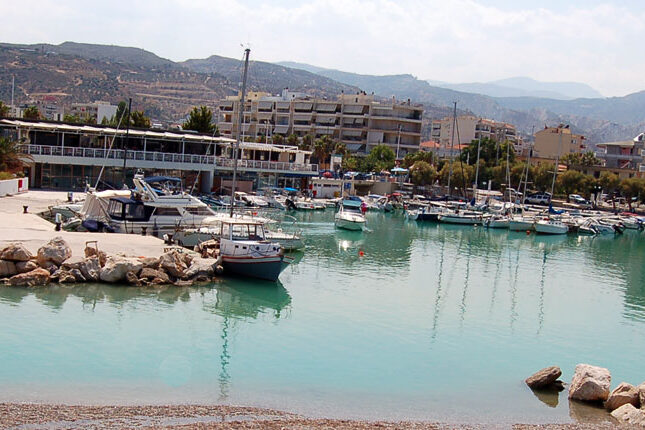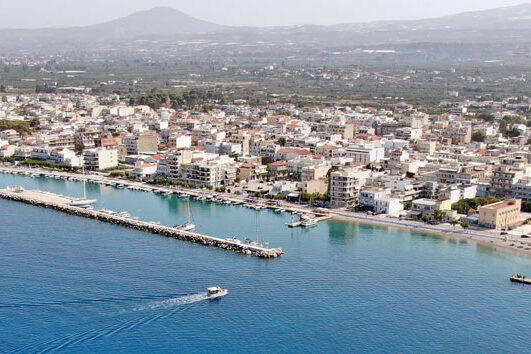


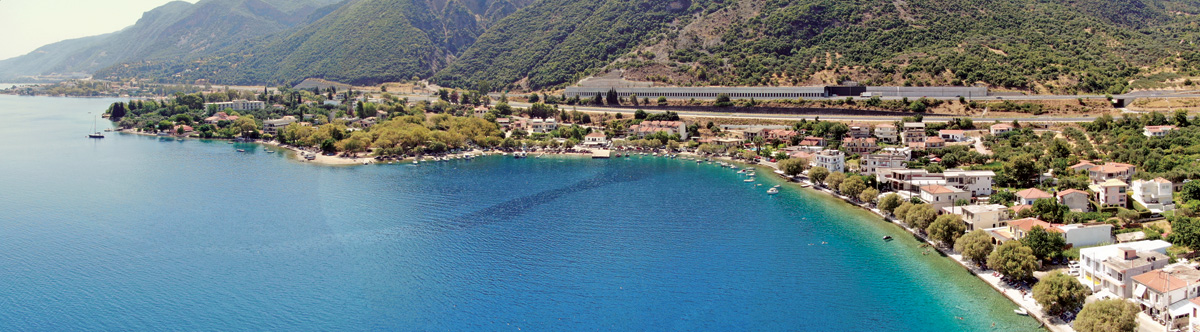
Along the southern shores of the Korinthiakos Gulf, between Kiato and Akrata, stretches a coastline that has quietly participated in some of the most important chapters of Greek history. Facing the mountains of Central Greece across the narrow waters of the gulf, this shore has long served as a natural maritime corridor, linking the Peloponnese with the wider Greek world. Though today it appears as a tranquil ribbon of villages, orchards, and beaches, its past is woven with trade, travel, and the movements of peoples and ideas across the gulf.
In antiquity, this coast lay close to the heart of the ancient territory of Sicyon, one of the most influential city-states of the northern Peloponnese. From its powerful acropolis near modern Kiato, Sicyon dominated the fertile plains and the sea routes that passed along this shoreline. Ports and anchorages along the gulf allowed merchants and sailors to move goods between the Peloponnese and the mainland, while nearby Corinth controlled the strategic Isthmus of Corinth, making the entire region a crossroads of commerce and politics in the classical Greek world.
During the Roman period (146 BC – AD 330), when Greece became part of the Roman Empire, the Korinthiakos Gulf grew even more important as a maritime route. Roman roads crossed the northern Peloponnese, connecting coastal settlements with inland cities and with the great ports of Corinth and Patras. Ships sailing along the gulf carried grain, wine, olive oil, and marble, while travellers and officials moved between the provinces of Achaea and central Greece. Though few monumental ruins remain directly on this stretch of coast, the sea lanes just offshore formed part of the commercial network that sustained Roman Greece.
With the transition to the Byzantine era (AD 330 – 1204), the gulf continued to function as a vital maritime passage. Coastal settlements survived as small agricultural and fishing communities, while monasteries and fortified hill settlements appeared in the surrounding mountains. The Korinthiakos itself was not only a route of trade but also, at times, a frontier threatened by Slavic raids and later pirate incursions, which shaped the defensive character of many communities along the Peloponnesian coast.
In the medieval centuries, particularly under Frankish and later Ottoman rule, the coastal settlements between Kiato and Akrata remained modest but strategically positioned along the northern Peloponnesian route. Travellers, merchants, and local fishermen continued to use the natural anchorages of the gulf. Inland valleys supported agriculture, while timber and agricultural products moved by sea toward larger regional markets such as Corinth, Patras, and the ports of Central Greece.
The region entered a new chapter during the Greek War of Independence (1821–1829). The northern Peloponnese became an important theatre of revolutionary activity, and the coastal villages of the Korinthiakos provided shelter, supply points, and communication routes for the Greek forces. Maritime links across the gulf allowed fighters and supplies to move between the Peloponnese and mainland Greece, making the gulf itself a strategic corridor during the struggle for independence.
In the modern era, the coast between Kiato and Akrata gradually developed into a chain of small seaside towns. The arrival of the railway along the northern Peloponnese in the late nineteenth century strengthened connections with Athens and Patras, transforming once-isolated villages into summer destinations and agricultural centres. Today the shoreline retains its quiet character, but beneath its calm waters lies a long maritime memory — one shaped by ancient trade routes, Byzantine survival, and the modern rhythms of the Greek seaside.