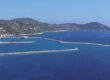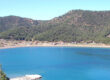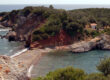


Agioi Apostoloi, from SE
Set between the low hills of central–southern Evvoia and the protected waters of the Aegean, Petries and its seaside haven Agioi Apostoloi form one of those quiet northern-Aliveri micro-regions where the ancient past, rural tradition, and maritime life blend into a single, understated story. Petries is an old inland settlement, shaped by agriculture and the rhythms of mountain–sea movement. Agioi Apostoloi began as its fishing outpost and, over the last two centuries, grew into a lively little harbour village with beaches, tavernas, and a soft summer buzz.
Ancient Roots (ca. 8th–1st Century BC)
The wider region of Petries was connected in antiquity to Eretria, one of the great city-states of Evvoia in the Geometric and Archaic eras. Local toponymy and later historical references point to a small settlement or district named Petri—almost certainly the ancestor of modern Petries. While the exact location is not archaeologically identified, the name’s survival is significant: many minor rural villages of ancient Eretrian territory simply vanished after the Roman and Byzantine periods, but Petri left behind a linguistic footprint strong enough to endure for more than two millennia.
The ancient inhabitants would have lived from olive cultivation, small-scale herding, and woodland exploitation, reflecting typical rural Eretrian life. A direct road or mule track likely connected the inland hamlet with the coast, where small fishing coves—like the one that would later become Agioi Apostoloi—served Eretrian rural populations.
A few kilometres to the west stood Dystos, a fortified city with deep Bronze and Classical layers. Its presence influences the Petries area indirectly: trade routes, local defence networks, and agricultural zones were shaped by Dystos’ shifting fortunes during Greek, Roman, and Byzantine times.
Byzantine and Medieval Landscape (4th–15th Century AD)
The Petries region enters the medieval era as a quiet agricultural pocket between larger centres—Chalkida, Aliveri, and Kymi. Significant settlements in this period tended to cluster around fortifiable hills or monastic estates; Petries was neither fortified nor monastic, but it formed part of a productive hinterland supporting these hubs.
The coastline, however, had a more dramatic role. The small protected bay of today’s Agioi Apostoloi, shielded by headlands and invisible from wider Aegean routes, became—at least according to strong local oral tradition—a favoured pirate anchorage during the 12th–16th centuries. While written sources are sparse, the claim is plausible: Evvoia was repeatedly attacked by Saracen raiders, later by Venetians, Catalans, and Ottoman corsairs. Remote coves like this were perfect for hiding small ships or repairing vessels.
During Venetian and later Ottoman rule, the interior villages maintained a stable pattern of small-scale fields, olive groves, and goat pastures. Paths connecting the hills to the sea were used seasonally but there was no permanent settlement on the coast—the shore was considered too exposed to corsairs, and too difficult to defend.
Early Modern Period: The Rise of Traditional Petries (16th–19th Century AD)
From the 16th to 18th centuries, Petries consolidated into a typical Evvoian hill village. Its people built stone houses with wooden balconies and tiled roofs, clustered along narrow lanes overlooking the fertile terraces below. Families relied on olives, vines, wheat, chestnuts, and occasional beekeeping. The region’s water resources powered small watermills in the ravine leading toward Stomio—an important piece of local economic history that survived until the early 20th century.
The coast, meanwhile, remained almost empty. Locals descended seasonally for fishing, gathering sea salt, or tending small vegetable gardens near freshwater springs. By the 18th century they had constructed temporary huts and boatsheds, but still no true village existed. The community lived “between hill and sea,” but firmly rooted in the hill.
The Birth of Agioi Apostoloi (19th Century AD)
Around 1830, shortly after the Greek War of Independence, something changed. As piracy declined, the coastal zone became safer. Families from Petries began to spend entire seasons on the shore, expanding temporary structures into small permanent cottages. By the end of the century the settlement was known as Paralia Petrion (“the seashore of Petries”).
This was the turning point. Fishing intensified, boats became larger, and the coast developed into the village’s epineion—a traditional harbour supporting its inland parent settlement. The life of Petries became bicentric: agricultural households often had relatives who lived or worked seasonally in Paralia Petrion.
20th Century
The first official recognition of the coastal village came in 1920, still under the name Paralia Petrion. Twenty years later, in 1940, it adopted the name Agioi Apostoloi, inspired by the local church dedicated to the Holy Apostles.
In the mid-20th century, fishing remained strong but the village also shifted slowly toward summer tourism, driven by Athenians and Evvoians seeking a simple seaside holiday. Rooms-to-let, tavernas, and small cafés appeared. The gently curving bay, sheltered waters, and easy access attracted families, while the inland village of Petries continued its quieter agricultural character.
Electricity, paved roads, and improved water supply arrived gradually after the 1960s, transforming Agioi Apostoloi into a small but vibrant summer community. Petries stayed more traditional, its population decreasing slightly as young people moved toward Chalkida or Athens but still maintaining a stable local presence.
Sights
- The Traditional Core of Petries
Wander through stone alleys, old houses, chapels and small squares. The village offers classic Evvoian hill architecture and peaceful views toward the coast. - The Old Watermills of the Stomio Ravine
A natural and cultural walk following the stream that once powered several mills. Though mostly ruined, they add a strong ethnographic element. - Agioi Apostoloi Harbourfront
A lively promenade where you can watch the fishing boats return, buy fresh fish, or enjoy seafood overlooking the bay. - Nearby Beaches
The sheltered beaches around Agioi Apostoloi offer calm waters ideal for families and relaxed swimming. - Day Trips to Dystos, Aliveri & Kymi
Ancient and medieval layers at Dystos, the industrial heritage of Aliveri, and the impressive vistas of Kymi are all within short reach.
Flavours
- Fresh Fish & Seafood
The daily catch remains the hallmark of Agioi Apostoloi, with grilled fish, octopus, and small fried delicacies served on the waterfront. - Local Olive Oil
Petries’ olive groves yield excellent oil, often found in local tavernas and village shops. - Honey & Herbal Mountain Teas
The hills surrounding Petries support small-scale beekeeping and fragrant herbs—perfect local gifts. - Traditional Greek Home Cooking
Tavernas in both villages serve classic Evvoian dishes—lathera vegetables, stews, pies, and grilled meats—reflecting the agricultural heritage of Petries.