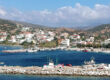


Kymi harbour, from S
Antiquity
Perched dramatically above the Aegean on a terrace of green ridges, Kymi has long enjoyed a reputation as one of Greece’s most picturesque “hanging towns”. The settlement’s earliest development is linked with ancient coastal communities scattered around the region, though Kymi itself—situated high above the sea—emerged more strongly during the Classical period. Its name has been associated since antiquity with the term “Komi” (village or township), but also with speculations of links to Aegean Kymis and even the Euboean diaspora in Italy. Though not proven archaeologically, ancient writers of the Roman Imperial period referred to an early city named Kymi on Evvoia, which contributed to local tradition identifying the town as a participant in wider Euboean maritime activity.
The wider region was influenced heavily by Chalkis and Eretria, the Euboean city-states whose rivalry shaped the island from the 8th to 5th century BC. Kymi’s coastal hinterland likely served as agricultural support land and as a secondary port site for the movement of goods—timber, wine, olive oil—products that made Evvoia important from antiquity onward. The strategic position of the promontories around Kymi allowed excellent watch over sea routes, which later became crucial in Byzantine and medieval times.
During the Hellenistic and Roman eras, the area around Kymi remained active through small farmsteads, rural shrines, and coastal installations. Roman travelers appreciated Evvoia for its mild climate and fertile valleys, and the ridge-line towns such as Kymi maintained a quiet but continuous habitation. Archaeological discoveries—mostly scattered remains, inscriptions, tombs—indicate ongoing life but no major urban centre on the scale of Chalkis or Eretria. Still, Kymi’s traditional claim as the birthplace of Dokos, a renowned doctor mentioned by Galen, reflects the enduring local cultural pride.
Early Christian and Byzantine Kymi
With the spread of Christianity after AD 325, the Kymi plateau acquired new significance. Monasteries and small churches appeared, often built on older sacred sites or vantage points with visibility across the sea. The rugged, forested terrain of eastern Evvoia served as a natural refuge during the troubled 6th–9th centuries, when piracy, Avar and Slavic pressures, and later Arab incursions made coastal life difficult. Populations throughout the region retreated uphill—precisely into places like Kymi.
By the Middle Byzantine period (9th–12th centuries), Kymi had grown into a stable agrarian and defensive settlement. The surrounding slopes were terraced for vines and olives, while local craft production—particularly pottery and textiles—appeared in sources referring to “Kymian goods”. Meanwhile, the coastline below Kymi continued to facilitate trade, despite pirate danger. The modern port of Paralia Kymis retains this memory: an indispensable maritime outlet connected to the hilltop town by a steep winding road.
Frankish, Catalan & Venetian Period (1204–1470)
After the Fourth Crusade in 1204, Evvoia was partitioned among Frankish lords of the famous Triarchy of Negroponte. Eastern Evvoia, including Kymi, fell under shifting control between Lombard knights, Catalan mercenaries, and eventually the Venetians. The Venetians, deeply interested in securing Aegean shipping lanes, fortified a network of outposts and towers around Evvoia’s coastlines, and the Kymi area—commanding long-range sea views—was ideal for lookouts and signalling.
The Frankish and Venetian years introduced western feudal structures but also stimulated commerce. Kymi became noted for its agricultural exports: olive oil, textiles, forest wood, and later silk. Venetian documents mention Evvoian sericulture, and Kymi would ultimately become one of the major silk-producing regions of Greece.
Ottoman Rule (1470–1830)
The Ottoman conquest of Evvoia in 1470, after the dramatic fall of Chalkis, placed Kymi under a new administration. Unlike many coastal towns that decayed under pirate pressure, Kymi thrived inland, protected by its altitude and thick forests. The settlement developed into an important local centre with a reputation for education, small industry, and crafts.
From the 17th century onward, Kymi became especially known for:
– Silk production, one of the finest in the Aegean
– Wine and olive oil of high quality
– Shipbuilding and maritime trade through its port
– Tile-making and ceramics
– A tradition of writers, merchants, and educators
The town’s prosperity is evident in the elegant neoclassical mansions and stone-built multi-story houses that still characterise its neighbourhoods. These structures, built mostly in the 18th and early 19th centuries, reflect wealth, education, and steady contact with urban centres like Constantinople and Smyrna.
The Greek War of Independence (1821–1830)
Kymi played a meaningful, though scattered, role in the struggle for independence. Many local families offered men, supplies, and ships to the revolutionary cause. The town’s elevated position served as a safe haven during periods of Ottoman reprisals. After Evvoia transitioned to the modern Greek state (formally in 1830s–1840s), Kymi continued its upward trajectory, enriched by maritime commerce empowered by the newly free Aegean.
19th–20th Centuries: Maritime Power
By the late 19th century, Kymi was among the wealthiest towns of eastern mainland Greece. It exported: – Silk and cocoons – Raisins – Citrus – Wood – Tiles – Local wine and olive oil And its merchant marine was among the most active in the Aegean. The port developed quickly: warehouses, shipyards, customs stations, and early steamship routes to Lavrio and Piraeus turned Paralia Kymis into a lively maritime hub. Kymi is also famously the birthplace of Giorgos Papanikolaou, the pioneering physician who invented the Pap smear test, revolutionising global medicine. His childhood home survives and is visitable today. During World War II, the region experienced occupation hardships, but once again its altitude and forests aided in local resistance. Post-war reconstruction restored many of the neoclassical dwellings and preserved the town’s character.
Sightseeing
Paralia Kymis
A picturesque port with cafés, fish taverns, wooden fishing boats, and lines of warehouses from the maritime boom years. Ferries depart to Skyros, making Kymi the island’s primary mainland connection.
Folklore Museum of Kymi
One of the best in Evvoia. Extremely detailed displays of traditional clothing, household equipment, tools, and local crafts.
House & Museum of Giorgos Papanikolaou
A small but important museum dedicated to the world-famous doctor and inventor of the Pap test.
Waterfalls of Koutsoubri & Surrounding Nature
Beautiful canyon-like routes with running water, especially in spring. The path continues through lush chestnut and plane forests.
Monastery of Agios Nikolaos
A peaceful monastic setting above the sea, with striking views. Historically connected to local resistance periods.
Beach Options Near Kymi
The eastern coastline is known for wild Aegean beauty: Soutsini (dramatic cliffs), Mourteri (long sandy beach), Thapsa (remote, turquoise), Agios Merkourios (quiet and scenic)
Flavours
Kymi Figs
Among the most famous figs in Greece. Soft, sweet, traditionally sun-dried and folded by hand. A local PDO treasure.
Silk Sweets & Traditional Confectionery
Kymi has a history in silk production, and many sweets echo that heritage:
– Pasteli with fig or sesame
– Galaktoboureko made traditionally
– Sweet preserves (especially cherry, fig, and quince)
Local Olive Oil & Wine
The slopes around the town produce excellent olive oil, lightly fruity and aromatic. Small family vineyards produce traditional white and rosé wines.
Seafood in the Port
Fresh Aegean fish—especially gouna, salted and sun-dried before grilling—and octopus cooked over charcoal.
Forest & Mountain Products
In the cooler months:
– Chestnuts
– Honey
– Wild herbs (thyme, oregano, sage)
– Local cheeses from small producers