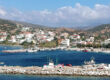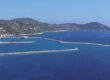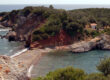


View of the beach in Pili
Pili sits on a quiet stretch of the North Evvoia coast, a place where the slopes of the Kandili mountains lean gently toward a wide, open bay. Today it feels like a peaceful seaside village, yet its story reaches back more than three thousand years. Archaeological surveys in the wider area have uncovered traces of Mycenaean and Hellenistic occupation, suggesting a constellation of small coastal and hilltop settlements that fed on fishing, subsistence farming and short-range maritime exchange. The most striking ancient presence survives on the nearby hills of Kastrí and Mesokotroni, where the foundations of fortified sites—acropolis-like in form—still cling to the ridge lines. Though they are modest remains, they confirm that the coastline of Pili was part of a much older landscape network during the classical and Hellenistic centuries.
By the early Byzantine period, settlement patterns shifted slightly inland, likely due to the uncertainties of the era and the need for defensible terrain. The slopes above Pili continued to host small monastic or defensive structures—little more than foundations today—but they attest to a quiet, continuous habitation. The Middle Ages added another layer: Mesokotroni in particular held a small medieval fortification remembered by locals as the “Kástro Piliou”. By the time the French traveller Alexandre Buchon passed through in 1841, he described fragments of ancient stones, columns and ruins scattered near the acropolis and the site of the present church of Agios Ioannis Theologos, evidence that the ruins had stood visible for centuries.
Like many coastal communities of Evvoia, Pili felt the pressure of piracy and Ottoman raids from the late medieval into the Ottoman period. The exposed shoreline offered little protection, so the inhabitants did what so many did across the island: they moved upslope into hamlets hidden among the forested hills. Oral tradition preserves a striking episode: a Turkish or pirate vessel approaching the bay, and the villagers, fearing enslavement, praying at the small coastal chapel of Agios Ioannis for deliverance. Local lore claims that a sudden storm forced the raiders to turn back. Whether miracle or meteorology, the story captures the tension of life on this contested coastline.
Only in the 19th century, after the decline of piracy and the gradual loosening of Ottoman control over Evvoia, did the population shift back toward the sea. When the area was finally liberated in 1835, Pili was still a cluster of modest dwellings and agricultural plots, but the promise of peaceful coastal living—fishing, small-scale trade, and contact with the ports of North Evvoia and Fthiotida—brought slow growth. A defining chapter of its modern history unfolded from the late 19th to mid-20th century with the exploitation of local magnesite deposits. Industrial installations, loading platforms and small piers were constructed along the beach; some survive today as evocative concrete and stone shells washed by the waves. They stand as reminders of a time when the global demand for magnesite brought sudden economic activity to otherwise quiet villages.
The 20th century brought both development and hardship. Pili, like much of North Evvoia, suffered during the Second World War and the Axis Occupation, with documented looting and destruction that scarred the community. Post-war decades slowly restored stability, but the magnesite industry declined, leaving behind abandoned structures and an economy returning to its traditional rhythms: fishing, olive cultivation, small tourism and summer residents.
One monument, however, anchors all eras: the tiny seaside chapel of Agios Ioannis Theologos, dating to around 1350 AD. Positioned just metres from the shore, it is one of the few medieval coastal chapels in Evvoia to survive nearly intact. Its plain stone walls and simple interior provide a direct physical link to the medieval communities that once navigated the dangers of the bay. It remains the spiritual and symbolic heart of Pili, a marker of continuity in a landscape that shifted repeatedly with the tides of history.
Today, Pili is a place of quiet authenticity rather than showpiece tourism. The sea is open and generous, the foothills retain the sense of old scattered hamlets, and the ruins on Mesokotroni watch silently over a coastline that has seen everything—from Mycenaean outposts and medieval fears to industrial ambition and modern tranquillity. It is an unassuming village, but for the traveller who prefers the subtle stories of place, Pili rewards with depth.
Prokopi
Prokopi is a village 7 km away from Pili, inland.
• Early formation (17th–18th c.)
Formed from scattered settlements in a fertile inland valley. Under Ottoman rule it became the seat of the local Turkish administrator Ahmet Ağa, and the village itself carried that name until 1927.
• Local Christian life under Ottoman authority
A mixed rural community developed around agriculture and forestry. The church of Saints Constantine and Helen served as the main parish centre.
• Asia Minor Catastrophe & Refugee Arrival (1924–1927)
After 1924, hundreds of Greek Orthodox refugees from Prokopi (Ürgüp) in Cappadocia were resettled here. They brought with them their material culture, liturgical objects, and most importantly the relics of Saint John the Russian.
• Change of name & cultural transformation
The resettlement transformed Ahmet Ağa into Neo Prokopi, restoring the Cappadocian name and infusing the village with a strong Asia Minor identity—musical traditions, recipes, festivals and religious customs.
• Emergence as pilgrimage centre (1930–1951)
Construction began in 1930 on the large new church of Saint John the Russian, completed in 1951. When the relics were transferred there, Prokopi became a national pilgrimage destination, especially on 27 May (Saint’s feast day).
• Modern era
Improved road access and year-round visitation strengthened the village economy. The Museum of Asia Minor Culture opened in 2018, preserving the objects transported from Cappadocia and documenting one of the most remarkable refugee stories in Greece.
Flavours of the Area
• Local fish
In Pili and the nearby coves you’ll find small tavernas specialising in fresh sardines, red mullet, atherina and grilled octopus. Simplicity rules: lemon, oregano, olive oil.
• Mountain meats & slow cooking
Prokopi and the inland villages favour goat stew, pork baked in the wood oven, kokkinisto, and lamb with herbs. Autumn brings excellent wild mushrooms from the Kandili forest.
• Asia Minor sweetness in Prokopi
One of the trademarks of the Cappadocian refugees is “prokopi halva” and soutzouk loukoumi—grape-must sweets dusted with sugar. You’ll also find revani, tahinopita, and aromatic Greek coffee served the old Cappadocian way.
• Local products
Excellent pine-honey from the surrounding forests, olive oil from northern Evvoia groves, and handmade spoon-sweets, especially walnut and quince.
• Herbal notes
The slopes above Pili are rich in sage, thyme, oregano and mountain tea, often sold by small local producers on the roadside.