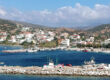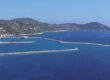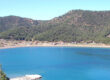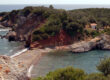


Vasilika beach (Psaropouli)
Ancient Times: The Shadow of Artemisium (ca. 480 BC)
The earliest historical reference to the wider area emerges from the naval battle of Artemisium, fought in 480 BC between the allied Greek fleet and the invading Persians. Although the exact anchorages are still debated, long-standing local tradition places the Persian fleet in the gulf of today’s Vasilika, while the Greek ships gathered in the neighbouring bay of Ellinika. From this interpretation derives the popular explanation for the toponyms: “Vasilika” from basilikos (“royal”), referring to the king’s or “royal” ships; and “Ellinika” from the Greek camp.
Hellenistic and Roman Eras: A Quiet Rural Hinterland
During the Hellenistic and Roman periods, the area remained a productive agricultural zone, supplying grain, olives, and timber to the coastal towns of northern Evvoia. The sea continued to play a role, but Psaropouli had not yet emerged as a harbour—its shoreline served mainly as a landing point for fishermen and coastal transport.
Roman-era finds in the wider region—farmsteads, rural pottery, and occasional small shrines—indicate a landscape shaped by small estates rather than urban centres. The main axes of life lay inland, where villages clustered around springs and fertile meadows. Vasilika’s site, close to water sources and protected from Aegean winds, fits this pattern well.
Byzantine Vasilika (AD 4th–12th centuries)
With the gradual Christianisation of Evvoia in the Early Byzantine period, the region saw the establishment of monastic estates and agricultural holdings tied to larger centres such as Chalkida and the monasteries of central Greece.
The strategic position of the coastline, however, also brought risk: from the 7th to the 10th centuries, the Aegean was exposed to raids by Slavs, Saracens, and later by pirates using the Northern Sporades as bases. These conditions pushed populations inland, reinforcing the pattern where Vasilika grew as an inland settlement and the coast remained sparsely used except by local fishermen.
It is likely that during this era the first fortified structures appeared on the low hills between the village and the sea—simple lookout posts controlling movement along the channel.
Late Byzantine & Medieval Turmoil: The Tower of Vasilika (13th–16th centuries)
After the Fourth Crusade (1204), northern Evvoia passed through Byzantine, Venetian, and Latin hands before falling gradually under Ottoman control. This was a period of instability, piracy, and conflict between competing powers for control of the Aegean routes.
From this era survives the region’s most important historical monument: the Tower of Vasilika. Standing on a modest hill with a commanding view toward Psaropouli, the tower was part of a network of coastal watchposts used to signal danger, protect agricultural estates, and monitor shipping lanes. Its exact origin is debated—most scholars place it in the late Byzantine or early Venetian period, while others consider an early Ottoman date—but in all scenarios it reflects a community living at the crossroads of empires, where defence and surveillance were essential.
Ottoman Period (15th–19th centuries): Rural Life
Under Ottoman rule, the area formed part of a timar (landholding) supporting agricultural production. Vasilika grew slowly as a farming village, tending vines, wheat, olives, and livestock. The mountains around it offered chestnut forests and grazing land.
The coast of Psaropouli—though not yet a formal “harbour”—was increasingly used by fishermen and small caiques carrying goods to and from the Sporades. Oral tradition preserves stories of families who spent the summers by the sea in seasonal huts, building an early pattern of transhumant coastal life.
Pirate activity, especially during the 17th–18th centuries, kept permanent coastal settlement limited. The tower’s presence remained essential until the very late Ottoman period, watching over a coastline that was beautiful but never entirely safe.
Revolution and 19th Century
During the Greek War of Independence (1821), northern Evvoia saw skirmishes, supply movements, and naval activity, with the nearby gulf of Oreoi and the straits of the North Evvoian Sea serving as corridors for Greek ships. Although Vasilika was not the site of major battles, the region’s rugged geography sheltered fighters, messengers, and local families moving between villages to avoid reprisals.
The Birth of Psaropouli as a Seaside Haven
The 20th century brought profound shifts. Improvements in roads and small-scale infrastructure allowed families to build permanent houses along the shore. Fishing became more organised, and Psaropouli gradually transformed from a working coast to a place of summer baths, small tavernas, and seaside life. Throughout the post-war decades, the area kept its character as a quiet, local, family beach, never adopting the intense tourism seen elsewhere in Evvoia.
Today, Vasilika remains a traditional inland village with stone houses, narrow lanes, and a strong agricultural identity, while Psaropouli serves as its open, breezy window to the Aegean: a long beach, a modest harbour for fishing boats, and a line of tavernas looking over the straits toward the Sporades.
Why Visit
- The Tower of Vasilika – atmospheric medieval watchtower with sea views.
- Psaropouli Beach – long sandy shore, ideal for relaxed swimming and family-friendly tavernas.
- Coastal Walks – scenic paths between Vasilika, Psaropouli, and neighbouring coves.
- Monastery of Osios David – one of the most important monastic sites of North Evvoia (short drive). Founded in the 16th century by the ascetic David of Evvoia, it became a refuge of learning and faith during Ottoman times and later a centre of resistance and relief during the 1821 Revolution. Its peaceful courtyards, frescoed katholikon, and views over chestnut-clad hills create an atmosphere of profound tranquillity, while the nearby cave of the saint adds a touch of mystical isolation that reflects the monastery’s enduring role as a place of prayer and retreat.
- Natura Landscapes – chestnut forests, springs, and hiking routes in the inland hills.
- Nearby Ellinika – probably the best beach of Evvoia, with nice taverns.
- Local Flavours – fresh fish in Psaropouli and traditional mountain honey, herbs, and chestnuts from Vasilika.