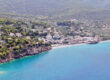


Loutraki, from NW
At the point where the Corinthian Gulf opens wide to the west and the Isthmus begins to narrow the land toward the Peloponnese, lies Loutraki — a place where water, earth, and myth have intertwined since antiquity. Today known for its thermal springs and resort life, Loutraki’s history runs deep beneath its baths, stretching back to the time when gods were believed to walk among men.
Ancient Times – The Waters of the Nymphs
The first settlers appeared here in prehistoric times, drawn to the fertile coastal plain and the abundant fresh and thermal waters that gushed from the foothills of Mount Geraneia. Archaeological finds near the modern town and the nearby site of Heraion at Perachora indicate that the area was inhabited continuously since the Bronze Age.
In classical antiquity, Loutraki was known as Thermae (Θέρμαι) — a name derived from its hot springs. The ancient Greeks considered these waters sacred to Asclepius, god of healing, and to the Nymphs, who were believed to inhabit the fountains and grottoes. Pilgrims came to bathe and offer sacrifices for health and fertility. The nearby sanctuary of Hera Akraia at Perachora — one of the most beautiful and atmospheric in Greece — was part of the same sacred landscape, combining sea, cliffs, and freshwater sources in a symbolic unity of purification and renewal.
Roman Period – From Sacred Baths to Imperial Leisure
The Romans, with their passion for bathing, made full use of the site’s natural resources. During the 1st and 2nd centuries AD, elaborate thermae complexes were constructed, with vaulted rooms, marble pools, and mosaics. Loutraki’s waters were exported as a curative product throughout the region, while Corinth, rebuilt as a Roman colony after its destruction by Mummius in 146 BC, became the main administrative and commercial center.
The town’s location, so near to the Isthmus and the Diolkos (the paved way on which ships were hauled across the land), meant that travelers, merchants, and soldiers frequently stopped here. Loutraki thus functioned both as a health retreat and as a resting point at the gateway between two seas.
Byzantine and Medieval Eras – Silence and Survival
After the decline of the Roman Empire, the baths of Thermae fell into ruin. Earthquakes and invasions scarred the region, and by the early Byzantine period, only small communities remained at the foot of Geraneia. Yet the reputation of the healing waters never entirely disappeared. Monks and hermits of the Geraneia monasteries are known to have used the springs, regarding them as divine gifts for both body and soul.
During the medieval centuries, the area formed part of the Byzantine Thema of the Peloponnese, later passing under Frankish, Venetian, and Ottoman control. The nearby fortress of Acrocorinth dominated the region, while the village of Loutraki survived quietly under the shadow of empire after empire. Travelers of the 17th and 18th centuries mention “the warm springs by Corinth,” still used by locals though without the grandeur of antiquity.
Modern Era – From a Spa to a City
The rebirth of Loutraki began after the Greek War of Independence (1821–1829). The new Greek state, eager to rediscover its ancient roots and develop health tourism, encouraged the scientific study of the thermal waters. In 1847, the chemist Ktenas analyzed their composition, confirming their therapeutic qualities. Soon after, the first bathing facilities were constructed, and the town took the name Loutraki — literally “the place of baths.”
By the late 19th century, Loutraki had become one of the premier spa towns of Greece. Elegant hotels, promenades, and thermal establishments attracted visitors from Athens and abroad. The grand Hydrotherapy Center, built in neoclassical style, symbolized this golden age of wellness. The arrival of the railway from Corinth further boosted tourism, making Loutraki a fashionable destination for the bourgeoisie and artists of the interwar years.
20th Century – Earthquake and Rebirth
A devastating earthquake in 1928 destroyed much of the old town. Yet Loutraki rose again almost immediately, rebuilt with modern urban planning and renewed optimism. New spa facilities were opened, and the town’s reputation as a place of rest and cure continued through the mid-20th century. The Casino Loutraki, one of the most famous in southern Europe, added an element of glamour that still defines its modern identity.
Today – Between Mountains and Sea
Modern Loutraki stretches gracefully along its pebble beach, backed by the pine-clad slopes of Mount Geraneia. The town remains proud of its dual nature — both seaside resort and mountain gateway. From here, visitors can explore the Heraion Lagoon at Perachora, the lighthouse of Melagavi, and the archaeological sites of ancient Corinth and the Isthmus. But above all, they come for the waters — mineral, transparent, and eternal — whose source has never ceased to flow since antiquity.
Sights
Loutraki and its Thermal Springs
Loutraki has been famous since antiquity for its thermal mineral waters, which were already considered therapeutic in ancient Greek times. Today the town hosts modern spa and hydrotherapy facilities, continuing a wellness tradition that spans more than two thousand years.
Loutraki Seafront Promenade
The long pebble beach and clear waters of the Corinthian Gulf form the heart of the town. The waterfront boulevard is lined with cafés and taverns, creating a lively seaside promenade ideal for an evening walk by the sea.
Monastery of Saint Patapios
Perched high on the slopes of the Geraneia Mountains, the monastery of Saint Patapios is one of the most important pilgrimage sites in the region. From its terrace visitors enjoy spectacular views over the Corinthian Gulf and the Corinthian plain.
Heraion of Perachora
At the far end of the Perachora peninsula lies the ancient Sanctuary of Hera, one of the most significant shrines dedicated to the goddess in Greece. The ruins of the temple stand beside the sea, close to Lake Vouliagmeni, creating a remarkable blend of history and landscape.
Lake Vouliagmeni (Perachora Lagoon)
This beautiful lagoon communicates with the sea through a narrow channel and is surrounded by low hills. The calm waters and nearby taverns make it a favourite destination for swimming, relaxation, and seaside dining.
Melagavi Lighthouse
Standing on the rocky edge of the Perachora peninsula, Melagavi Lighthouse marks the entrance to the Corinthian Gulf. The surrounding cliffs offer wide views across the gulf and are particularly famous for their sunsets.
Flavours
Fresh Fish and Seafood of the Corinthian Gulf
Taverns in Loutraki and nearby Perachora are known for fresh fish, prawns, and calamari brought in from the Corinthian Gulf. Expect simple, honest cooking—charcoal-grilled or lightly fried—finished with olive oil and lemon.
Classic Corinthia Taverna Cooking
Alongside seafood, most menus include familiar Greek favourites such as slow-roasted lamb, stovetop stews, stuffed vegetables, and homemade pies. The best places lean on seasonal produce and good local olive oil rather than complicated sauces.
Nemea Wines
A short drive inland brings you to Nemea, one of Greece’s most important wine regions. Reds made from Agiorgitiko are a natural match for grilled meats and rich casseroles, and they appear on many local wine lists.
Corinthian Currants
The region is famous for its small black currants (Corinthian raisins), historically one of Greece’s great export products. You’ll meet them in breads, cakes, and traditional sweet bites served at the end of a meal.
Meze for Ouzo or Tsipouro
For a relaxed seaside table, order a spread of meze: grilled octopus, marinated anchovies, fried small fish, and seasonal salads. It’s the classic way to eat by the sea—shared plates, a chilled glass, and an unhurried evening.