

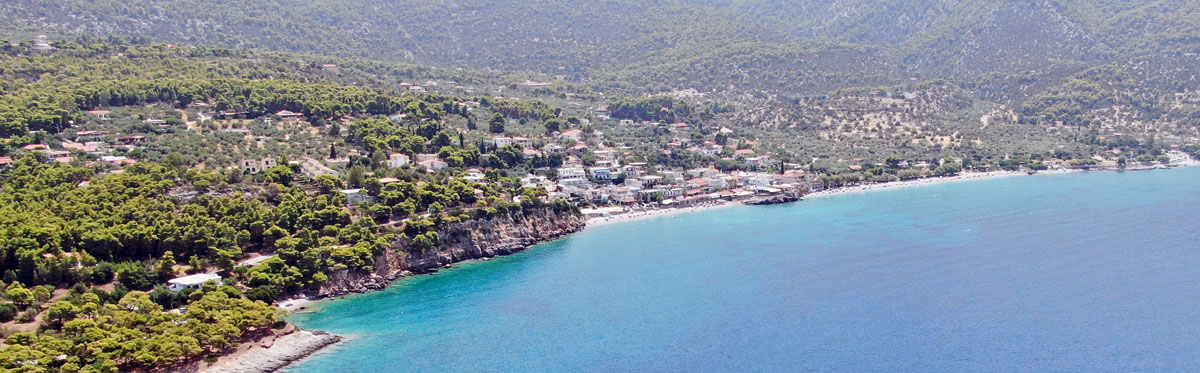
Porto Germeno, from NW
At the western edge of Attica, where the mountains of Kithairon and Pateras descend sharply to the blue waters of the Corinthian Gulf, lies Porto Germeno — a tranquil seaside village whose serene atmosphere conceals one of the most impressive ancient fortresses in Greece. In antiquity, this was Aigosthena , a small but strategically vital city of Megaris, guarding the frontier between Attica and Boeotia. Today, visitors come for its crystal-clear waters and mountain backdrop, but the stones of its ancient walls still whisper tales of centuries of vigilance and glory.
The Ancient Citadel of Aigosthena
Aigosthena was founded as a fortified outpost of the Megarid, serving both military and religious purposes. It stood as the northwesternmost point of Megara, overlooking the narrow passes that connected the Corinthian Gulf to the inland routes of Boeotia. The site’s most striking monument is the ancient fortress of Aigosthena, one of the best-preserved fortifications of the Classical period in all Greece. Dating to the 4th century BC, its massive stone walls, towers, and gates still stand tall — especially the northwestern tower, which rises to its full ancient height.
Within the citadel stood a sanctuary dedicated to Heracles, the hero revered as the protector of the region. Inscriptions found on-site confirm the importance of the cult, and Aigosthena was even a member of the Amphictyony of Anthela, a league centered around the worship of the hero. The position of the fortress allowed communication by fire or signal with other strongholds across the Gulf, part of a defensive network that protected the Megarian borders.
Hellenistic and Roman Eras
During the Hellenistic period, Aigosthena maintained its strategic importance. The Megarians, often caught between the expanding powers of Athens and Thebes, relied on the fortress to defend their autonomy. In the 3rd and 2nd centuries BC, the walls were repaired and strengthened, evidence that the site continued to be actively used by military garrisons.
With the arrival of the Romans in Greece (after 146 BC), Aigosthena gradually lost its military function. The nearby trade routes shifted, and the coastal settlements along the Corinthian Gulf began to prosper more as fishing and maritime centers rather than fortresses. Still, the small port likely remained inhabited, serving as a stop for ships crossing the Gulf from Corinth to Antikyra and beyond.
Byzantine and Medieval Continuity
In Byzantine times, Aigosthena (now referred to as Porto Germeno) was transformed into a small coastal village. The fortress, although partly ruined, continued to offer shelter to the local population during raids. Archaeological traces show that the site was reoccupied — small chapels, pottery shards, and defensive modifications point to continuous habitation into the Middle Byzantine period (10th–12th centuries).
The area’s modern name, Porto Germeno, likely emerged during the Frankish and Venetian periods of the Middle Ages. Some scholars connect it to the Latin “Portus Germanorum”, perhaps meaning “Port of the Germans” — possibly referencing medieval mercenaries or pilgrims. The port’s strategic location ensured its survival through centuries of shifting rule, including brief control by Catalans and Venetians who valued its sheltered anchorage.
Ottoman and Modern Times
During the Ottoman period, Porto Germeno was a remote hamlet, occasionally used by fishermen and shepherds from nearby villages. In the early 19th century, during the Greek War of Independence, its fortress again served briefly as a defensive refuge for local fighters. Yet, it never became a center of military activity, and the area remained largely isolated until the 20th century.
The modern village of Porto Germeno developed gradually after World War II, when Athenians discovered its beauty and built summer homes by the shore. Today, the peaceful bay, framed by pine-covered slopes and crowned by the ancient citadel, forms a rare union of landscape and history. Visitors can still walk through the ancient gates, climb the tower walls, and imagine the watchmen who once kept vigil over the waters of the Gulf.
Legacy
Porto Germeno remains a living link between ancient Megara and modern Greece — a place where the mountains meet the sea and where time itself seems to stand still. Few sites in Greece allow such a direct encounter with Classical architecture in its natural setting. The fortress of Aigosthena, rising silently above the calm waters, still fulfills its ancient role — guarding, not against invaders, but against forgetting.
Sights
Ancient Fortress of Aigosthena
At the northern edge of the bay stand the impressive walls of the ancient fortress of Aigosthena, a fortified city guarding the western frontier of ancient Megaris. Its well-preserved circular tower is one of the finest surviving examples of ancient military architecture in Greece.
Porto Germeno Beach
The long pebble beach stretches along the sheltered bay and is known for the clear waters of the Corinthian Gulf. Surrounded by mountains and pine-covered slopes, it offers a peaceful setting for swimming and relaxation.
Coves and Coastline of the Bay
Several smaller coves and quiet beaches lie around the bay, providing more secluded bathing spots. The scenery combines rocky shores, pine forests, and distant views of the Peloponnese across the gulf.
Mount Kithairon
Rising behind the bay is Mount Kithairon, a mountain famous in Greek mythology and ancient history. The surrounding landscape offers opportunities for hiking and exploration, with wide views over the Corinthian Gulf and Boeotia.
Small Byzantine Chapels
Scattered across the wider area are small chapels and rural churches, many of Byzantine or post-Byzantine origin. These simple buildings add a quiet historical dimension to the coastal landscape.
Flavours
Fresh Fish from the Corinthian Gulf
Taverns in Porto Germeno are known for fresh fish and seafood brought directly from the waters of the Corinthian Gulf. Sea bream, sea bass, calamari, and small fried fish are commonly grilled over charcoal.
Seafood Meze
Seaside tables often feature meze such as grilled octopus, marinated anchovies, fried prawns, and fresh seasonal salads. These dishes are traditionally enjoyed with a glass of ouzo or tsipouro.
Traditional Central Greek Cuisine
Beyond seafood, many taverns serve regional dishes including roast lamb, slow-cooked meat stews, and homemade pies. The cooking reflects the rustic traditions of mainland Greece.
Local Honey and Sweets
The nearby slopes of Mount Kithairon are known for producing aromatic mountain honey. It often appears in desserts, syrup sweets, or served simply with yoghurt at the end of a meal.