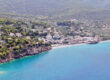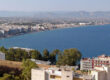


Corinth, from ENE
Ancient Corinth — The City Between Two Seas
Long before Athens rose to glory, Corinth had already mastered the arts of trade, craftsmanship, and diplomacy. Nestled between the Saronic and Corinthian Gulfs, it occupied the most strategic position in Greece — the narrow Isthmus that linked the Peloponnese with the mainland. Its harbor towns, Lechaion on the Corinthian Gulf and Kenchreai on the Saronic, opened the city to the entire Mediterranean.
Corinth’s prosperity came from both land and sea. Merchants carried goods across the isthmus using the Diolkos, a paved way where ships were dragged on wooden rollers — a feat of ancient engineering that spared sailors the dangerous circumnavigation of the Peloponnese.
Under the rule of the Cypselid dynasty in the 7th century BC, Corinth flourished. Periander, one of the Seven Sages of Greece, made it a center of culture and power. The Temple of Apollo, still standing in part today, symbolized its grandeur. Corinthian artisans created fine pottery and bronze, and the city’s name gave birth to the elegant Corinthian column, the most ornate of the classical orders.
Corinth’s colonies, such as Corcyra (Corfu) and Syracuse, spread its influence across the seas. But its wealth also bred rivals. During the Peloponnesian War in the 5th century BC, Corinth joined Sparta against Athens, shaping the fate of Greek politics for decades.
Towering above the city, the Acrocorinth — a massive rocky fortress — guarded its people and treasures. It would remain a citadel of power for every empire that followed.
Roman and Early Christian Corinth — From Ruin to Renewal
In 146 BC, Corinth’s proud history met its first great tragedy. The Roman general Lucius Mummius destroyed the city after a fierce siege, killing or enslaving its people. For a century, the once-vibrant metropolis lay silent among its ruins.
But Rome would not forget Corinth’s value. In 44 BC, Julius Caesar refounded it as Colonia Laus Iulia Corinthiensis, populating it with freedmen and veterans. The new Corinth rose swiftly, adorned with marble temples, theatres, and fountains — a blend of Greek artistry and Roman grandeur.
The apostle Paul visited the city around AD 50, preaching Christianity and founding one of the earliest Christian communities in Greece. His Letters to the Corinthians would become among the most influential texts of the New Testament, shaping Christian ethics and theology for centuries.
By late antiquity, Corinth was again a bustling port and a center of faith, trade, and learning — a city reborn from its ashes.
Byzantine, Frankish, and Ottoman Eras — A Fortress of Empires
During the Byzantine centuries, Corinth remained a significant provincial capital, known for its silk and artistic crafts. The mighty Acrocorinth was continually strengthened and became one of the most formidable fortresses of the empire.
In the 13th century, after the Fourth Crusade, Corinth fell under Frankish rule, then passed through the hands of Venetians and Ottomans in a succession of sieges. Each left its mark on the city’s walls, towers, and churches.
By the 18th century, Corinth had become a small Ottoman town surrounded by ruins — but still alive, a witness to the layered history of Greece.
Modern Corinth — Between Ruins and the Sea
The Greek War of Independence in the 1820s brought new hope. The ancient city lay mostly in ruins, but its location once again made it vital. The modern town of New Corinth was founded near the coast in 1858, after a devastating earthquake destroyed the old settlement.
The Corinth Canal, completed in 1893, finally fulfilled an ancient dream — to cut through the Isthmus and join the Aegean with the Ionian Sea. Though narrow for modern shipping, it remains a marvel of engineering and a symbol of the city’s eternal link between two worlds.
Today, Corinth combines its layered history with modern life — a lively port, a regional hub, and the gateway to the Peloponnese, where the echoes of Apollo, Periander, and Saint Paul still linger in the wind.
Sights
Ancient Corinth
One of the most important archaeological sites in Greece, preserving the remains of a city that once dominated Mediterranean trade. Visitors can walk among the ruins of the Temple of Apollo, the Roman agora, and early Christian basilicas, while the nearby museum displays finds spanning several millennia.
Acrocorinth
The imposing rock rising above the Corinthian plain hosts one of the largest and most impressive fortresses in Greece. Its massive walls reveal layers of Greek, Byzantine, Frankish, Venetian, and Ottoman history, and the summit offers sweeping views over both the Corinthian and Saronic Gulfs.
Corinth Canal
Completed in the late nineteenth century, this remarkable engineering work cuts through the narrow Isthmus connecting the Peloponnese with mainland Greece. Watching vessels pass between the steep limestone walls of the canal is a memorable experience.
Isthmia and the Sanctuary of Poseidon
A short distance east of Corinth lies the archaeological site of Isthmia, where the famous Isthmian Games were held in honour of Poseidon. The remains of the temple, stadium, and theatre recall the importance of this sanctuary in the religious and athletic life of ancient Greece.
Archaeological Museum of Corinth
Located beside the site of Ancient Corinth, the museum houses an outstanding collection of artefacts from the prehistoric to the Roman periods. Mosaics, sculptures, inscriptions, and everyday objects illustrate the wealth and influence of the ancient city.
Corinth Waterfront and Harbour
The modern city of Corinth features a pleasant seaside promenade overlooking the Corinthian Gulf. Cafés, taverns, and small squares create a lively setting where locals and visitors gather to enjoy the sea and the sunset.
Flavours
Fresh Fish of the Corinthian Gulf
Taverns along the coast serve fresh fish, calamari, and small fried fish caught in the waters of the Corinthian Gulf. Simple preparations with olive oil, lemon, and oregano highlight the natural flavours of the catch.
Corinthian Black Raisins
The famous Corinthian currants have been one of Greece’s most important agricultural exports for centuries. These small black raisins appear in desserts, breads, and traditional recipes throughout the region.
Nemea Wines
Nearby Nemea is one of Greece’s leading wine regions. Its robust red wines made from the Agiorgitiko grape pair perfectly with grilled meats and rich Mediterranean dishes.
Traditional Peloponnesian Cuisine
Local taverns offer classic dishes such as moussaka, slow-cooked lamb with herbs, stews, and homemade pies. Most recipes rely on excellent local olive oil and fresh seasonal produce.
Local Sweets and Pastries
Pastry shops in the area prepare sweets based on honey, almonds, and raisins. Syrup-soaked desserts, walnut cakes, and spoon sweets often provide the traditional ending to a meal in Corinth.