

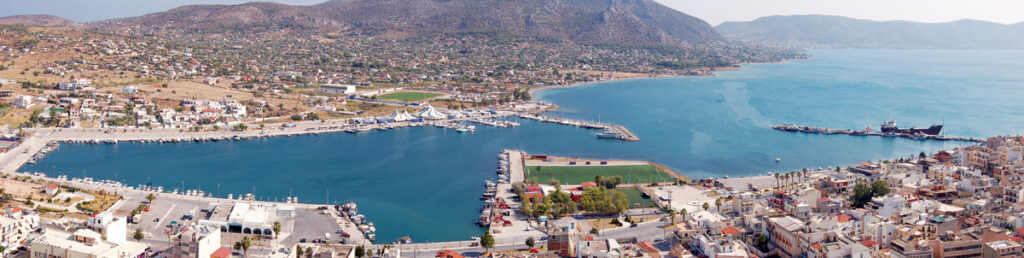
The island of Salamina, the largest island in the Saronic Gulf, has been a place of considerable historical importance since antiquity. According to the geographer Strabo, the ancient city of Salamis during Homeric times was located near the area known today as Kolones, where the ruins of the ancient harbour and a tower can still be seen. This site is believed to have been the seat of the legendary king Telamon, father of Ajax, one of the great heroes of the Trojan War.
Tradition holds that the island took its name from Salamis, daughter of the river god Asopus and sister of Aegina. After the reign of Asopus and his descendants, the island was occupied by settlers from Aegina led by Telamon. His sons, Ajax and Teucer, took part in the Trojan War with twelve ships. After the war, Teucer was exiled and sailed to Cyprus, where he founded the magnificent city of Salamis of Cyprus.
During the Classical period the city of Salamis moved to the area of modern Selinia, where remains of the ancient harbour and monuments dedicated to the fighters of Salamis still survive. In later centuries the fate of the island became closely linked with Athens, to which it had already been attached in the archaic period. After the conflict between Athens and Macedonia, however, the Athenians accused the inhabitants of Salamis of betrayal and abandoned the island. Historical references to the island are scarce in the following centuries, although the ancient city is known to have been completely destroyed around AD 170.
The modern town of Salamina began to develop during the Byzantine period, when a settlement was established to host populations moving to the island. Over time it grew into an important harbour and trading centre of the Saronic Gulf, maintaining close ties with Athens and Piraeus.
The Battle of Salamis
The Battle of Salamis, fought on 22 September 480 BC, is widely regarded as one of the most decisive naval battles in history. The Persian fleet of King Xerxes, numbering about 1,200 ships, faced the Greek fleet of 380 ships, commanded nominally by the Spartan Eurybiades but strategically directed by the Athenian Themistocles.
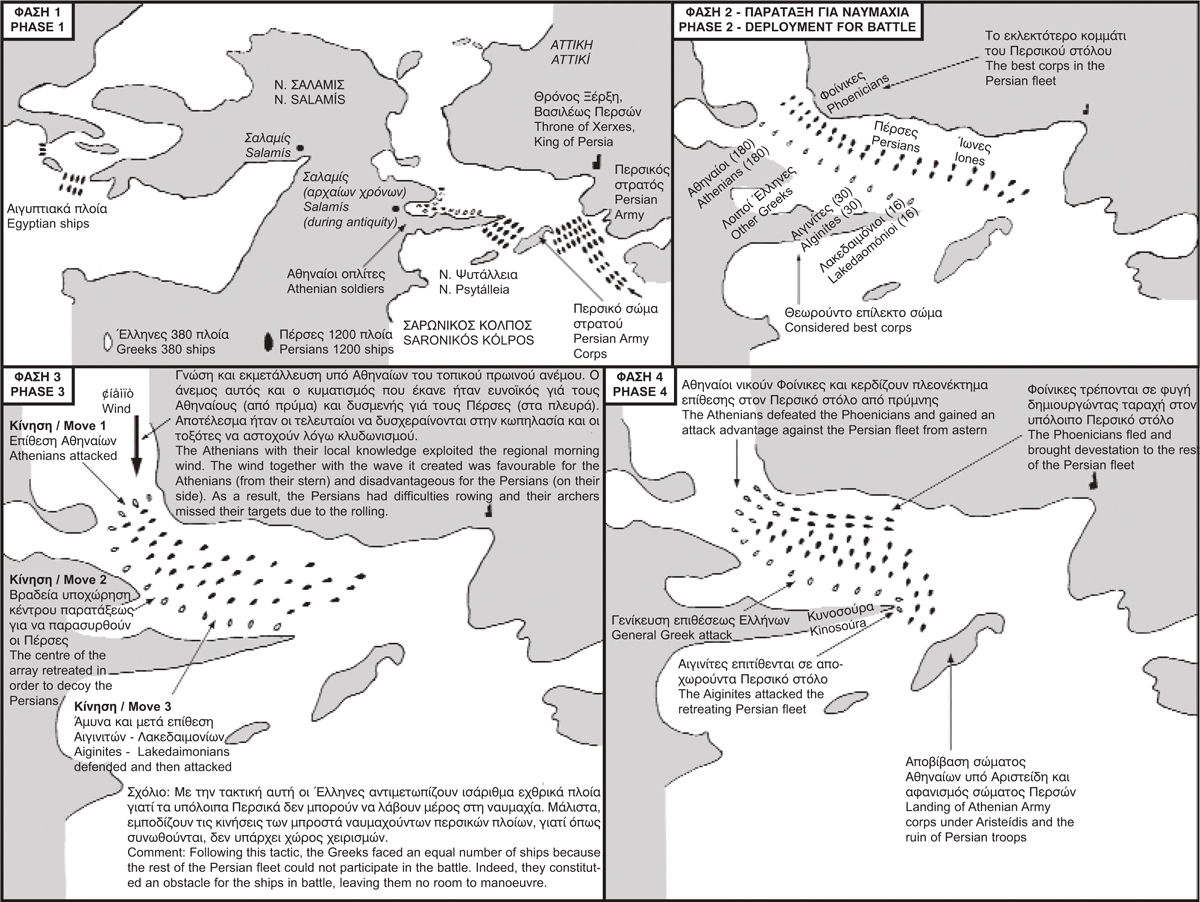
The Persians had already captured Athens, and the city’s population had been evacuated to Salamina. During the war councils the Peloponnesian commanders wished to fight near the Isthmus of Corinth, but Themistocles insisted on the strategic advantages of the narrow straits of Salamis, where the larger Persian fleet would be unable to manoeuvre effectively.
Using a clever stratagem, Themistocles secretly sent a message to Xerxes claiming that the Greeks planned to withdraw. The Persian fleet moved quickly to block their escape, forcing the two fleets into battle within the narrow straits. The tragic poet Aeschylus, who took part in the battle, recounts that the Greeks boarded their ships singing the paean:
“Sons of the Greeks, go forth and free your fatherland…”
The battle ended in a decisive Greek victory. The Persian fleet suffered heavy losses and its morale collapsed. The victory at Salamis proved to be the turning point of the Persian Wars, ultimately securing the independence of the Greek world and allowing the flourishing of classical Greek civilisation.
Sights
Kolones Archaeological Site
Here lie the remains of the ancient city and harbour of Salamis. The striking columns that gave the area its name recall the significance of the site in antiquity.
Tumulus of the Salamis Fighters
This memorial honours the Greeks who fell in the Battle of Salamis. Located near Selinia, it stands as a place of remembrance for one of the defining moments of ancient history.
Selinia
This coastal area preserves remains of the ancient harbour. From here one can gaze across the strait where the fleets of Greece and Persia once clashed.
Holy Monastery of Faneromeni
One of the most important religious monuments of Salamina, the monastery was founded in the 17th century AD at the site where, according to tradition, an icon of the Virgin Mary was discovered from an earlier Christian temple. The monastery preserves old manuscripts and sacred relics, and during the Greek War of Independence in 1821 it served as a refuge for civilians and as a hospital for wounded fighters. Just below the monastery, at sea level, stands the two-storey house of the great Greek poet Angelos Sikelianos.
Byzantine Chapels of the Island
Visitors may also explore the small Byzantine chapels of Agios Ioannis Kalivitis, near the Monastery of Agios Nikolaos, and Agios Grigorios just outside Salamina town. These churches date from around the 8th century AD and represent characteristic examples of early Byzantine ecclesiastical architecture.
Folklore Museum of Salamina
The Folklore Museum displays an interesting collection illustrating the island’s cultural heritage, with particular emphasis on traditional Salaminian costumes and their elaborate ornaments. The exhibits provide a vivid insight into the island’s traditional way of life.
Flavours
Fresh Fish of the Saronic Gulf
The tavernas of Salamina are renowned for their fresh fish and seafood, delivered daily by the island’s fishing boats.
Grilled Prawns and Calamari
Simple but delicious dishes, best enjoyed beside the sea with views across the strait of Salamis.
Local Wine and Meze
Small plates of traditional Greek meze are usually accompanied by wine from Attica or a glass of ouzo, creating the relaxed atmosphere of a true seaside meal.
The Fisherman’s Festival
During the full moon of August, Salamina hosts the popular Fisherman’s Festival, where visitors can dance, enjoy freshly cooked fish, and drink wine in a lively seaside celebration.