

Southern Salamina is the quieter and less populated side of the island, where the coastline forms a series of small coves, rocky headlands and natural anchorages. Since antiquity the area has held particular maritime importance because it overlooks the Strait of Salamis, the passage separating the island from Attica and leading toward Piraeus and the inner Saronic Gulf.
According to mythology, the island was named after Salamis, daughter of the river god Asopus, while archaeological evidence shows that the southern part of the island was already inhabited during the Neolithic period (4th millennium BC). The region reached its greatest prosperity during the Mycenaean era.
In the area of Kanakia, archaeologists discovered a significant Mycenaean acropolis with a palace complex and remains of an extensive settlement. So far about 45 rooms and auxiliary spaces have been uncovered, indicating the presence of an important administrative centre during the 13th century BC. The acropolis appears to have been abandoned shortly after 1200 BC, probably during the wider collapse of the Mycenaean world.
On the western side of southern Salamina lie the Peristeria, two small islets close to the coast that gave the area its name. About one kilometre inland stands the small settlement of the same name. The area is particularly known for the Cave of Euripides, a natural refuge associated with the great tragic poet, whose name was discovered inscribed inside the cave.
The cave was used over many centuries as a place of shelter or habitation, as archaeological finds date from the Neolithic, Mycenaean, Classical and Roman periods, as well as the era of the Frankish rule. Beneath the cave archaeologists also discovered a cult complex dating from the 3rd–2nd century BC, believed to have been dedicated to the god Dionysus.
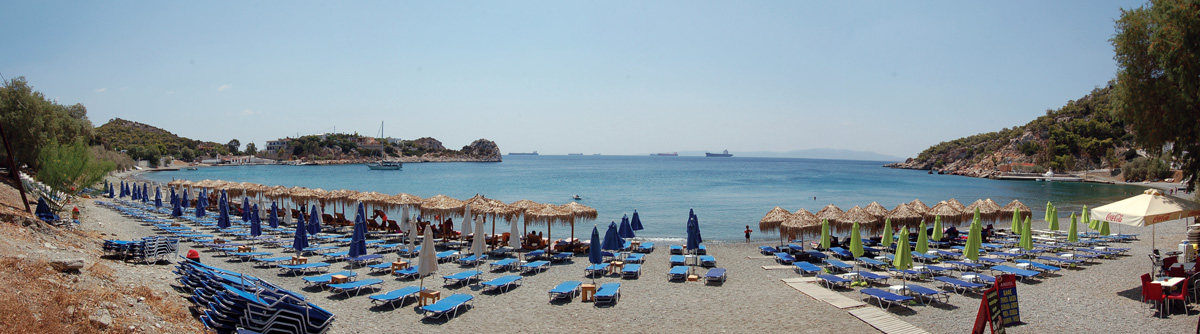
Today southern Salamina retains a quiet and natural character, with small settlements, fishing boats and peaceful beaches that attract visitors and sailors seeking the island’s more authentic side.
Sights
Kanakia
A small and remote settlement with a long sandy beach and clear waters surrounded by beautiful natural scenery. Nearby lies the important Mycenaean acropolis of Kanakia, one of the most significant archaeological discoveries on the island.
Peristeria
Two small islets close to the coast that gave the area its name. The settlement of Peristeria lies about one kilometre inland, surrounded by a tranquil natural landscape.
Cave of Euripides
In the area of Peristeria lies the cave traditionally associated with the great tragic poet Euripides, who is believed to have retreated here to write his tragedies. In 1997 a goblet inscribed with the name “EVRIPPIDIS” was discovered inside the cave, strengthening its connection with the poet. Archaeological excavations have also revealed significant findings dating back to the Neolithic period.
Southern Coastal Coves
The southern coastline forms several natural anchorages and quiet bays, popular with sailing yachts and small pleasure boats. In addition, the western and southern coasts of the island are covered with extensive pine forests, creating a landscape of remarkable natural beauty. Despite being so close to Athens, this part of Salamina preserves the peaceful atmosphere of a traditional island with quiet beaches and clear waters.
Flavours
Fresh Fish of the Saronic Gulf
Small seaside tavernas serve fish delivered daily by local fishing boats.
Grilled Octopus and Squid
Classic flavours of the Greek sea, simply prepared over charcoal with olive oil and lemon.
Traditional Seafood Meze
Shrimps, mussels and other seafood dishes are typically enjoyed with ouzo or local wine at a relaxed seaside table.