


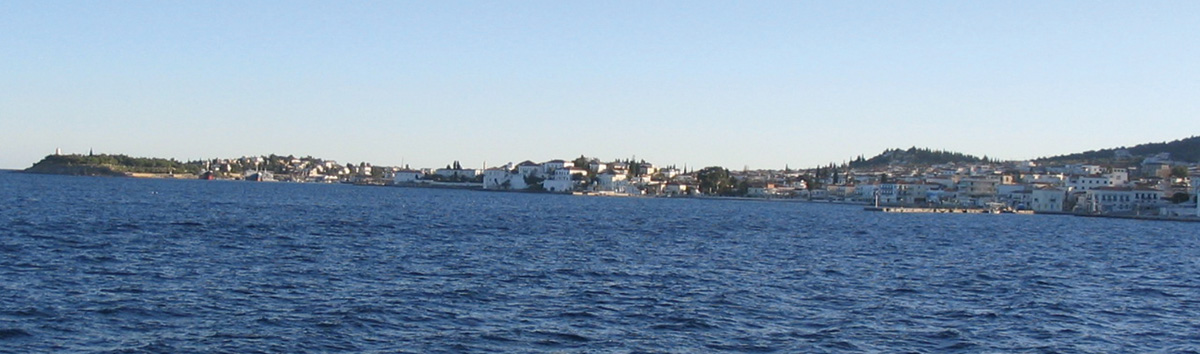
Spétses harbour (Dapia)
The island of Spétses was not always an island. Until about 8000 BC, at the end of the last Ice Age, sea levels were significantly lower than today and Spétses was connected to the Peloponnese by a narrow strip of land. In fact, many islands of the Argolic Gulf were either joined to the mainland or formed mountain peaks rising from the sea. Fossils of mussels and other shellfish have been discovered in the surrounding hills up to 300 metres above sea level, evidence that these lands once lay beneath the sea.
Ancient geographers Strabo (1st century BC) and Pausanias (2nd century AD) referred to the island as Pityousa, meaning “the island of pines”. The name reflects the island’s dense pine forests, which still dominate its landscape today. Over the centuries the name evolved. In medieval times the island was known as Petsa, the Venetians called it Spétsa, and after the Greek War of Independence in 1821 the name was Hellenised to Spétsai. The modern form Spétses eventually prevailed.
Human presence on the island dates back to the Bronze Age (around 2300 BC). Excavations have uncovered Mycenaean settlements near water sources, particularly at Agía Marina and Ágioi Anárgyroi. At that time Spétses already possessed a notable fleet and active maritime trade with nearby coastal cities. Its main natural harbours were Agía Marina, Agía Paraskeví and Zogeriá.
During the Roman period (2nd–3rd century AD) the Peloponnese suffered repeated barbarian raids, yet Spétses seems to have initially escaped major destruction thanks to its insular position. By the 4th century AD it was mentioned as one of the three most important cities of Argolis, together with Argos and Hermioni. This prosperity was short-lived. The Vandals (464 AD) and later Slavic incursions (587 and 623 AD) eventually reached the island. By the 8th century Spétses was almost entirely depopulated.
In the 13th century, following a major Venetian naval victory over Byzantine–Genoese forces near the islet of Spetsopoúla, the island came under Venetian rule. Spetsopoúla itself was known in antiquity as Aristerá, meaning “the left island”, probably because it lies to the left of Spétses when approached from the Peloponnese. Over the following centuries the island changed hands repeatedly between Turks, Catalans, Franks and Venetians, while the population gradually concentrated on the fortified hill of Kastélli for protection against piracy.
A new era began in 1714, when the Ottomans captured Náfplio from the Venetians. Many Christian Albanians (Arvanites) who had defended the city settled on Spétses. Fearing a Venetian return, the Ottomans granted the island significant privileges and autonomy, which allowed the local population to develop a powerful merchant fleet and maritime economy.
Despite these privileges, the desire for freedom remained strong. In 1770, Spétses joined the uprising known as the Orlov Revolt. When the Russians abandoned the Greeks and made peace with the Ottomans, the retaliation was severe. The harbour and the fortified settlement of Kastelli were destroyed, and many islanders fled to Kythera. The nearby island of Hydra, which had refused to participate in the revolt, was blamed by many Spetsiots for its failure — marking the beginning of the famous rivalry between the two islands.
When the Greek War of Independence began in 1821, Spétses was among the first to raise the revolutionary flag. Its fleet played a decisive role in early operations, including the sieges of Náfplio, Monemvasia and Tripolitsá. The experienced Spetsian captains and sailors became an essential force of the revolutionary navy.
Laskarina Bouboulina — The Heroine of Spétses
Among them stands the towering figure of Laskarina Bouboulina, the Spetsian sea captain and the only woman ever honoured with the rank of Admiral in Greek history, a title granted to her after her death.
Her life began under dramatic circumstances. She was born inside the prisons of Constantinople, where her mother had gone to visit her imprisoned father, who had been arrested for participating in the Orlov revolt. She married twice, was widowed twice, had seven children, and used the fortunes she inherited to build ships and prepare crews — as if she knew the revolution was coming.
Her flagship, the Agamemnon, became one of the strongest ships of the revolutionary fleet. When the uprising began, Bouboulina devoted her entire fortune to the struggle for independence.
Her ships took part in the blockade of Náfplio, and she fought alongside the great leaders of the revolution, including Theodoros Kolokotronis. Her fame spread far beyond Greece, and she was later awarded the honorary rank of Admiral of the Russian Navy.
Yet her end was tragic. During the Greek civil conflicts of 1825, the government of Kountouriotis exiled her to Spétses and confiscated much of her property. Shortly afterwards her son Giorgos Giannouzas fell in love with Eugenia, the daughter of Christodoulos Koutsis. When the family refused the marriage, Giannouzas abducted the girl.
Bouboulina went to the house to see what had happened. Soon afterwards the girl’s family arrived and a heated argument followed. During the confrontation a shot was fired.
The bullet struck Laskarina Bouboulina in the head, killing her instantly. The identity of the person who fired the shot has never been confirmed.
Thus ended the life of one of the greatest figures of the Greek Revolution, a woman who gave her ships, her wealth, her children and ultimately her life to the cause of freedom.
Sightseeing
Old Harbour of Spetses
The historical heart of the island, lined with captains’ mansions, traditional caiques and the statue of Bouboulina overlooking the harbour.
Bouboulina Museum
Located in the historic mansion of the Bouboulina family, this museum displays personal artefacts, weapons and documents from the revolutionary period.
Kastelli Hill
The fortified hill where inhabitants gathered during centuries of piracy and instability, offering archaeological remains and views across the sea.
Spetsopoúla Islet
The small island opposite Spétses, known in antiquity as Aristerá, associated with medieval naval battles.
Flavours
Spetses Almond Sweets (Amygdalota)
The island’s most famous delicacy: soft almond sweets scented with rose or orange blossom water, traditionally served at celebrations.
Fresh Fish of the Argolic Gulf
Local tavernas specialise in fresh fish, prawns and calamari, usually prepared simply with olive oil and lemon.
Fishermen’s Kakavia
A traditional Greek fisherman’s soup, prepared with a mix of fresh fish, vegetables and olive oil.

