


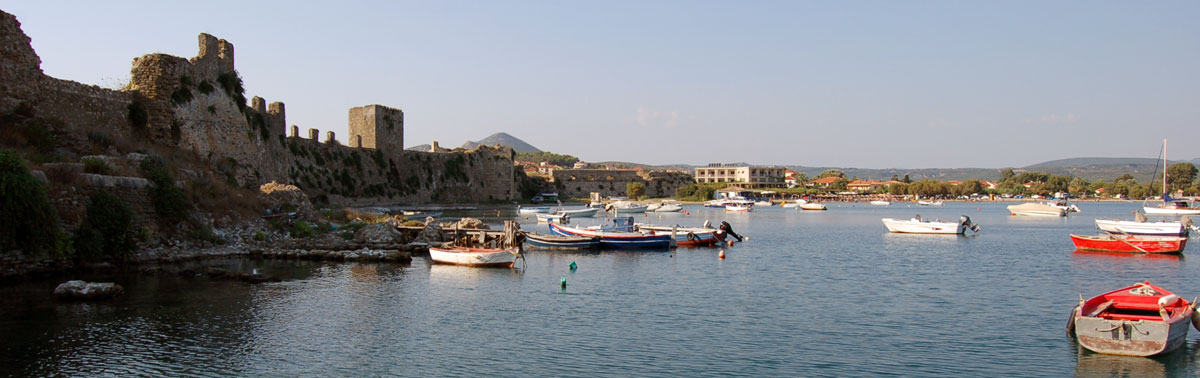
Methoni castle
Methoni, a jewel on the southwestern coast of the Peloponnese, has long commanded attention for its strategic location along key maritime routes linking the Ionian and Aegean seas. Its natural harbor, sheltered from prevailing winds, made it a coveted settlement since prehistoric times, and archaeological discoveries suggest continuous human presence from the Neolithic period through the Mycenaean era (circa 1600–1100 BC). Evidence of Mycenaean ceramics and fortification remnants hints at early organized communities exploiting both land and sea resources.
During the classical Greek period (5th–4th century BC), Methoni was integrated into the wider Messenian territory. Although overshadowed by larger centers such as Pylos and Messene, it served as a small maritime outpost, facilitating trade and contributing to the coastal network of the Peloponnesian cities. Its location on the southwestern extremity of the peninsula made it a convenient waypoint for ships traveling between the western Greek coast and Crete. Like many coastal settlements, Methoni experienced the ebb and flow of regional conflicts, including the Peloponnesian War, where the Messenian coast was often the arena for naval skirmishes.
With the Roman conquest of the Peloponnese in 146 BC, Methoni assumed a secondary yet functional role as a minor port. It became a waypoint for commercial traffic along the western Peloponnesian coast, providing shelter and resupply for ships transporting olive oil, wine, and other goods. Roman infrastructure, including roads connecting Methoni to inland Messenia, facilitated integration into the broader economic network of the Roman province of Achaea. Although Methoni never reached the prominence of nearby Pylos or Kalamata under Roman rule, it remained a strategically useful harbor.
The Byzantine period (330–1204 AD) brought both continuity and transformation. Methoni’s harbor remained vital for maritime trade and military purposes, serving as a defensive outpost against pirate incursions from the southern seas. The settlement was modest but sustained, reflecting the broader pattern of coastal communities in the Peloponnese during the Middle Byzantine period. Christianization of the region left its imprint, with small churches and chapels appearing along the coast, some of which survive as ruins today.
The medieval era began a dramatic chapter in Methoni’s history. Following the Fourth Crusade in 1204 AD, Methoni fell under Venetian control by 1207 AD. Recognizing the town’s strategic value, the Venetians undertook extensive fortifications, erecting the imposing Methoni Castle, complete with a moat, massive walls, and the iconic “Porta della Madonna.” During Venetian rule (1207–1500 AD), Methoni became a thriving commercial hub, connecting Venice to the Levant. Merchants traded spices, silk, and other luxury goods, and the town attracted artisans, sailors, and administrators. Its prosperity, however, also made it a target for Ottoman expansion.
In 1500 AD, the Ottomans captured Methoni after a brief but intense siege, initiating a period of administrative reorganization and demographic change. Under Ottoman rule, the castle remained militarily important, though commercial activity declined relative to its Venetian peak. Methoni experienced intermittent Venetian recaptures, notably in the late 17th century during the Morean War, but the town ultimately reverted to Ottoman control. The fortress and harbor continued to serve as a point of maritime control in the Ionian Sea.
The Greek War of Independence in 1821 saw Methoni once again as a contested site. While the town did not witness large-scale battles, it played a supporting role in naval operations and provided refuge for revolutionary forces. Following independence, Methoni became part of the modern Greek state. The town, now largely a quiet coastal settlement, preserved its Venetian and Ottoman architectural heritage, most notably the castle and remnants of fortifications.
During the 19th and 20th centuries, Methoni’s identity shifted toward a peaceful, scenic town. The 20th century, marked by the upheavals of the World Wars and the Greek Civil War, saw Methoni maintaining its small size but benefiting from modern infrastructure improvements such as roads and a modest port for fishing and tourism. Its historic castle, harbor, and surrounding natural beauty attracted travelers and scholars alike, establishing Methoni as a place where history and landscape intertwine. Today, visitors encounter a town layered with history: prehistoric settlements, Byzantine chapels, Venetian fortifications, and Ottoman vestiges, all set against the backdrop of golden beaches and the deep blue Ionian Sea.


