


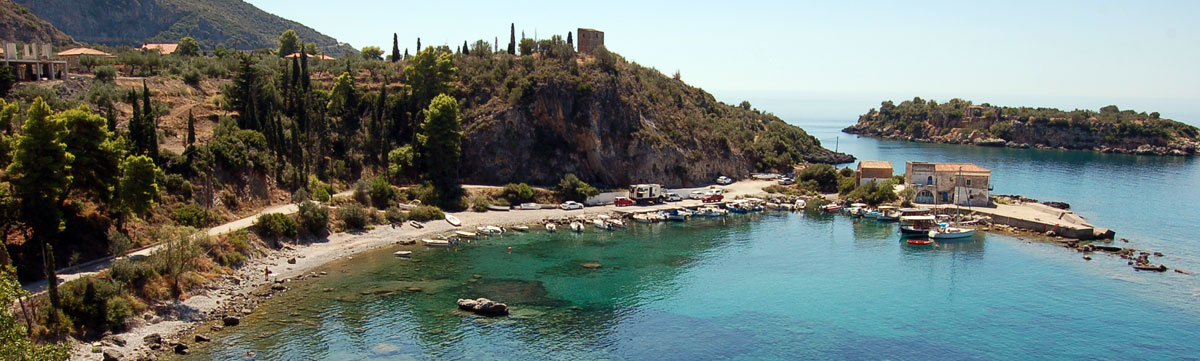
The picturesque harbour of Kardamyli
The Mani peninsula — a rugged finger of land stretching southward between the Messenian and Laconian Gulfs — is a world apart. Its mountain spine, the Taygetos, descends dramatically into a maze of cliffs, stone villages, and hidden coves. To travel through Mani is to move through time itself: from ancient Laconian tribes and Spartan outposts to Byzantine fortresses, Frankish towers, Ottoman struggles, and the defiant independence that made Mani one of the most unique regions of Greece. Even today, the stones of Vathia, Areopolis, and Gerolimenas whisper tales of pride, hardship, and endurance — a people who never bowed to conquerors, never forgot their ancestry, and never abandoned their mountains.
The Ancient Roots of Mani
The earliest inhabitants of Mani were the Leleges and Pelasgians, prehistoric peoples of the Aegean world who left traces in place names and myths. By the early 1st millennium BC, the Laconians, descendants of the Dorians, had settled the region. In antiquity, Mani formed part of ancient Laconia, the territory of Sparta, though its southern mountains remained sparsely populated and semi-independent. Ancient sources mention small settlements like Oitylo (Oetylus) and Gythium, the latter serving as Sparta’s port on the Laconian Gulf.
The Perioikoi — the “dwellers around” Sparta — inhabited Mani. Though not full Spartan citizens, they were free and often served as craftsmen, traders, and soldiers. The rugged terrain of Mani was difficult to conquer or control; even in the height of Spartan power, its inhabitants lived in semi-autonomous communities bound by kinship, honor, and the land.
The cape of Tainaron, the southern tip of Mani, held sacred meaning for the ancient Greeks. Here, in a sea-worn cave near modern Porto Kagio, stood the Sanctuary of Poseidon Tainarios, and nearby was said to be the Gate to Hades — the mythical entrance to the Underworld. Heracles and Orpheus were both said to have descended here in mythic quests. Ancient mariners revered the cape, and ships passing this treacherous point offered sacrifices to the sea god.
Roman and Early Christian Centuries
With the Roman conquest of Greece in the 2nd century BC, Mani came under Roman rule but retained much of its isolation. The Romans appreciated its strategic position on the routes between the Ionian and Aegean seas and built small garrisons and harbors along the coast, particularly at Gythium, which flourished as a Roman port. The Pax Romana brought limited peace, yet the Maniot mountains remained difficult to tame.
Christianity reached Mani early, probably through seafaring routes from Cythera and Corinth. By the 4th and 5th centuries AD, small basilicas appeared in Oitylo, Kardamyli, and Tainaron, marking the spread of the new faith. When the Roman Empire divided in AD 395, Mani became part of the Byzantine Empire, within the Theme of Laconia.
The Byzantine Mani and the “Maniates”
In the Byzantine centuries, Mani’s people — known as Maniates — were fiercely independent. From the 7th century onward, they resisted repeated Slavic incursions that swept across much of Greece. The Byzantines re-fortified Oitylo, Kardamyli, and Passava, turning them into defensive strongholds against both invaders and pirates. The Maniots’ reputation for resilience was already legendary: the Byzantine chronicler Constantine Porphyrogenitus wrote that “the Mainotes are not yet fully subject to the imperial rule.”
The region’s remoteness gave rise to a semi-feudal structure based on clans, known as gené. Each clan controlled a cluster of towers, olive groves, and small harbors. This pattern of family fortresses — tall, stone-built pyrgoi — would define Mani’s landscape for centuries.
Byzantine churches multiplied across the peninsula, adorned with delicate frescoes and Byzantine crosses. The small church of Agios Nikolaos in Kitta, for instance, retains exquisite 12th-century frescoes, reminders of a faith practiced in solitude and stone.
Frankish, Venetian, and Ottoman Encounters
After the fall of Constantinople to the Crusaders in 1204, Mani was briefly absorbed into the Frankish Principality of Achaea, but the Franks never truly subdued it. The rugged terrain, lack of fertile land, and fierce autonomy of its people made conquest almost impossible. In the late Middle Ages, Venetian and Genoese fleets vied for control of the southern Peloponnese, building and rebuilding small fortresses like those at Porto Kagio and Kelefa.
By the 15th century, Mani fell nominally under Ottoman control, though in reality, the Turks never ruled it effectively. The Ottomans preferred to negotiate through local Maniot leaders, the beys, who collected tribute but retained autonomy. The first of these semi-independent rulers was the Bey of Mani, based at Tsimova — today’s Areopolis, the symbolic heart of Mani.
The Mani Way of Life
Life in Mani was shaped by scarcity and honor. The stony soil yielded little beyond olives, figs, and goats; survival demanded toughness and cooperation within the clan. Blood feuds — vendettas known as “grevenes” — governed social relations. If an insult or murder occurred, families built higher towers and lived under siege for generations until peace was restored through intermarriage or divine mediation.
These towers, often four or five stories high, formed vertical fortresses against both neighbors and invaders. Villages such as Vathia, Kitta, and Nomia remain open-air museums of this architecture: clusters of towers rising from barren rock, overlooking the sea like petrified warriors.
The women of Mani played a crucial role — working the fields, tending olive trees, maintaining households in times when men were away at sea or at war. Songs and laments, the mirologia, became a defining feature of Maniot culture, combining ancient mourning rituals with Byzantine echoes.
The Maniates and the Greek War of Independence
When the Greek Revolution broke out in 1821, Mani was among the first to rise. The cry for freedom was sounded in Areopolis on March 17, 1821, when the local chieftains raised the banner of the cross and declared war against Ottoman rule. Maniot forces under Petros Mavromichalis (Petrobey) and Kyriakoulis Mavromichalis marched north, capturing Kalamata and joining the uprising across the Peloponnese.
Mani’s contribution was decisive. Its warriors, accustomed to hardship, became the backbone of the revolutionary army. The Maniot fleet, though small, harassed Ottoman supply lines along the coast. In recognition, Mani remained a proud symbol of unyielding resistance — the only region of Greece never fully subjugated in four centuries of Ottoman rule.
After independence, the Maniots were reluctant to accept the authority of the new Bavarian regency under King Otto. Blood feuds and rivalries persisted, and Petrobey’s own family became embroiled in political conflict, culminating in the assassination of Ioannis Kapodistrias, the first Governor of Greece, by members of the Mavromichalis clan — an act that epitomized Mani’s fierce sense of personal justice.
Gerolimenas: The Quiet Harbor of Stone
Amid Mani’s austere landscape, Gerolimenas — from Hieros Limen, “Sacred Harbor” — offered a rare refuge. Nestled beneath towering cliffs near Cape Tainaron, this small coastal village served for centuries as a fishing port and shelter for trading vessels braving the treacherous cape.
In the late 19th and early 20th centuries, Gerolimenas developed into a modest export center for olive oil, fish, and stone products. Its harbor was one of the few places where boats could anchor safely along Mani’s western shore. The old stone warehouses and captain’s houses still line the waterfront, silent witnesses to the days when Gerolimenas connected the remote villages of Mesa Mani with the outside world.
Today, Gerolimenas retains its timeless atmosphere — a handful of stone houses, a tranquil bay of turquoise water, and the looming presence of Vathia on the hills above, the most photographed village of Mani. Together, they form the living heart of the old Mesa Mani, where the sea meets the mountain, and the past feels eternally near.


