Maroneia

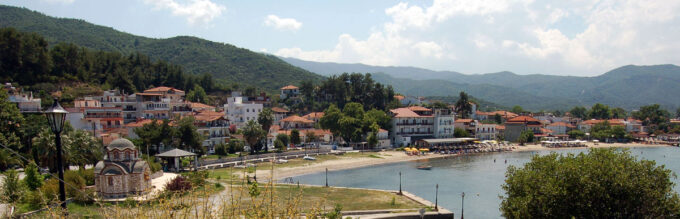
Maroneia, view of the harbour Maroneia, built on the south-western foothills of the Rhodope Mountains and facing the Thracian Sea, is one of the longest-lived and historically dense cities of Thrace. Its location —between fertile hinterland, natural anchorages and major maritime routes— shaped its development from early antiquity to modern times. Mythical beginnings and Homeric…

Vistonikos Bay

Channel entrance, Porto Lagos Vistonikos Bay is a place where land and sea interlock: coastal lakes, lagoons, sandbars and shallow channels form a single wetland complex, with Lake Vistonida at its heart and the Porto Lagos lagoon system at its edge. In antiquity, “Bistonis” (Lake Vistonis) lent its name to the Bistones, a Thracian people…

Avdira

Avdira, harbour Avdira, known in antiquity as Abdera, lies in western Thrace, within today’s Xanthi regional unit, close to the mouths of the Nestos and the northern Aegean Sea. Its position among coastal lagoons, alluvial plains, and shifting shorelines proved both an advantage and a challenge: sediment carried by the river continually reshaped the landscape,…

Philippi & Thasos

View of Thásos, from N The history of eastern Macedonia was shaped by the dynamic interaction between land and sea, and nowhere is this more clearly expressed than in the relationship between Philippi and Thasos. One city was inland, fortified, and strategic; the other insular, maritime, and outward-looking. Together, they formed a complementary historical system…

Kavala

Kavala old town and castle Kavala is a city whose destiny has been shaped by geography. Built amphitheatrically on a peninsula with a naturally protected harbour facing the North Aegean, it has, since antiquity, functioned as a key point of control over maritime and land routes linking Macedonia with Thrace and the wider Eastern Mediterranean.…

Ierissos

Ierissos gulf and harbour From prehistoric ground to early Greek city-ports Modern Ierissos stands beside the site of Ancient Akanthos (Acanthus), a major city-port founded in the 7th century BC, traditionally linked to settlers from Andros. Its position—on a ridge just above the shore—gave it both a defensible acropolis and immediate access to the sea…

Strymonian Gulf

The gentle slopes of Strymonikos (Olympiada) The Strymonian Gulf has, since antiquity, formed a natural maritime crossroads between Macedonia, Thrace, and Chalkidiki. Its gentle coastline, sheltered bays, and the mouth of the Strymon River created ideal conditions for navigation, trade, and permanent settlement. From prehistoric times, the area functioned as a transitional zone between land…

Ouranoupoli and Ammouliani

Ouranoupoli tower The area of modern Ouranoupoli and Ammouliani has long stood at the threshold between land and sea, but also at the boundary between the secular world and the monastic realm. From antiquity to modern times, the gulf of Ierissos and the maritime passages towards Mount Athos formed a strategic sea corridor, while simultaneously…

Eastern Sithonia

Prehistoric and Archaic Period Sithonia has been inhabited since prehistoric times, as shown by scattered archaeological finds along both the coast and the interior. Its landscape — combining sheltered bays, fertile inland zones and immediate access to the sea — favoured small, dispersed communities rather than large, centralised settlements. Early habitation followed the rhythms of…

Porto Koufo

Porto Koufo The bay of Koufo, today known as Porto Koufo, owes its historical importance primarily to its exceptionally sheltered natural harbour, one of the safest anchorages in northern Greece. Almost landlocked and protected from every wind, it was known in antiquity as kophos limen—the “silent or deaf harbour”—a name that reflects how little wave…