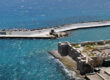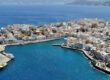


View of Siteia harbour
Amphitheatrically arranged around its namesake bay on the north-eastern coast of Crete, Sitia combines island tranquillity with historical depth. Unlike the larger urban centres of the island, it preserves a sense of authenticity, where daily life unfolds at an unhurried pace and the past remains visibly embedded in the landscape. For the mariner, Sitia offers a safe harbour and natural passage towards Cape Sidero and the eastern Aegean.
Minoan Roots – Petras of Sitia
The history of the area stretches back to the Minoan period (c. 3000–1100 BC). Just west of the modern town lies the archaeological site of Petras, where a significant Minoan settlement with administrative and residential functions has been excavated. Flourishing mainly during the Middle and Late Minoan phases, the site includes fortification elements, storage facilities, and building complexes reminiscent of a small palatial centre.
The presence of Petras demonstrates that Sitia was never a marginal region, but rather integrated into the network of Minoan maritime trade. Its geographical position facilitated contact with the Dodecanese and the eastern Mediterranean, making it a key point of communication and exchange.
Hellenistic and Roman Periods
During the Hellenistic era, the area formed part of the broader political landscape of eastern Crete. Although the ancient city of Sitia has not been fully excavated, inscriptions and scattered finds indicate organised urban life and commercial activity.
After the Roman conquest of Crete in 67 BC, the eastern coastline maintained its importance as a maritime corridor. Roman administration introduced stability and infrastructure, enabling the region to participate in a wider system of economic and administrative cohesion across the Mediterranean.
Byzantine Continuity and Defensive Necessity
Throughout the Byzantine period (4th–13th centuries AD), Sitia formed part of Crete’s ecclesiastical and administrative framework. The Arab occupation of the island (824–961 AD) severely affected coastal settlements, increasing the need for defensive measures. Following the Byzantine reconquest in 961 AD, fortifications were strengthened and coastal security reorganised.
The protection of the bay and harbour became a lasting feature of Sitia’s identity, shaping it as a fortified town of strategic eastern importance.
Venetian Era – The Kazarma Fortress
After AD 1204, Crete passed into the hands of the Republic of Venice. Sitia became an important administrative and military centre of the eastern province. Its most prominent monument is the Kazarma Fortress, whose name derives from the Italian Casa di arma (house of arms or barracks).
Built or reconstructed in the 13th century AD, the fortress dominates the town and commands the harbour. It suffered heavy damage from an earthquake in AD 1508 and from the raid of Barbarossa in AD 1538, events that underline the strategic value of the site. Its architecture reflects the functional austerity of Venetian military engineering.
Ottoman Conquest and Temporary Abandonment
During the Cretan War, Sitia proved difficult to defend. In AD 1651, the Venetians abandoned the town and partially dismantled its fortifications to prevent their use by the Ottomans. The settlement declined temporarily but remained inhabited, preserving its agricultural and commercial character.
Modern Sitia gradually developed, particularly after the union of Crete with Greece in AD 1913, acquiring a more contemporary urban structure while maintaining its historical imprint.
Toplou Monastery
A few kilometres north-east of Sitia, in a stark yet commanding landscape near Cape Sidero, stands Toplou Monastery — one of the most important monastic complexes in Crete. Its exposed position, open to winds and once vulnerable to pirate raids, shaped its distinctive character as a fortified monastery, where spirituality and defensive architecture exist side by side.
Foundation and Name
The foundation of the monastery is generally placed in the 15th century AD, although earlier monastic activity in the area is considered likely. The name “Toplou” is believed to derive from the Turkish word top (cannon), referring to a piece of artillery reportedly granted to the monastery for protection. Its official name is the Monastery of Panagia Akrotiriani, yet the name “Toplou” prevailed, reflecting its defensive role in a turbulent frontier landscape.
Architecture and Fortification
The monastery presents strong fortress-like features: high perimeter walls with battlements, reinforced corner towers, and a heavy entrance gate. Its design reflects the constant threat of pirate attacks that plagued the eastern Cretan coastline during both the Venetian and Ottoman periods.
At the centre stands the katholikon (main church), dedicated to the Virgin Mary, characterised by restrained yet imposing architectural lines. The monastery also preserves an important collection of icons and ecclesiastical treasures, testifying to its religious and artistic influence across eastern Crete.
Venetian and Ottoman Periods
During the Venetian era, Toplou developed into a centre of spiritual life and learning. It maintained a library and contributed to the copying of manuscripts, reinforcing its role as a beacon of Orthodox continuity under Latin rule.
Following the Ottoman conquest of Crete, the monastery continued to function, though often under pressure and restriction. It played a significant role during the Cretan uprisings of the 19th century, serving as a refuge and supply base for revolutionaries. In 1821 AD and in subsequent revolts, monks and local inhabitants suffered reprisals, firmly establishing Toplou as a symbol of faith intertwined with resistance.
Twentieth Century and Cultural Legacy
During the German occupation of Crete (1941–1944 AD), the monastery is believed to have supported resistance networks, further strengthening its historical identity as a place of moral and practical endurance.
Today, Toplou Monastery remains an active religious institution and a major site of pilgrimage and visitation. It also manages extensive agricultural estates, producing high-quality olive oil and wine, integrating tradition into a model of self-sustaining rural economy. Rising from the dry terrain of eastern Crete, the monastery conveys an atmosphere of austere beauty and spiritual resilience.
Sightseeing
The Kazarma Fortress is the dominant landmark of the town. From its ramparts, visitors enjoy panoramic views over the bay, gaining a clear sense of Sitia’s strategic geography.
The archaeological site of Petras offers direct insight into the Minoan world and highlights the prehistoric importance of the region.
A short drive away stands the historic Toplou Monastery, a fortified 15th-century AD monastery that played a significant role in the struggles of Crete. Its austere form reflects the need for spiritual and defensive self-reliance.
The wider area also offers unspoilt beaches such as Kouremenos and Xerokampos, where nature remains raw and luminous, shaped by wind and sea.
Flavours of Sitia
Sitia is renowned for its extra virgin olive oil, a product of Protected Designation of Origin, celebrated for its balanced fruitiness and low acidity. Olive cultivation remains a cornerstone of local identity and economy.
The local cuisine is based on simple, authentic ingredients: legumes, wild greens, seasonal vegetables, and fresh fish from the bay. Traditional dishes such as slow-roasted lamb, small cheese pies (kalitsounia), and barley rusks are accompanied by local wine and raki, creating a table that is honest, sun-shaped, and deeply rooted in place.