


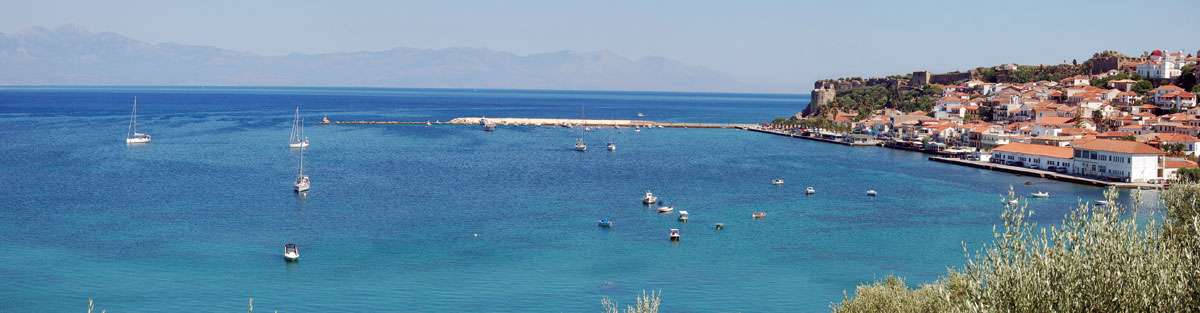
Koroni harbour, from W
Nestled on the southwestern coast of the Peloponnese, Koroni’s strategic position at the entrance of the Messinian Gulf has shaped its history for millennia. From its earliest settlements to its role as a Venetian stronghold, Ottoman port, and modern town, Koroni embodies the layers of Greek and Mediterranean history in a single location.
Ancient and Classical Periods
Koroni is identified with the ancient town of Asine, mentioned in Homeric sources and later by Pausanias. Archaeological evidence suggests habitation as far back as the Mycenaean period (c. 1600–1100 BC), when it formed part of the complex network of coastal settlements that linked the Peloponnese with the islands and the wider Aegean trade routes. The town’s location, with a natural harbor protected by the promontory, made it ideal for maritime commerce.
During the Classical period (5th–4th centuries BC), Koroni fell under the influence of Messene after the liberation of Messenia from Spartan control in 369 BC. While little evidence survives of monumental architecture from this era, coins and pottery fragments suggest a thriving small port engaged in trade with Athens and other Aegean cities. Its proximity to the fertile Messinian plain allowed the town to combine agriculture with maritime activity, forming the backbone of its local economy.
Hellenistic and Roman Times
Following Alexander the Great’s campaigns and the fragmentation of his empire, Koroni, like much of Messenia, became contested territory among the successor kingdoms. The Hellenistic period saw limited urban expansion, yet the town maintained its strategic relevance as a coastal node.
By the Roman period (146 BC–AD 395), Koroni had been integrated into the province of Achaea. It served as a minor port facilitating grain and olive oil shipments from the Peloponnesian hinterlands to larger Mediterranean markets. Archaeological finds, including Roman-era mosaics, inscriptions, and amphorae fragments, attest to a stable, if modest, urban life. Its harbor offered refuge to ships navigating the sometimes treacherous waters of the Ionian Sea, and its surrounding territory remained agriculturally productive.
Byzantine Era
With the fall of the Western Roman Empire, Koroni remained under Byzantine control (AD 395–1204). The town’s fortifications were reinforced to guard against the increasing threats of piracy and Lombard incursions. By the 9th century, Koroni had become an ecclesiastical center, as evidenced by references to its bishopric in Byzantine documents.
The town prospered modestly during the middle Byzantine period, benefitting from the revival of local trade networks connecting the Peloponnese to the Adriatic and Ionian coasts. Byzantine architecture, including remnants of churches and fortifications, reveals a town adapting to both commercial and defensive needs. In the 11th and 12th centuries, Koroni’s harbor became an essential stop for Venetian merchants en route to the Levant, setting the stage for the town’s more prominent role in the Late Medieval Mediterranean.
Frankish and Venetian Periods
The Fourth Crusade of 1204 dramatically reshaped the Peloponnese. Koroni fell under the influence of the Frankish Principality of Achaea, and its castle underwent significant fortification. Venetian merchants recognized the harbor’s potential and gradually established a commercial presence.
By the late 13th century, Koroni was formally controlled by Venice, marking the start of its most renowned historical phase. The Venetians expanded the castle on the hill overlooking the harbor, building the massive bastions and towers that still dominate the town today. The Venetian administration encouraged settlement by Italian merchants and artisans, creating a vibrant, multi-ethnic trading community. During this period, Koroni became a hub for the export of local products—primarily olives, wine, and soap—while serving as a crucial naval base controlling access to the Messinian Gulf.
Koroni’s prosperity was occasionally interrupted by Ottoman raids, particularly during the 15th century, but the town’s fortifications and Venetian garrison ensured it remained under Venetian control until 1500. A period of reconstruction followed in the 16th century, during which the castle’s fortifications were adapted to withstand artillery attacks, reflecting broader changes in Mediterranean military architecture.
Ottoman Rule
In 1500, after a siege, Koroni fell to the Ottoman Empire, marking a new chapter in its history. Under Ottoman rule, the town retained its commercial function but saw a gradual demographic transformation, with a Muslim administrative elite settling alongside the existing Christian population. The harbor continued to be a critical node for trade, linking the Peloponnese with the broader Ottoman Mediterranean network.
During the 17th century, the town briefly returned to Venetian control during the Morean War (1684–1699), reflecting the ongoing struggle between Venice and the Ottomans for dominance in the Peloponnese. Venetian rule brought reconstruction of the castle, churches, and warehouses, and Koroni flourished as a fortified maritime outpost. However, the Treaty of Karlowitz (1699) returned it to Ottoman control, under which it remained for over a century.
Modern Era and Greek Independence
The 19th century brought a period of decline, exacerbated by piracy, shifting trade routes, and the political instability of Ottoman administration. Despite these challenges, Koroni played a role in the Greek War of Independence (1821–1829). Local fighters joined the revolutionary forces, and the town served as a landing point for supplies and reinforcements from the Ionian Islands and Western Europe. Although it was briefly captured by Ottoman forces during the conflict, it eventually became part of the newly independent Greek state in 1830.
In the 20th century, Koroni evolved into a small but vibrant town, balancing its historical legacy with modern life. The harbor remained active for fishing and limited trade, while tourism began to develop, drawn by the imposing Venetian castle, traditional architecture, and scenic coastline. Archaeological excavations in the mid-20th century uncovered further evidence of the town’s ancient and Roman past, providing valuable insights into the continuity of settlement in this strategic location.


