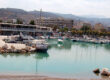


From Sicyon to Kiato: An Ancient Lineage
The origin of the name “Kiato” is not definitively established. One theory suggests it derives from a corruption of an earlier local toponym, while another links it to a Latin or medieval root associated with land use or estate ownership.
The modern town of Kiato stands on one of the oldest continuously inhabited sites in Greece, tracing its roots to the illustrious ancient city of Sicyon (Σικυών). In antiquity, Sicyon was one of the most important city-states of the Peloponnese, famous for its art, politics, and early cultural innovations. Located slightly inland from today’s Kiato, the ancient acropolis crowned a hill that offered views over the Corinthian Gulf — a natural fortress and a stage of history.
According to myth, Sicyon was founded by Aegialeus, one of the sons of Inachus, king of Argos, and its early rulers were among the oldest dynasties in Greek lore. During the Classical period, the city flourished under Cleisthenes of Sicyon, the grandfather of the Athenian lawgiver of the same name. This Cleisthenes was famed for his tyranny but also for promoting arts and public festivals. Sicyon became a center of painting and sculpture, home to masters such as Lysippos, who sculpted Alexander the Great, and the painter Eupompus, who inspired a whole school of art rivaling that of Athens.
In 323 BC, after Alexander’s death, Sicyon’s fate was intertwined with that of the Achaean League, of which it later became a leading member. During the Hellenistic period, the city moved gradually closer to the coast — a shift that would eventually give rise to what we now call Kiato. Earthquakes, floods, and silt from nearby rivers encouraged this slow migration toward the shore.
Under Rome and Byzantium
When the Romans conquered Greece in 146 BC, Sicyon retained some prominence, supplying fine ceramics and wines to Corinth and Patras. Roman villas, mosaics, and bath complexes discovered in the area testify to its continued prosperity. Yet over time, as the Roman road network favored the coast, settlement gradually concentrated near the shoreline — the seed of Kiato’s later form.
During the Byzantine era, the area around Sicyon-Kiato remained inhabited, though the ancient city declined. New Christian communities formed, with small basilicas and rural chapels dotting the fertile plain. Byzantine texts mention “Eutychia” and “Helikea”, small settlements possibly corresponding to early Kiato. The plain’s abundance of olives, vines, and grains made it an enduring agricultural hub even as invasions swept across Greece.
Frankish and Venetian Periods
In the medieval period, after the Fourth Crusade (1204), the region fell under Frankish and later Venetian control, as part of the Principality of Achaea. The nearby fortress of Acrocorinth served as the key to controlling the northern Peloponnese, and Kiato’s coastal position made it a modest but useful harbor for the occupying powers. Venetian records mention the export of raisins, olive oil, and timber through the port of Sicyon — the first time the name “Kiato” (Chiatto, Chiato) appears in written form, likely referring to the new coastal town that replaced the inland ruins.
Ottoman Rule and the Path to Independence
Under Ottoman rule (15th–19th century), Kiato remained a small but active settlement on the Gulf, known for its vines and currants, which would become the region’s economic lifeline. The plains of Sicyon produced one of the finest varieties of black Corinthian raisins, exported throughout Europe via the ports of Patras and Kiato. Local monasteries such as Leontiou and Agios Vlasios played spiritual and educational roles, preserving Greek traditions and manuscripts through the centuries.
During the Greek War of Independence (1821–1829), the people of Kiato and Sicyon took part in the uprising, supplying fighters and provisions to revolutionary bands. The plain was a corridor of movement between the mountains of Corinthia and the sea. After independence, Kiato began to grow as a market town, serving the agricultural hinterland of Sicyon.
Modern Kiato: From Raisins to Resorts
The modern identity of Kiato truly formed in the late 19th century, with the arrival of the railway connecting it to Corinth and Patras. The harbor expanded, and the town became a vital export hub for raisins and citrus fruits. Beautiful neoclassical houses built by raisin merchants still survive in the town center — silent witnesses of a time when Kiato prospered through trade with France and England.
In the 20th century, after the decline of the raisin trade, Kiato reinvented itself as a coastal resort and administrative center. The long pebbled beaches, shaded by tamarisk trees, began to attract visitors from Corinth, Patras, and later Athens. The post-war decades saw significant urban growth, blending modern life with traces of the old coastal charm.
Today, Kiato is both a gateway to the northern Peloponnese and a place with a serene rhythm — where cafés line the seafront, the hills of ancient Sicyon rise quietly in the background, and every stone still echoes the dialogue between antiquity and the sea.
Sights
Ancient Sicyon
Located just west of Kiato, the archaeological site includes a theatre, agora, and fortifications. It offers direct insight into the region’s past and highlights its rich cultural heritage.
Kiato Seafront Promenade
The town’s waterfront is a focal point of daily life, lined with cafés and tavernas. It is ideal for a stroll, offering open views across the Corinthian Gulf and a relaxed seaside atmosphere.
Stymphalia Lake and Mountainous Corinthia
A short drive inland leads to Lake Stymphalia and the surrounding mountains, providing a contrasting landscape. The area combines natural beauty with mythological significance, as it is linked to the labours of Heracles.
Flavours
Corinthian Currants
A hallmark product of the region with centuries of history. Once a cornerstone of the local economy, they remain a symbol of agricultural tradition.
Corinthian Citrus Fruits
Oranges and lemons thrive in the fertile plains around Kiato. Known for their aroma and flavour, they express the richness of the Corinthian land.
Local Wines and Spirits
The Corinthian hinterland produces notable wines and tsipouro, perfectly complementing local cuisine and reflecting the region’s deep-rooted viticultural heritage.