

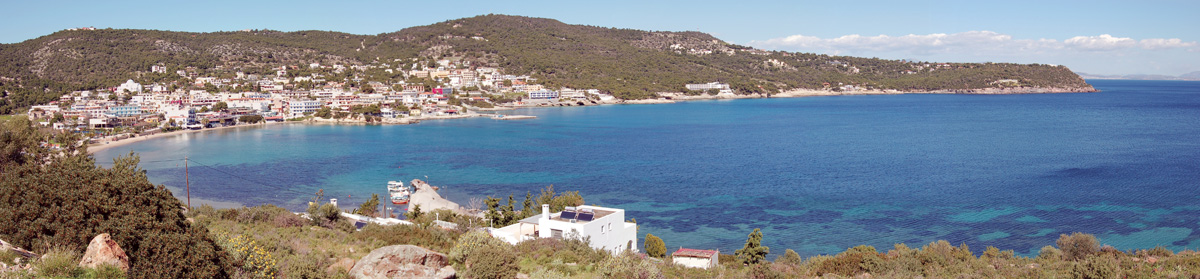
Agia Marina, on the northeastern coast of Aegina, is the island’s largest seaside resort. Its popularity as a holiday destination is mainly due to its long sandy beach, where the seabed deepens very gradually, making it particularly suitable for families and children.
The settlement takes its name from the small chapel of Saint Marina, located at the edge of the beach. The village gradually developed as a holiday resort mainly during the 20th century and today it is one of the most lively summer destinations on the island.
Agia Marina is also located close to one of Aegina’s most important archaeological sites, the Temple of Athena Aphaia. The area had already been a sacred place since prehistoric times, probably from the 13th century BC, when the fertility deity Eugonia was worshipped there.
According to mythology, King Minos of Crete fell in love with the nymph Britomartis, who tried to escape his pursuit. After fleeing across the sea she reached Aegina and hid on the hill where Artemis was worshipped. There the goddess made her disappear, and when people came searching they found a statue in her place, which they named Aphaia, meaning “the unseen”. The Aeginetans then established a sanctuary in her honour, later identifying the goddess with Athena, and building the famous Temple of Athena Aphaia, around 500 BC.
Sights
Agia Marina Beach
The long sandy beach of Agia Marina is among the most popular on Aegina. Its shallow waters, organised facilities and water sports make it particularly attractive for families and visitors.
Temple of Athena Aphaia
A short distance from the village stands the Temple of Athena Aphaia, one of the best preserved Doric temples in Greece and one of the most important archaeological monuments of the Saronic Gulf.
Chapel of Saint Marina
At the edge of the beach stands the small chapel of Saint Marina, from which the village takes its name. Each year on 17 July, the feast of the saint is celebrated with a lively local festival.