


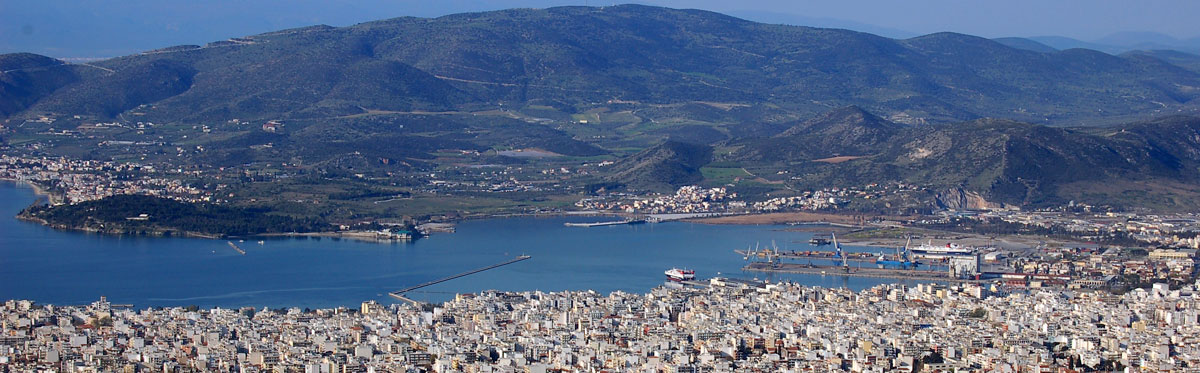
Volos and harbour, from NE
Volos, stretched along the inner curve of the Pagasitikos Gulf and framed by the commanding presence of Mount Pelion, is one of Greece’s few cities whose identity has been shaped equally by myth, seafaring, industry, and catastrophic rebirth. Today its waterfront cafés and neoclassical facades suggest a relaxed Mediterranean charm, yet beneath this surface lies a long continuum: from Neolithic innovators to Bronze Age kingdoms, from Byzantine estates to Ottoman port-town, and from smoking factory chimneys of early modern Greece to a cosmopolitan urban centre.
Prehistoric Volos: The Cradle of Neolithic Innovation
Few Greek regions can rival Volos in prehistoric depth. The settlements of Dimini and Sesklo, both just outside the modern city, created one of the earliest continuous cultural landscapes in Europe.
Around 6000 BC, the inhabitants of Sesklo built a dense village of stone foundations, rectilinear houses, pottery workshops, and a sophisticated social layout that suggests early communal organisation. Their red-on-cream ceramics became so distinctive that archaeologists today speak of a “Sesklo culture.” The village was fortified at various times, evidence that even early farming communities had to negotiate security, resources, and territorial identity.
A few kilometres away, Dimini emerged later (c. 4500–4000 BC) with an entirely different architectural logic: concentric stone-built enclosures, gradually rising toward a central megaron. Whether these rings were defensive walls, status demarcations, or ceremonial boundaries remains debated, but they reflect complex social organisation. The inhabitants cultivated grain, practiced animal husbandry, developed early trade networks, and crafted high-quality pottery.
Together, Sesklo and Dimini form a prehistoric “twin capital” of the Thessalian plain, demonstrating uninterrupted human presence for thousands of years. Their innovations — permanent architecture, ceramic specialization, community planning — laid the foundations of settled society in the region that would later become Volos.
Myth and Early Greek Traditions
Volos is inseparable from Greek myth. Iolcos, usually located in or near modern Volos, was the kingdom of Jason, leader of the Argonauts. From its natural harbour the legendary Argo is said to have sailed in search of the Golden Fleece. This story, though mythical, reflects the region’s early maritime orientation: a coastal centre facing the Aegean, commanding fertile plains, and interacting culturally with the wider Greek world.
Several Mycenaean sites around Volos — including remains at Dimini reused in the Late Bronze Age and various chamber tombs across the area — suggest that Iolcos was indeed a significant centre. Its kingship, wealth, and sea connections echo throughout Homeric traditions. The region’s horses, praised in antiquity, also tie into the image of Thessaly as the land of skilled riders and aristocratic families.
Argonautic Expedition
The Argonautic Expedition is one of the oldest and most influential Greek heroic legends, rooted deeply in the region of Volos. According to myth, the kingdom of Iolcos, usually identified with the wider Volos area, was ruled by King Pelias, who usurped the throne from his brother. When Jason — rightful heir and hero in the making — returned to claim his inheritance, Pelias set him an impossible challenge: to sail to distant Colchis on the shores of the Black Sea and bring back the Golden Fleece, a symbol of divine authority and kingship.
To accomplish this, Jason gathered Greece’s greatest young heroes: Herakles, Orpheus, Atalanta, Castor and Polydeuces, and many others. They embarked on the Argo, the first ship built to undertake a long open-sea voyage, crafted with the guidance of Athena. Their journey became a tapestry of marvels — encounters with Harpies, clashing rocks, enchanted islands, and foreign kings — illustrating the expansion of Greek imagination toward the unknown seas of the east.
Classical and Hellenistic Periods: A Strategic Gulf
In the Classical period, the Pagasitikos Gulf became a contested but valuable maritime zone. The city of Pherai and later the Thessalian League exerted influence over the coastal settlements. The gulf’s sheltered waters made it a natural anchorage, particularly for fleets operating between northern Greece and the central Aegean.
During the Hellenistic period, the region benefited from the wider economic expansion of Macedonian influence. Ports around the gulf facilitated grain transport, timber shipment from Pelion, and trade with the islands. Archaeological finds in the area indicate an active coastal economy: vineyards, small farming estates, and artisan workshops contributing to broader networks within the Macedonian world.
Roman and Early Byzantine Volos
Under Roman rule, the Pagasitikos region gained stability and infrastructure. Road networks linked the coast to Larisa and Phthiotis, channeling agricultural produce toward the sea. The gulf also served the Roman navy, which required sheltered harbours for surveillance of the northern Aegean.
Christianity arrived early, as suggested by scattered basilica remains and burial sites across the wider plain. During the Early Byzantine centuries (4th–7th AD), the area remained a productive agricultural zone supplying the empire’s northern provinces. Earthquakes, known from historical sources, periodically disrupted settlement patterns, yet the continuity of habitation never stopped.
Middle Byzantine and Late Medieval Transformations
In the Middle Byzantine period, habitation shifted toward fortified hilltops as coastal insecurity increased. Slavic groups settled across Thessaly in the 7th–8th centuries, blending into local populations over time. As imperial control reasserted itself, the plains around Volos became part of a mosaic of estates, monasteries, and small fortified villages.
By the late medieval era, Volos (referred to in some sources as Golos) began emerging as a regional coastal node, though not yet the major city it would become. Control of the region passed between Byzantines, Franks, Catalans, Serbs, and finally the Ottomans, reflecting the geopolitical volatility of Thessaly.
Ottoman Volos: A Port Emerges
Volos truly began to acquire urban character under Ottoman rule (15th–19th centuries). The plain produced grain, cotton, and silk, while Pelion supplied timber, chestnuts, olives, and skilled artisans. The gulf acted as a natural outlet for all these products.
By the 18th century, Volos’s port became an essential commercial intermediary between Pelion’s prosperous villages — Zagora, Makrinitsa, Portaria — and markets as far as Constantinople, Alexandria, and the Black Sea. Pelion merchants developed an international profile, and many of their fortunes flowed through the port of Volos. European consulates, warehouses, small shipyards, and a growing permanent population began shaping a town with cosmopolitan tendencies long before the Greek War of Independence.
Nineteenth Century: Liberation and Industrial Birth
Thessaly was incorporated into the modern Greek state in 1881, and Volos entered a transformative period. Within a generation it became one of the most dynamic cities of Greece.
Its natural harbour, proximity to agricultural hinterlands, and connection to the newly established railway turned Volos into an industrial magnet. Flour mills, textile factories, tobacco warehouses, metalworks, and ship-repair facilities sprang up rapidly. The city absorbed waves of workers from the countryside and entrepreneurs from across Greece and the Mediterranean.
Volos also suffered: devastating earthquakes in 1894 and 1955 reshaped the city, destroying large neighbourhoods but also clearing space for modern urban planning and neoclassical architecture.
Early 20th Century: A Cosmopolitan Port
By the early 1900s, Volos had dockyards, electric lighting, newspapers, clubs, and an active cultural life. It became a centre of progressive labour movements and commercial innovation.
The Asia Minor Catastrophe of 1922 brought thousands of refugees to the city, especially from the coastal towns of Asia Minor. They gave Volos new neighbourhoods, new craft traditions, and new flavours — particularly in cuisine and urban culture.
During the Second World War, Volos endured occupation, resistance, and destruction, including bombardments and famine. Yet the post-war decades saw renewed growth, further industrialisation, and the expansion of the University of Thessaly, transforming the city into an intellectual and economic anchor of Central Greece.
Contemporary Volos
Today Volos blends its layered history with modern vibrancy: a harbour promenade filled with cafés, a youthful population, an active cultural scene, and restoration efforts that highlight its neoclassical, industrial, and archaeological heritage. The city remains the essential gateway to Pelion, the Sporades, and the Pagasitikos Gulf, continuing the maritime identity it has held for millennia.
Sightseeing
1. Archaeological Sites
- Archaeological Site of Sesklo
One of Europe’s earliest Neolithic settlements, with stone foundations, pottery workshops, and remarkable ceramics. - Archaeological Site of Dimini
Famous for its concentric enclosures and Late Neolithic megaron; also includes a Mycenaean palace complex from the Late Bronze Age. - Archaeological Museum of Volos
Displays finds from Dimini, Sesklo, and wider Thessaly: figurines, pottery, jewellery, Mycenaean grave goods, and inscriptions.
2. Urban and Architectural Heritage
- The Waterfront (Paralia)
A long promenade lined with modern cafés and neoclassical buildings, emblematic of Volos’s 19th- and 20th-century identity. - St. Nicholas Cathedral
A landmark church with impressive icons and architectural presence. - The Rooftile and Brickworks Museum (Tsalapatas)
A preserved industrial complex showcasing machinery, kilns, and the working culture of early 20th-century Volos.
3. Surrounding Highlights
- Mount Pelion Villages (Makrinitsa, Portaria, Anakasia)
Stone mansions, cobbled paths, fountains, panoramic views, and a rich tradition of craftsmanship. - Goritsa Hill
Remains of an ancient classical city with walls and urban layout; excellent viewpoint over Volos and Pagasitikos. - Beaches of Pagasitikos
Alykes, Agria, and the small coves toward Malaki offer calm waters and easy urban access.
Flavours
Volos is renowned for its tsipouro culture, where small glasses of the strong spirit accompany an array of mezedes. This ritual reflects Asia Minor influence combined with Pelion’s agricultural bounty. Typical flavours include:
- Grilled octopus, fried squid, and marinated anchovies
- Spetsofai (Pelion sausage with peppers)
- Politika appetisers from 1922 refugee tradition
- Local cheeses from Pelion
- Seafood meze platters served in tsipouradika of the waterfront
Desserts often draw from Pelion’s orchards: spoon sweets, apple pastries, and chestnut treats. Together these flavours encapsulate the city’s maritime, refugee, and mountain heritage.


