


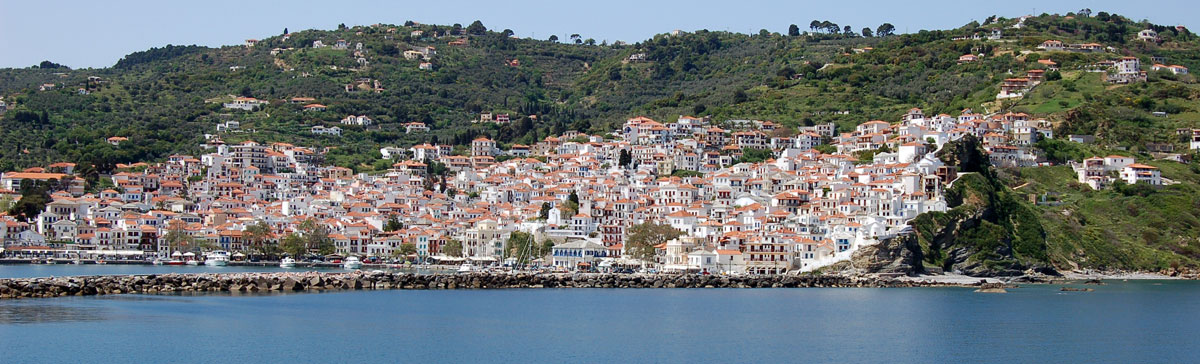
View of Skopelos town, from NE
The western coastline of Skopelos—stretching from Loutraki in the north to the broad, serene bay of Panormos and the sheltered inlet of Agnontas—forms a distinct historical landscape shaped by maritime life. Unlike the main urban centres of the island, which were typically positioned on elevated ground for defensive reasons, these coastal areas developed in relation to the natural bays, anchorages, and sea routes that connected Skopelos with the rest of the Northern Sporades, Euboea, the Magnesia peninsula, and the wider Aegean.
Ancient Foundations: The City-States and Their Maritime Zones
In antiquity, Skopelos was organised around three main city-states: Peparithos (Skopelos Town), Selinous (above Panormos), and Glossa (above Loutraki). Each possessed its own hinterland, acropolis, religious sanctuaries, and—crucially—its own coastal outlets. The west coast therefore was never an empty frontier but part of a structured network of ancillary harbours, landing areas, and coastal roads that served the needs of each city-state.
Loutraki functioned as the maritime access point for Glossa, allowing transport of goods, movement of populations, and small-scale trade with nearby islands. Panormos, blessed with one of the best natural harbours in the Sporades, was tightly linked to the fortified city of Selinous, which overlooked the bay from the acropolis of Paleokastro. Agnontas, although not itself an ancient settlement, provided a sheltered anchorage between the two major zones, used by passing ships and local fishermen.
The maritime orientation of these communities is evident in archaeological traces, the distribution of ancient walls, and the presence of high-quality anchorages that were almost certainly used for both commercial and military purposes. Skopelos was known in antiquity for shipbuilding, wine production, and olive cultivation, and its coastal districts supported these activities by offering access to transport and regional networks.
Hellenistic and Roman Eras: Harbours, Baths, and Coastal Activity
During the Hellenistic period the Sporades experienced increased naval movement, particularly as the successor kingdoms of Alexander the Great competed for control of the Aegean. Skopelos became part of these shifting alliances, and its harbours—especially Panormos—played a role as staging points or refuges for fleets moving between Skiathos, Magnesia, and Euboea.
By the Roman era, Skopelos enjoyed relative security, which encouraged the construction of structures related to comfort and leisure. The toponym Loutraki strongly suggests the presence of bathing installations. While no large-scale Roman thermae have been excavated there, the linguistic evidence aligns with similar cases across the Aegean where coastal springs or small bathing complexes lent their names to settlements.
The coastline continued to support agriculture-based maritime trade: amphorae filled with Skopelitan wine or olive oil were shipped from small coves to larger ports. Panormos, in particular, served as a natural port of call for Roman travellers navigating the sheltered route of the Northern Sporades. The clarity and depth of the bay, combined with protection from prevailing winds, made it an ideal anchorage for ships that preferred to avoid the open Aegean.
Byzantine and Medieval Skopelos: Piracy, Monastic Lands, and Coastal Life
The decline of Roman power and the rise of Byzantine naval struggles brought new pressures to the coastlines. Piracy, often semi-official under rival states or independent raiders, became a defining force in the Aegean. As a result, permanent settlement along the exposed western coast diminished, and populations concentrated in fortified inland villages such as Glossa and the settlements around the acropolis of Selinous.
Nevertheless, these bays remained in active use. Merchant vessels travelling between Constantinople, Thessaloniki, and the southern Aegean frequently sought refuge in the west coast during storms. Agnontas, in particular, was mentioned in local monastic chronicles as a safe landing point for monks transferring goods, olive harvests, and supplies between monasteries.
Large monastic estates played a significant role in shaping land use. Much of the forested western interior belonged to monasteries, which managed olive groves, beehives, fields, and timber. This ecclesiastical presence persisted into the Late Byzantine and early Venetian–Ottoman periods, giving continuity to the agricultural and maritime activities of the region.
Ottoman Period to 19th Century: The Rise of the Skopelitan Fleet
From the 16th century onwards, Skopelos entered a period of economic prosperity, fuelled by its exceptional olive oil, wine, and maritime transport. The island established one of the most notable merchant fleets of the Sporades, with vessels sailing to the Black Sea, Smyrna, Thessaloniki, and even the western Mediterranean.
Although the major shipyards and anchorages were centred around Skopelos Town, secondary coves such as Loutraki, Panormos, and Agnontas played essential supporting roles. They provided:
- calm waters for repairing hulls
- sheltered overnight anchorages
- landing areas for agricultural products
- hideaways during periods of pirate activity
Panormos and Agnontas were especially valued by captains who wished to approach or depart the island discreetly, avoiding visibility from the main sea routes where corsair vessels might lurk. Oral histories from this period describe caiques slipping into Agnontas under the cover of the pine-covered hillsides, unseen from the open sea.
Modern Era: From Harbours of Necessity to Places of Leisure
With the decline of piracy and the modernisation of sea travel, the west coast began to shift from utilitarian maritime use to recreation and tourism. In the early 20th century, fishing communities expanded their presence, and the sheltered waters became sought after by small motorised boats.
By the mid-to-late 20th century, travellers began to discover the stunning beauty of the western bays—turquoise water, pine forests descending to the sea, and gentle, protected beaches. Agnontas developed a reputation for its seaside tavernas, Panormos became one of the most photographed bays of the Sporades, and Loutraki served as a tranquil gateway to Glossa.
Yet beneath this serene modern identity lies a continuity stretching back to antiquity: the bays still serve the same purpose they did thousands of years ago—safe, reliable anchorages in a sea that has always been both a road and a risk.
Loutraki
Harbour of Ancient Glossa
Loutraki occupies the narrow coastal plain directly below Glossa, the ancient and modern settlement perched high on the hillside. In antiquity, Glossa was one of the three city-states of Skopelos, and Loutraki functioned as its natural maritime outlet. Although Glossa itself was fortified and located inland for protection, Loutraki provided access to trade routes linking the island to Skiathos, Magnesia, and northern Euboea.
Archaeological traces indicate long-term coastal use rather than dense urbanisation: pottery fragments, small structures, and evidence of mooring places where boats could pull ashore. The strategic value of the area lies not in monumental remains but in its position—protected from extreme winds yet close to the maritime corridors of the Northern Sporades.
Roman Bath Traditions and Coastal Settlement Patterns
The name Loutraki (“little baths”) offers an important clue to Roman-era life. Toponyms of this type throughout Greece often indicate the presence of bathing structures or coastal springs utilised during Late Hellenistic and Roman times. Although no standing ruins survive today, the pattern is consistent with other modest Roman bathing installations found on Skopelos, most notably near Stafilos.
This suggests that Loutraki may have hosted a small bathing facility, catering either to travellers or to coastal populations who used the shore as a place of leisure, ritual cleansing, or therapeutic immersion—practices common across the Aegean.
From Piracy Eras to a Modern Landing Point
Throughout the Byzantine and later medieval periods, piracy shaped life across the Sporades. Loutraki, exposed to open sea routes, was vulnerable to raids, pushing residents to maintain their main settlement inland. Nevertheless, the bay continued to operate as a landing point for travellers and fishermen, who relied on its shelter during sudden storms.
In the 18th and 19th centuries, when the Skopelitan fleet flourished, Loutraki regained maritime significance. Captains from Glossa often landed goods here, particularly olive oil and resin, before transferring them to ships operating long-distance routes. Loutraki’s modern identity as a quiet harbour thus reflects a very old function: a modest but dependable coastal threshold connecting Glossa to the world.
Panormos
A Natural Harbour of Exceptional Strategic Value
Panormos possesses one of the finest natural harbours in the entire Aegean. Its deep, wide, and perfectly sheltered bay, protected from both north and south winds, made it invaluable from antiquity onward. Ancient ships, vulnerable to sudden storms and reliant on safe anchorages, would have gravitated toward Panormos as a secure refuge.
Because of its maritime advantages, Panormos became closely tied to Selinous, the ancient city-state located directly inland on the heights of Paleokastro. The harbour acted as the maritime arm of the city, enabling agricultural exports, troop movements, and regional commerce. Archaeological evidence of ancient walls, towers, and gates on the Paleokastro ridge suggests a fortified urban presence that carefully monitored the bay below.
Panormos maintained its strategic importance during later centuries. Pirate-hunting flotillas, merchant caiques, and monastic vessels all used the bay as a resting point. During the 18th and 19th centuries, when local ship captains sailed long commercial routes, Panormos served as a discreet mooring zone and a safe overnight anchorage.
The Acropolis of Paleokastro and the City of Selinous
Rising above Panormos is the prominent ridge of Paleokastro, the fortified acropolis of ancient Selinous, one of Skopelos’ three city-states. Although only fragments of walls, foundations, and defensive structures survive today, their position reveals the city’s scale and strategic planning.
The fortifications, built primarily in the Classical and Hellenistic periods, incorporate polygonal and ashlar masonry typical of the 4th–3rd centuries BC. Gates and defensive towers controlled movement to and from the harbour, demonstrating a deliberate coordination between the maritime zone below and the fortified civic centre above. Selinous likely oversaw both coastal agriculture and maritime exchanges, positioning itself as a significant node in the regional economy of the Northern Sporades.
Excavated pottery, architectural fragments, and surface finds testify to a settlement with administrative, religious, and domestic activity. The acropolis also offered a vantage point over the sea routes that threaded through Skiathos, Skopelos, Alonissos, and the Magnesia coastline. For ancient sailors, the sight of Selinous’ acropolis above Panormos was a visual marker of both safety and authority—an elevated guardian watching over one of the best natural bays in the region.
Maritime Lifeways from Antiquity to Today
Across all eras, Panormos has remained inseparable from maritime life. Its protected waters encouraged early fishing, coastal farming communities, Roman travellers, Byzantine monks, Ottoman-era traders, and modern sailors. Unlike other bays that changed function over time, Panormos remained constant in its purpose: a harbour of reliability.
During the age of piracy, the bay served as a safe retreat for local caiques. Captains valued the ability to slip into Panormos during adverse weather or when corsairs were reported offshore. In the 18th and 19th centuries, when Skopelos’ merchant fleet was in full flourish, Panormos occasionally hosted ship repairs and acted as a convenient staging point for vessels preparing to enter or leave the island’s main port.
Agnontas Bay
The Legacy of the Olympic Victor Agnon (396 BC)
Agnontas is unique among the coastal areas of Skopelos: its name directly commemorates Agnon, a celebrated local athlete who won in the 96th Olympic Games in 396 BC. Ancient sources describe his victory and the honour he received upon returning to the island. Tradition holds that when his ship arrived, it anchored in the bay now known as Agnontas, and the community subsequently named the cove in his memory.
This connection to an Olympic victor gives Agnontas a rare distinction—a toponym rooted not in geography or function but in personal achievement. Such names are found in only a few places in Greece and reflect the pride of ancient island communities in their athletes, who served as ambassadors of local prestige in pan-Hellenic competitions.
A Harbour of Refuge Across the Ages
Agnontas has been consistently used as a secondary harbour, particularly when Skopelos Town faced strong winds or rough seas. Its inward-facing orientation and pine-covered slopes create a natural basin that protects vessels from the open Aegean. As a result, Agnontas became a preferred anchorage for:
- merchant ships during the Roman and Byzantine periods
- monks and farmers transporting goods in the Middle Ages
- caiques of the Ottoman and early modern eras
- fishing boats and later small passenger vessels in the 20th century
Local oral traditions recount instances when vessels escaping pirates or corsair fleets slipped into Agnontas at night, hidden by its dark, forested backdrop. The settlement above remained sparse, reflecting a pattern common throughout the Sporades: the coast was used intensively for maritime purposes but remained lightly inhabited for defensive reasons.
From Fishing Anchorage to Alternative Port of Skopelos
By the early 20th century, Agnontas had developed into a true fishing harbour, supplying Skopelos with fresh catches and serving as a base for local fleets. Seaside tavernas emerged, many initially operated by fishing families who served their own daily catch.
Agnontas also continued its role as an alternative port during bad weather. Even today, ferries occasionally divert to Agnontas when strong northern winds prevent docking at the main harbour. This modern logistical function represents a direct continuation of the bay’s ancient and medieval usage patterns.
Sightseeing
Paleokastro (Acropolis of Selinous)
The ancient acropolis above Panormos offers remnants of fortifications, walls, and towers dating from the Classical and Hellenistic periods. The site provides a commanding view over the bay and the wider maritime landscape, illustrating the strategic relationship between coast and acropolis.
Panormos Bay
One of the finest natural harbours in the Sporades, Panormos is ideal for swimming, boating, and appreciating the island’s maritime heritage. Its calm, turquoise waters reflect a history of safe anchorage stretching back to antiquity.
Agnontas Bay
A sheltered, pine-framed inlet with a rich maritime history. Visitors can enjoy a scenic walk along the water’s edge, explore the fishing harbour, or simply watch boats entering the protective bay.
Loutraki and Glossa
Loutraki’s quiet shore contrasts beautifully with the traditional village of Glossa above, offering visitors a sense of continuity between ancient harbour and historic settlement. Exploring both reveals how inland and coastal life were interlinked.
Forest Trails and Coastal Walks
The western coast is crossed by forested paths traditionally used by monks, farmers, and fishermen. These trails provide insight into the island’s rural landscape and historical land use.
Flavours
The western coast of Skopelos is renowned for simple, fresh cuisine tied closely to maritime and agricultural life.
Fresh Fish and Seafood
Agnontas is particularly famous for its seaside tavernas, many of which still source fish directly from local boats. Grilled octopus, fried calamari, and baked fish with herbs are emblematic dishes.
Skopelitan Cheese Pie
A signature dish of the island, characterised by hand-rolled spiral pastry fried to perfection. Found in tavernas from Glossa to Panormos.
Local Olive Oil and Almond Sweets
Skopelos’ long tradition of olive cultivation is reflected in its rich olive oil, used generously in local dishes. Almond-based sweets such as amygdalota offer a taste of island hospitality.
Wine and Pine Honey
Ancient Skopelos was famed for its wine, and while production today is smaller, local varieties still appear in tavernas. The pine forests surrounding Panormos and Agnontas produce wonderful honey with a distinctive resinous aroma.
Tavernas by the Sea
Dining at the water’s edge—whether in Panormos or Agnontas—connects visitors to a living maritime tradition. Meals are simple but deeply rooted in centuries of coastal life, offering an authentic taste of the island’s identity.
