

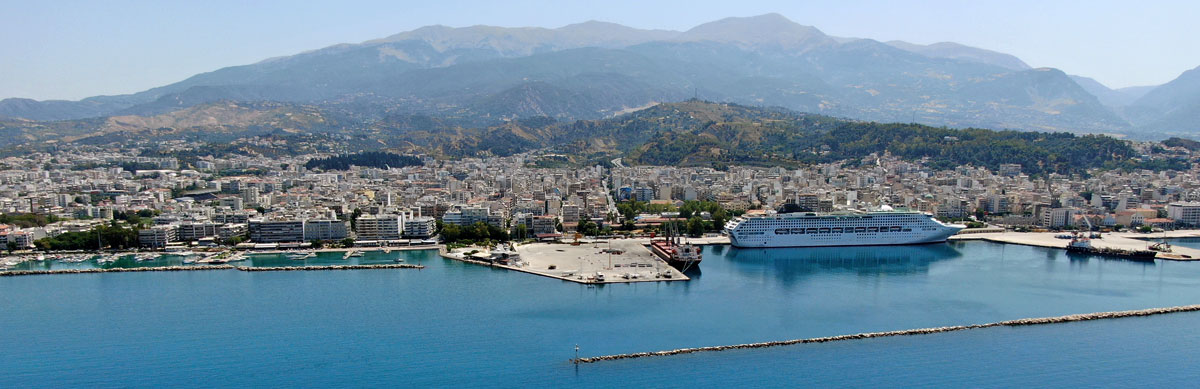
View of Patra and its harbour
Origins and Early Antiquity
At the northwestern edge of the Peloponnese, where Mount Panachaikon slopes gently toward the Gulf that bears its name, Patra stands as one of the oldest continuously inhabited cities in Greece. Archaeological traces show human presence as early as the Neolithic period, around the 3rd millennium BC, when small settlements thrived on the fertile coastal plain. Later, in the Mycenaean era (c. 1600–1100 BC), Patra—then a cluster of three villages named Aroe, Antheia, and Mesatis—formed part of a wider Achaean landscape that included Mycenaean centers such as Helike and Olenos.
Mythology links Patra’s founding to Patreus, an Achaean hero who, according to legend, gathered the scattered inhabitants of the area after the Dorian invasion and gave the new city his name. The “Achaean League,” that loose confederation of city-states on the northern Peloponnesian coast, found in Patra a western gateway between Greece and Italy—a role the city would play repeatedly through the ages.
Classical and Hellenistic Periods
During the Classical period (5th–4th century BC), Patra remained relatively modest compared to other Peloponnesian centers. Yet its position near maritime routes connecting the Ionian Sea to the Corinthian Gulf gave it commercial value. Following the Macedonian domination of Greece, Patra joined the revived Achaean League in the 3rd century BCE, sharing in the League’s attempt to balance Macedonian and Roman power
It was around this time that the lower city began to expand toward the sea, while temples and sanctuaries rose on the surrounding hills. Archaeological evidence points to a Temple of Artemis, a sanctuary of Demeter, and an Asklepieion, reflecting the city’s diverse religious life. Patra’s coinage of the period—depicting Athena or Apollo—attests to its growing autonomy and civic identity.
Roman Patra — Prosperity and Transformation
The decisive transformation of Patra came with Rome. In 146 BC, after the fall of Corinth, Greece was absorbed into the Roman sphere. A century later, in 14 BC, Emperor Augustus re-founded Patra as a Roman colony—Colonia Augusta Aroe Patrensis. He populated it with veterans from his campaigns and established it as the capital of the province of Achaea.
Under Roman rule, Patra flourished spectacularly. Its port became one of the empire’s most active trade nodes, linking the Peloponnese with Brindisi and southern Italy. Wine, ceramics, olive oil, and textiles flowed through its harbors, while Roman merchants and settlers brought with them Latin culture, urban planning, and monumental architecture.
Patra gained all the hallmarks of a Roman city: a forum, amphitheater, aqueduct, and bath complexes, the remains of which still surface across the modern city. The Roman Odeon, restored today and still used for performances, was among the finest in Greece—smaller but older than that of Athens.
The Christian Era — The Apostle Andrew and the Early Church
The Roman period also brought Patra into the light of Christian history. According to early tradition, Saint Andrew the Apostle preached in the city and was martyred there by crucifixion on an X-shaped cross around 60 AD. His tomb became a site of veneration, and by the 4th century, Patra was already a significant Christian center.
The city’s conversion marked a shift from pagan prosperity to spiritual prominence. Churches rose over ancient sanctuaries, and the cult of Saint Andrew endured through the centuries, making Patra one of the earliest episcopal seats in Greece. The great Cathedral of Saint Andrew, built much later in the 20th century, still honors this legacy as one of the largest Orthodox churches in the Balkans.
Byzantine and Medieval Periods
After the division of the Roman Empire, Patra became part of the Eastern Byzantine world. Though its importance waned compared to Constantinople or Corinth, it remained a thriving regional hub. Byzantine chronicles describe it as a fortified town with a bishop, artisans, and merchants trading across the Ionian and Adriatic.
The Slavic incursions of the 6th–7th centuries devastated much of the Peloponnese, yet Patra survived, thanks in part to its maritime connections and fortified acropolis. The Miracles of Saint Andrew, a 9th-century text, recount how the saint’s intervention saved the city from siege—a story blending faith and legend but reflecting real danger.
During the Middle Byzantine period (9th–12th centuries), Patra enjoyed renewed prosperity. It became a center of silk weaving and trade, exporting textiles to Italy and the Levant. The Byzantine castle, still standing atop the ancient acropolis, was expanded and strengthened during this time—its thick walls a silent witness to the city’s endurance.
Frankish, Venetian, and Ottoman Rule
In 1205, after the fall of Constantinople to the Crusaders, Patra fell under the control of the Principality of Achaea, ruled by Frankish knights. The Latin archbishopric of Patras became one of the richest sees in the Peloponnese, and the castle served as both fortress and residence.
Venetians and Byzantines struggled over the city in the 14th and 15th centuries until, in 1460, Patra was taken by the Ottoman Turks. For the next three centuries, the city experienced alternating periods of decline and modest revival. Under Ottoman rule, it became a provincial port known as Badrá or Batro, inhabited by Greeks, Turks, and Jews.
In the late 17th century, the Venetians under Francesco Morosini briefly recaptured Patra (1687–1715), fortifying its castle and improving its harbor before the Ottomans regained control. Venetian maps of the time show Patra as a small but active trading town at the crossroads of east–west commerce.
Revolution and Rebirth
By the dawn of the 19th century, Patra had grown into a town of several thousand inhabitants, known for its port and vineyards. When the Greek War of Independence broke out in 1821, Patra was among the first cities to revolt. The local leader Panagiotis Karatzas led the uprising, but the city suffered brutal retribution. The Ottoman garrison retreated into the castle, and fierce fighting followed, leaving much of Patra in ruins.
The destruction was so complete that when Ioannis Kapodistrias, the first governor of independent Greece, visited in the late 1820s, he described Patra as “a desolate plain of ashes.” Yet it rose again—rebuilt under a new urban plan drawn by the architect Stamatis Voulgaris in 1829, who designed a grid city with wide boulevards and neoclassical mansions reflecting European ideals of order and progress.
Modern Patra — From Wine to University City
In the late 19th century, Patra became the commercial capital of the Peloponnese. Its port boomed thanks to the currant trade—the export of dried grapes that made fortunes for local merchants. Elegant neoclassical buildings such as the Apollon Theatre and Patras Municipal Theatre symbolized this prosperity, as did the construction of warehouses, customs houses, and banks along the waterfront.
Railways connected Patra to Athens and Pyrgos, while steamships linked it to Italy, reinforcing its traditional role as Greece’s western gate. The great Carnival of Patra, originating in the mid-19th century, expressed the city’s cosmopolitan spirit—a blend of Ionian, Italian, and Aegean influences that survives vibrantly today.
In the 20th century, Patra endured the upheavals of wars and occupation but remained resilient. Postwar reconstruction, the founding of the University of Patras (1964), and the construction of the Rio–Antirrio Bridge (2004) confirmed its place as a dynamic urban center of western Greece.
Sights
Castle of Patra
Built upon the ruins of the ancient acropolis, the castle dominates the city and offers panoramic views over the Patraikos Gulf. Its present form mainly dates from the Byzantine, Venetian, and Ottoman periods.
Roman Odeon
One of the best-preserved Roman odeons in Greece, constructed during the 2nd century AD. Today it hosts concerts and cultural events, keeping the city’s ancient heritage alive.
Church of Saint Andrew
The imposing cathedral dedicated to the patron saint of Patra is among the largest churches in the Balkans. Relics of Saint Andrew are preserved here and attract thousands of pilgrims each year.
Upper Town and Neoclassical Districts
The narrow streets, stairways, and old mansions of the Upper Town reveal the most authentic and atmospheric side of Patra.
Achaia Clauss Winery
Founded in 1861, this historic winery resembles a small stone castle overlooking the hills outside the city. It was here that the famous Mavrodaphne wine was first created.
Roman Stadium and Ancient Remains
Roman Patra was among the empire’s most important Greek cities. Baths, mosaics, and remains of public buildings scattered throughout the city still reflect its former prosperity.
Georgiou I Square
The heart of modern Patra, surrounded by elegant neoclassical buildings and the historic Apollo Municipal Theatre designed by Ernst Ziller.
Apollo Municipal Theatre
One of Greece’s oldest opera theatres and often described as a miniature version of La Scala in Milan. It reflects the wealth and cosmopolitan spirit of 19th-century Patra.
Patra Carnival
The largest carnival in Greece transforms the city each winter into a vibrant celebration of music, parades, and festivities. The tradition dates back to the 19th century.
Waterfront and Marina
Patra’s modern seafront offers wide promenades, cafés, and views towards the bridge and gulf, while the marina becomes lively with visiting yachts during summer.
Flavours
Mavrodaphne Wine
Patra’s famous sweet wine has been produced since the 19th century and remains one of Greece’s most distinctive wines. It pairs beautifully with desserts and mature cheeses.
Tentoura Liqueur
The city’s traditional liqueur flavoured with cinnamon, cloves, and spices. It is usually served as a digestif or enjoyed warm during winter.
Currants and Raisin Bread
Black Corinthian currants once formed the economic backbone of the region. Traditional raisin bread remains a beloved local speciality.
Fresh Fish from the Patraikos Gulf
Local tavernas serve anchovies, sardines, red mullet, and octopus, usually grilled simply with olive oil and lemon.
Traditional Sweets and Loukoumi
Patra preserves a rich confectionery tradition influenced by the Ionian Islands and western Europe, producing delicate sweets and local specialities.
Wines of Achaia
Beyond Mavrodaphne, the surrounding vineyards produce excellent wines from grape varieties such as Roditis and Agiorgitiko, deeply connected with the identity of the region.
Patraikos Gulf Shrimps
The small shrimps of the gulf are particularly flavourful and are often served fried or cooked saganaki-style.
Traditional Meze Culture
Patra is known for its lively mezedopoleia serving small dishes of seafood, cheeses, and cured meats accompanied by ouzo or local wine.
Pasteli and Mountain Honey
The nearby mountains of Achaia produce excellent honey and traditional sesame sweets enjoyed throughout the region.