


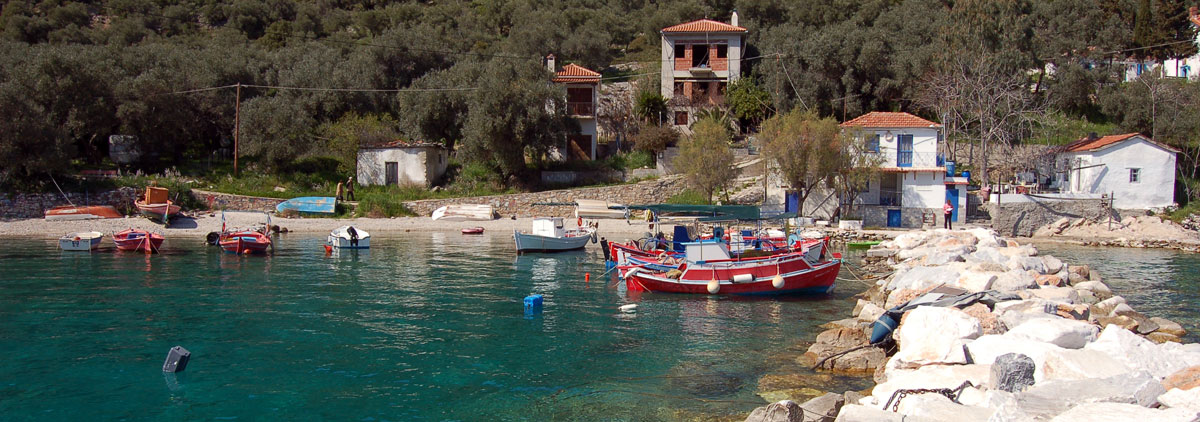
Kottes fishing harbour, Trikeri
The region formed by Palaio Trikeri, the small island at the southern exit of the Pagasitic Gulf, and the mainland settlements of Trikeri and Kottes, presents a compact but historically distinctive zone shaped by maritime activity, population movements, religious life, and political upheaval. Although geographically limited, it has accumulated a layered historical record extending from antiquity to the recent past.
Antiquity and Early Habitation
In classical geography, Palaio Trikeri is identified with Kikynithos, an island referenced by Strabo. Archaeological traces—mainly scattered ceramic fragments—indicate sporadic use during the Classical and Hellenistic periods, likely related to fishing, lookout functions, and temporary anchorage.
On the mainland, the area around modern Trikeri shows evidence of modest Byzantine-era rural habitation, but the exposed coastline and recurring pirate threats prevented dense or continuous settlement. The region remained sparsely populated and defensive in character throughout antiquity and the medieval world.
Piracy, Retreat, and the Birth of Trikeri (17th Century)
Between the late medieval era and the 17th century, escalating Aegean piracy forced communities to abandon exposed coastal sites. Residents who had been living on or frequently using Palaio Trikeri began relocating uphill, establishing the mainland village of Trikeri in a naturally defensible position with broad visibility and safer access to farmland.
By the late 1600s, Trikeri had become a consolidated rural settlement with a distinctly maritime orientation that would define its trajectory for the next two centuries.
Maritime Expansion and Local Economy (18th–19th Centuries)
From the early 1700s to the mid-1800s, Trikeri evolved into one of the key maritime communities of Thessaly. Its shipowners operated merchant brigs, sloops, and armed vessels across:
- the Black Sea,
- ports of Asia Minor and Constantinople,
- Ionian Sea routes,
- and the Sporades–Northern Aegean network.
The wealth generated by this maritime activity reshaped the built environment. Families invested in substantial stone mansions, financed churches decorated with quality woodcarving, and supported schools and public works.
The smaller coastal settlement of Kottes grew in parallel as a practical harbour for fishermen, sponge divers, and small coastal vessels, supporting the broader shipping economy of southern Pelion.
Trikeri’s Role in the Greek War of Independence (1821–1829)
During the Greek Revolution, Trikeri captains contributed to escort operations, provisioning missions, and coastal defence within the Pagasitic Gulf.
Although not a major naval power on the scale of Hydra or Spetses, Trikeri maintained active cooperation with them. Meanwhile, Palaio Trikeri served as a refuge and temporary base for families, fighters, and vessels seeking protection from Ottoman forces.
The Monastery of the Annunciation (Moni Evaggelistrias) 1825–1830
A key historical turning point for the island occurred in the 1820s, when, according to tradition, a miraculous icon of the Virgin Mary was discovered. This led to the founding of the Monastery of the Annunciation (Moni Evaggelistrias) between 1825 and 1830.
The monastery became the island’s single permanent institution and an important pilgrimage centre for southern Pelion, the Sporades, and northern Evia. For the rest of the 19th century, Palaio Trikeri remained sparsely inhabited, centred almost entirely on monastic life, olive cultivation, and small-scale fishing.
Decline of Maritime Activity in the 20th Century
The transition from sail-powered shipping to steam, combined with economic hardship and the consolidation of commercial trade in major ports such as Volos and Piraeus, led to the rapid decline of Trikeri’s traditional maritime economy after World War I.
Many residents emigrated, and fishing once again became the principal occupation. Kottes continued as a small fishing settlement, maintaining the older maritime rhythms on a modest scale.
The Women’s Prison Camp on Palaio Trikeri (1947–1953)
1. Establishment and Function
The most consequential modern episode for the island was its transformation into a political detention camp for women during the Greek Civil War. Established in September 1947, Palaio Trikeri became one of the central components of the state’s internal exile system, intended for individuals considered “dangerous to national security.”
2. Scale and Demographics
The island soon became the largest women’s political prison camp in Greece, housing more than 4,000 detainees at its peak. These included:
- members or suspected sympathisers of the Left and the wartime resistance,
- wives, daughters, and sisters of male partisans,
- women detained under broad security measures, often without trial.
A wide range of ages was present, from young adults to elderly women. Some infants and small children remained with their mothers inside the camp.
3. Living Conditions
The camp consisted of wooden barracks, tents, and makeshift facilities surrounding the monastery. Conditions were harsh:
- severe overcrowding
- limited access to fresh water,
- poor shelter in winter,
- minimal medical care,
- inadequate rations often supplemented by Red Cross parcels or family aid.
Discipline was strict, enforced by military police. Detainees were subject to daily inspections, roll calls, labour details, and constant pressure to sign statements of political repentance.
4. Internal Organisation and Cultural Life
Despite the conditions, detainees developed a structured internal life. Women organised:
- literacy and educational classes,
- collective childcare systems,
- basic health-care groups led by imprisoned nurses or midwives,
- cultural activities such as reading circles and handicraft workshops.
These forms of self-organisation played a crucial role in maintaining morale and became a lasting part of survivor testimony.
5. Transfers and Closure
After the end of the Civil War in 1949, many detainees were transferred to Makronisos and Aï-Stratis, but the camp on Palaio Trikeri remained active at reduced capacity. Between 1950 and 1953, it served partially as a holding site for women awaiting clearance and administrative processing. The camp closed officially in 1953, leaving behind a significant memorial legacy that continues to this day.
Post-Camp Era and Modern Identity
Following its closure, Palaio Trikeri returned to a state of light habitation, centred on the monastery and seasonal fishing activity. Olive groves continued to be maintained mainly by families from Trikeri and Kottes.
The mainland settlements preserved their architectural and maritime character, carrying forward a heritage visible in their built environment and communal memory even as their economic roles diminished.


