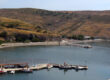


Myrina, harbour and castle
The island of Lemnos, in the north-eastern Aegean, lies at a key maritime junction between Thrace, Samothraki, Imbros and the sea routes that lead to the Hellespont and the Sea of Marmara. Its position granted it strategic value across civilisations, while its fertile plains and volcanic nature shaped an identity rooted in agriculture, metallurgy and seafaring. Through mythology, prehistory, classical antiquity, Byzantium and modern warfare, Lemnos repeatedly emerges as a stage of conflict, worship, cultivation and naval history.
Prehistory – Poliochni and the Dawn of Urban Society
Human presence on Lemnos reaches deep into the 12th millennium BC, with stone tools and habitation remains at Ouriakos suggesting Epipalaeolithic activity. The true leap, however, unfolds at Poliochni, on the island’s south-eastern coastline. Founded in the late 4th–early 3rd millennium BC, Poliochni is widely regarded as one of the earliest organised cities in Europe, contemporary with early Troy across the sea.
Excavations revealed fortification walls, multi-room houses, storage buildings, workshops and an advanced drainage system, as well as a Council House (bouleuterion) – evidence of early communal decision-making and proto-urban planning. The settlement’s layers show constant evolution, trade with Troy, the Cyclades and Anatolia, and an economy built on cereals, animal husbandry and metalworking.
Even at this early stage, Lemnos appears as a node of exchange, craftsmanship and agricultural stability, a role that will persist for thousands of years.
Mythology & Sacred Identity of the Island
Myth and history intertwine strongly on Lemnos. The island is sacred to Hephaestus, god of fire and metalwork. According to tradition, after being cast from Olympus, Hephaestus fell upon Lemnos, where he was tended by the Sinties, a local Thracian tribe. From this bond emerges a cult of fire, craftsmanship and rebirth, deeply rooted in the island’s volcanic nature.
Lemnos is also central to the tragic myth of Philoctetes, abandoned here by the Achaeans due to a serpent bite and left to suffer until divine fate brought him back to Troy as the bearer of Heracles’ bow. Through Philoctetes, Lemnos becomes a literary symbol of exile, endurance and redemption.
Rituals of purification with fire, offerings to Hephaestus and agricultural symbolism reflect a religious landscape where nature and craftsmanship were equally sacred.
Archaic & Classical Period – Athenian Control and Maritime Power
In historical antiquity the island was dominated by two major poleis: Hephaistia in the north and Myrina in the west. By the 6th century BC, Lemnos fell under Athenian influence, later becoming an Athenian cleruchy, where Athenian citizens settled and cultivated the land. This strengthened Athenian presence in the northern Aegean, especially during the Persian Wars and the Peloponnesian conflict.
Rich in grain, wine and salt, Lemnos served as Athens’ northern agricultural outpost, supplying the city and supporting fleets and troops on their way to the Hellespont and Thrace. Archaeological remains, sanctuaries and theatre remnants speak of a thriving civic life, shaped by commerce and maritime activity.
Hellenistic–Roman Era
After the death of Alexander the Great, Lemnos followed the shifting currents of the Hellenistic kingdoms before eventually coming under Roman administration. Its importance remained agricultural but also naval: the island acted as a maritime checkpoint controlling Aegean routes. Under Rome, Lemnos retained autonomy in local affairs and continued exporting wheat and wine, preserving economic stability even in turbulent times.
Byzantine Period – Fortress of the Northern Aegean
Within Byzantium Lemnos belonged to the Theme of the Aegean Sea. Its fertile land served as a grain reserve for Constantinople, especially after the empire’s losses in Asia Minor. Fortifications strengthened throughout the island to protect maritime access to the Straits, while monasteries and churches contributed to a dense spiritual landscape.
After the Fourth Crusade (1204), Lemnos fell under Latin rule, controlled first by the Navigajoso family, who fortified strategic points such as Myrina, Moudros and Kotsinas. Late in the 13th century the Byzantines regained control, only for the island to be entrusted later to the Gattilusio Genoese lords. Their architectural work left lasting marks, particularly in the castle of Myrina.
The Ottoman conquest in the 15th century confirmed Lemnos as a gatekeeper of the Dardanelles. Under Ottoman rule, agricultural production continued, local communities retained a measure of autonomy, and maritime trade remained active.
Modern Era – Balkan Wars, WWI and the Armistice of Moudros
During the First Balkan War (1912) Lemnos was liberated and integrated into the Kingdom of Greece. Soon after, the island was thrust into global importance during World War I.
The vast natural harbour of Moudros became the Allied headquarters for the Gallipoli campaign (1915). Naval fleets anchored across the bay, field hospitals operated, and cemeteries still remind the visitor of soldiers from Australia, New Zealand, Britain and France. Camps, depots and command centres turned Lemnos into a hub of strategic logistics.
On 30 October 1918, aboard HMS Agamemnon anchored at Moudros, was signed the Armistice of Moudros, which ended hostilities between the Ottoman Empire and the Allies. This moment marked a pivotal turning point in the Eastern Mediterranean, effectively opening the path to the dissolution of the Ottoman Empire.
The post-war decades saw redevelopment, agricultural expansion and port improvement. Lemnos returned to what it has long been: a fertile island of wheat and vineyards, a maritime link between continents, and a place where history has left layers rather than scars.
Myrina – Castle, commerce and the heart of Lemnos
Myrina, the capital and main harbour, stretches between two bays with a volcanic headland crowned by an imposing Byzantine-Genoese castle. Its dual-bay setting offered an ideal safe anchorage for centuries, fostering trade and community life. The castle was fortified extensively by the Gattilusio lords, whose towers and walls today create one of the most dramatic fortresses in the Aegean, often accompanied by the sight of wild deer roaming freely within the grounds.
During later Byzantine and Ottoman eras, Myrina functioned as the administrative and commercial core of the island, hosting markets, churches and civic buildings. In the 20th century it became the formal capital, centralising public services, education and maritime administration.
Today Myrina remains the cultural heart of Lemnos, blending old neighbourhoods and neoclassical houses with modern life, museums, coastal promenades and the whisper of ships arriving from mainland Greece.
Moudros – The naval harbour of World War I
Moudros, built around one of the largest natural bays in the Mediterranean, has always been a haven for ships. Calm waters and ample depth rendered it a strategic anchorage for fleets, especially those bound for the Hellespont.
In Byzantine times Moudros operated as an alternative port to Myrina, fortified and provisioned. Under the Ottomans it remained commercially active. Yet its greatest chapter came in the early 20th century.
During the Gallipoli campaign (1915), Moudros served as Allied headquarters and logistical hub. Naval squadrons assembled here; hospitals tended the wounded; cemeteries honour ANZAC and other fallen soldiers. Across the bay echoes remain of makeshift docks, telegraph stations and command rooms.
On 30 October 1918, the signing of the Armistice of Moudros aboard HMS Agamemnon brought the Eastern front of WWI to an end. Through this moment Moudros transcended local history to enter global diplomatic memory, symbolising peace after devastation.
Kotsinas – Fortress, Holy Sophia & the sacred healing earth
The northern coastal settlement of Kotsinas flourished during the medieval era as a fortified port. Latin and Genoese rulers strengthened its castle, holding a defensive vantage over northern Aegean trade routes. Today the church of Zoodochos Pigi stands on the castle’s foundations, associated with the legendary Saint Sophia of Lemnos, who is said to have fought and died defending the stronghold – a rare female warrior figure in Greek tradition.
Kotsinas is also linked with the renowned Lemnian Earth (terra sigillata) – a medicinal clay famed in antiquity and used until modern times. The clay was extracted ritually once per year, shaped into sealed tablets and traded throughout the Mediterranean as a cure for poisoning, infections and wounds. This practice gave Kotsinas both economic value and ritual prestige, embedding it deeply into the island’s identity.
Sightseeing in Lemnos
Lemnos is a land of volcanic plains, gentle hills, sandy beaches and wide horizons. It is a quieter island compared to much of the Aegean, ideal for travellers who value authentic landscapes, archaeology, local produce and calm seafront towns.
Poliochni
- Major prehistoric site, considered by many the earliest organised city in Europe.
- Visitors explore house foundations, storage buildings, bouleteurion and fortification walls overlooking the sea.
Hephaistia
- One of the island’s two principal ancient cities.
- Features an archaeological zone with theatre, tombs and sanctuary remains
- connected with the cult of Hephaestus.
Castle of Myrina
- Byzantine–Genoese fortress crowning a steep volcanic headland.
- Wild deer roam around the castle, a rare and atmospheric sight.
Castle of Kotsinas & Zoodochos Pigi
- Fortified medieval site with chapel rising on its foundations.
- Linked to legends of Saint Sophia, the island’s warrior heroine.
Moudros & Moudros Bay
- Key location for First World War history.
- Allied cemeteries, WWI points of interest and references to the 1918 Armistice.
Petrified Forest
- One of the few petrified forests in Greece, located near Moudros–Fanaraki.
- Features fossilised trunks and volcanic sediment layers.
Salt Pans (Alikes)
- Seasonal lakes forming large salt flats, frequently visited by flamingos and migratory birds.
- Beautiful in spring–summer.
Museums
- Archaeological Museum of Myrina – Neolithic & Classical collections, finds from Poliochni & Hephaistia.
- Folklore & Cultural Heritage Museums – daily life, tools, costumes.
- Naval & Gallipoli History Museum (Kallipoli focus) – excellent for WWI history travellers.
Flavours of Lemnos – Local Products & Gastronomy
Lemnos is a grain island, born of earth and wind. Volcanic soil gives depth to its produce and the island retains a strong cheese-making and viniculture tradition. Food culture is simple, rustic and authentic, grounded in local ingredients.
Cheese & Dairy
Kalathotos Lemnos (PDO)
- Soft cheese made from cow’s or sheep’s milk, shaped and matured in woven baskets which give it its name and texture.
- elicious with watermelon in summer or in salads.
Melichloro (Melitza)
- Dense late-summer cheese, left to air-dry until it becomes rich and piquant.
- Excellent grated or sliced with local wine.
Other Dairy
- Kasseri and fresh seasonal cheeses, plus yoghurt and butter from local herds.
Wines & Grapes
Muscat of Alexandria
- Signature Lemnian grape.
- Produces aromatic whites, semi-sweet and sweet wines with floral and honey undertones.
Kalambaki (Lemnion)
- Ancient red variety, possibly the oldest recorded Greek grape.
- Earthy, balanced reds with gentle tannins and historical lineage.
Traditional Grains & Pasta
Flomari
- Classic handmade long, thick pasta, often served with rooster stew or local cheese.
- Staple in island households and tavern tradition.
Rusks & Wheat Goods
- Lemnos has long been a granary of the North Aegean. Excellent rusks, pies and wheat-based specialties.
Honey & Sweets
- Thyme, heather and floral honey, dense and aromatic.
- Traditional sweets include samsades, katefthén (local festive pastry), spoon sweets, often almond- or sesame-based.
Seafood & Cuisine
- Abundant fresh fish and seafood, especially around Moudros and Myrina.
- Specialities: Lemnian crab pie, octopus in wine, fish soups, fried cuttlefish.
- Classic dish: flomari pasta with rooster or kid goat, paired with Muscat or Kalambaki wine.
Other Products
- Trahanas, hilopites, and goat-milk pasta grains.
- Local pulses and herbs
- Lemnian tsikoudia