


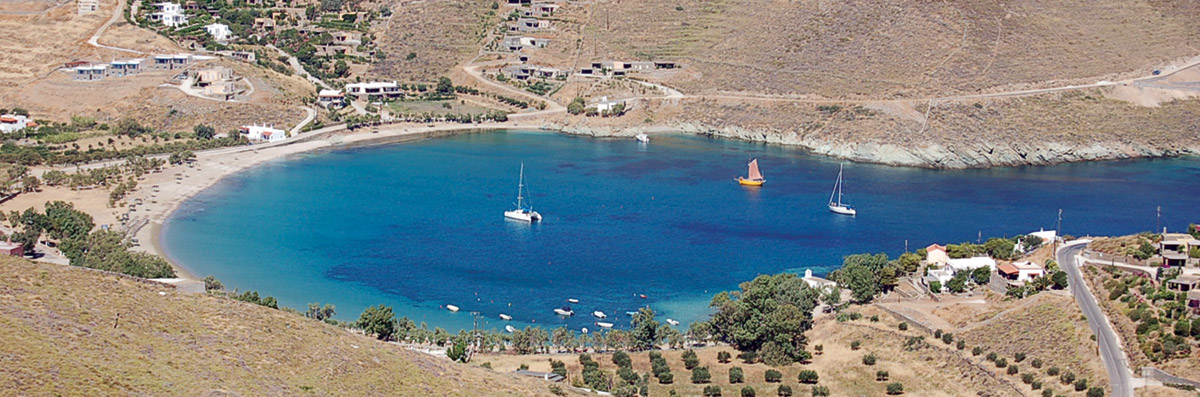
The island took its name by the hero Kéo, son of god Apollo and the nymph Rodoéssi. His presence on the island is estimated around the 11th century BC. Earlier to that, the island was named Ydroúsa (=watery), due to its many wells, rivers and dense vegetation.
According to mythology, when its name was still Ydroúsa, the island was inhabited by nymphs and when they left (chased by a mythical lion), Sirius, the brightest star on the sky, burned all of the Cyclades and Kéa transformed to a waterless, dry land. The inhabitants prayed to god Apollo to help them and he sent his son Aristaío, who organized the island, taught the villagers the art of agriculture and livestock and brought the meltemi wind, so that the islanders would cool off in the heat of the summer.
Archaeological findings revealed signs of settlements in the peninsula of Agía Eiríni and Vourkári village, dating from the Neolithic Era. In the following centuries, the island was inhabited by Káres, Minoans from Crete and then Iones in the 11th century BC. The latter, founded the cities of Ioulís, Karthía, Korissós and Poiiéssa, brought the economic growth and made the island known to the rest of the Hellenic world, due to the excellent political system of its society, for which later the great philosopher Aristotle wrote of.
The legislator Aristeídis, known as the “righteous Aristeidis”, originated from Kéa and was renowned to all of Hellas for the strict but practical laws he wrote.
After the Classical Years, Kéa enters the Athenian Alliance and up until the end of the Roman Empire (3rd century AD), follows the general course of history of Athens.
During the Byzantine years, the island suffers from continuous piratical raids and its inhabitants gradually become sparse. In the 13th century AD, the Byzantine historian Nikítas Akominátos visited the island and writes that life is scarce, only few agricultural settlements and that there are still bears and wild boars on the island.
In 1789, Lábros Katsónis brings the Hellenic fleet inside the natural harbour of Ágios Nikólaos and fortifies the bay. After the sea battle of Ándros with the Turks, the latter blockade Lábros Katsónis inside the bay, however, together with his wife from Kéa, he escapes with a boat, crossing the narrower point of the northern peninsula by land. That narrow point is even today called “Lábros strait”.
Thirty years later, in the Hellenic Wars of Independence, Kéa took an active part and in 1830 was freed.
Sights
Ioulis (Chora)
The capital of Kea is built amphitheatrically on a hillside and continues the legacy of ancient Ioulis. Its narrow alleys, stone houses and remains of the medieval castle create an atmosphere of authentic Cycladic life, while the Archaeological Museum presents finds from prehistoric to historic times.
The Lion of Kea
A short walk from Ioulis leads to the impressive ancient stone lion carved into the rock. This unique monument is linked with local mythology and stands as one of the island’s most distinctive landmarks.
Ancient Karthea
One of the most important archaeological sites on the island, set in a stunning coastal location. The ruins of temples and public buildings reveal the prosperity of the ancient city and combine history with natural beauty.
Ancient temples (Apollo, Athena, etc.)
Kea was home to important sanctuaries in antiquity, reflecting its cultural and religious importance. The remains of these temples offer valuable insight into the ancient Greek world.
Castle of Agia Marina
A Hellenistic defensive tower (3rd–1st century BC) that connects the island’s ancient and later history. Its position offers beautiful views and a strong sense of continuity.
Monastery of Panagia Kastriani
One of the most important religious sites on Kea, dramatically located above the sea. The setting, views and atmosphere make it a memorable and meaningful visit.
Kefala (Neolithic settlement)
Excavations in this area have revealed some of the earliest settlements in the Cyclades. The findings shed light on prehistoric life in the Aegean.
Beaches (Otziás, Spathí, Orkós, etc.)
Kea offers a wide range of sandy beaches with clear waters and easy access. From calm bays to more open shores, there is something for every visitor.
Flavours
Mostra
A classic local dish made with barley rusks, tomato and soft cheese. Simple yet full of flavour, it represents the essence of Cycladic cuisine.
Strapatsada
A traditional dish of eggs with tomatoes, often enriched with local ingredients. Ideal for a quick and satisfying meal.
Kakavia
A traditional fish soup made with fresh catch and simple ingredients, reflecting the island’s close relationship with the sea.
Paspalas
A hearty inland speciality made with small pieces of pork cooked with eggs and tomatoes. A rich and satisfying dish rooted in rural tradition.
Louza of Kea
A cured pork delicacy with a strong, aromatic flavour, perfect as a meze.
Local meats and barley bread
Kea is known for the quality of its meats and traditional breads, which form the backbone of its cuisine.
Pasteli of Kea
The island’s signature sweet, made with sesame and honey. A timeless delicacy with deep roots in Greek tradition.