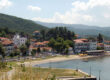


Ierissos gulf and harbour
From prehistoric ground to early Greek city-ports
Modern Ierissos stands beside the site of Ancient Akanthos (Acanthus), a major city-port founded in the 7th century BC, traditionally linked to settlers from Andros. Its position—on a ridge just above the shore—gave it both a defensible acropolis and immediate access to the sea lanes that threaded the northern Aegean. In practical terms, Akanthos was the ancient “Ierissos area” hub: a place that could export, import, and project power along the gulf.
A few miles north, Ancient Stageira (Stagira) developed on the Liotopi peninsula near today’s Olympiada, and it too traces its foundation to settlers from Andros in roughly the same era. This closeness matters: Stageira and Akanthos formed a paired coastal system—two city-ports looking onto the same seaways, with inland routes linking them to timber, metals, and pasture. Stageira later gained a unique fame as the birthplace of Aristotle (384 BC), but it was also a real, walled polis with its own economy and strategic anxieties.
The Persian Wars and the Athos “shortcut”
The Athos headland was notorious for dangerous weather; ancient fleets feared rounding it. That fear is one reason Xerxes I ordered the construction of the Xerxes Canal across the Athos isthmus near Nea Roda in 480 BC, creating a navigable passage that avoided the cape. Whether a ship anchored off Akanthos/Ierissos or staged near Stageira/Olympiada, this canal turned the whole area into a logistics theatre—a place where sea power, engineering, and local provisioning intersected.
Classical to Roman: city rivalry, trade, and continuity
Through the Classical and Hellenistic centuries, these city-ports lived within the shifting balance of Greek power politics, yet their deeper constant was commerce: harbour activity and coastal exchange. Akanthos’s archaeological footprint and long occupation underline that it was not a minor settlement; it endured through multiple eras and remained tied to the sea even as hegemonies changed. Stageira, likewise, was substantial enough to leave strong fortifications and an identifiable urban plan still visible in the ruins near Olympiada.
Under Roman rule, Macedonia’s coastal towns often prospered by feeding into imperial routes and markets. In the Ierissos–Stageira zone, that meant the old “port + resources” logic continued: nearby mountains and valleys supplied materials, while the gulfs provided the highway. Even when the names changed, the coastal geometry did not.
Byzantine Ierissos and the pull of Mount Athos
In the Byzantine period, Ierissos (as Hierissus/Erissos) appears as an ecclesiastical centre, and from about the 10th century its story becomes tightly bound to Mount Athos’s expanding monastic world. Border disputes between Ierissos and Athonite communities are recorded as early as the mid-10th century, showing that land, taxation, and jurisdiction mattered intensely in the contact zone between town and monasteries.
This is also when the wider gulf landscape becomes “institutional”: Athos is not just a mountain but a polity-in-the-making, and nearby coastal settlements—ports, landing places, provisioning towns—gain roles as gateways and suppliers. That is why places close to Ierissos (later including Ouranoupoli and the Athos approaches) belong in the same historical frame, even when the narrative focus is “the town”.
Ottoman era: the mining villages and a different kind of privilege
The inland mountains above Ierissos hold ore, and that fact reshaped local society under the Ottomans. Northeastern Chalkidiki became known for the mines around Siderokausia/Stratoniki, and the associated settlements—the Mademochoria (“mine villages”)—held special privileges in exchange for mining production and taxes (famously, a share of silver output).
Ierissos’s connection here is both direct and practical: as a coastal town on the edge of that mining zone, it naturally links the mountain economy to the sea—moving people, tools, and shipments, and serving as one of the outward-looking faces of a privileged interior. The same regional web explains Stratoni’s later importance: a small place can become crucial when it is the port and loading point for mines set slightly inland.
Revolution, 20th-century shock, and rebuilding
Like many Chalkidiki communities, Ierissos is remembered for participation in the broader upheavals of the Greek War of Independence (beginning in 1821) and the hard reprisals that followed in parts of Macedonia. What truly redefined the modern town’s physical form, however, was the 1932 Ierissos earthquake (magnitude about 7.0), which devastated Ierissos and nearby villages and left thousands homeless; even a small tsunami was reported.
That catastrophe is why “old” and “new” Ierissos are not just words: the rebuilding era shaped the townscape you see today, while the surrounding region continued to live with both seismic risk and industrial opportunity. The earthquake is even linked in scientific discussion to the Stratoni fault, a reminder that Stratoni and Ierissos are connected not only by economy and coast but by the deeper structure of the land.
Stratoni and the mining coastline in modern times
Stratoni’s modern identity is strongly tied to mining and to its role as a coastal facility for ore movement. Technical reporting on the “Stratoni Project” describes how mines lie a few kilometres inland from the village and its port/loading infrastructure, capturing the classic Chalkidiki pattern: mines in the hills, outlet on the sea.
This is the clearest “historical connector” for nearby locations: Stratoniki, Olympiada, and other settlements of the mining belt belong to the same long arc that begins with Byzantine–Ottoman Siderokausia and continues into modern industrial phases. Meanwhile, Ierissos sits a short distance south of this belt, close to the Athos boundary, and remains a regional hub in administration and everyday life.
Stageira and Aristotle
Ancient Stageira (near today’s Olympiada) is best known as the birthplace of Aristotle (born 384 BC), one of the most influential thinkers of Classical antiquity; he died in 322 BC at Chalcis in Euboea. He grew up in a world connected to Macedon (his father, Nicomachus, was associated with the Macedonian court tradition), later studied for many years at Plato’s Academy in Athens, and eventually founded his own school at the Lyceum—launching the Peripatetic tradition that shaped philosophy for centuries.
Aristotle’s surviving corpus is wide-ranging and unusually systematic: in logic (the Organon), natural philosophy (e.g., Physics), first philosophy (Metaphysics), ethics (Nicomachean Ethics), political theory (Politics), psychology (On the Soul), and literary theory (Poetics), among others. In broad terms, his work tried to describe how the world “hangs together”, from causes and change to civic life and moral character—an ambition that explains why Aristotle remains a reference point not only in philosophy, but also in the history of science and scholarly method.
For visitors, there are two “Aristotle” experiences in the area. The first is the archaeological site of Ancient Stageira on the Liotopi peninsula, just southeast of Olympiada, where you can walk among fortifications and ruins in a dramatic coastal landscape. The second is Aristotle’s Park (in/near the modern village of Stagira), a themed open-air park with interactive, educational installations inspired by physical principles associated with Aristotle, set in panoramic countryside.