


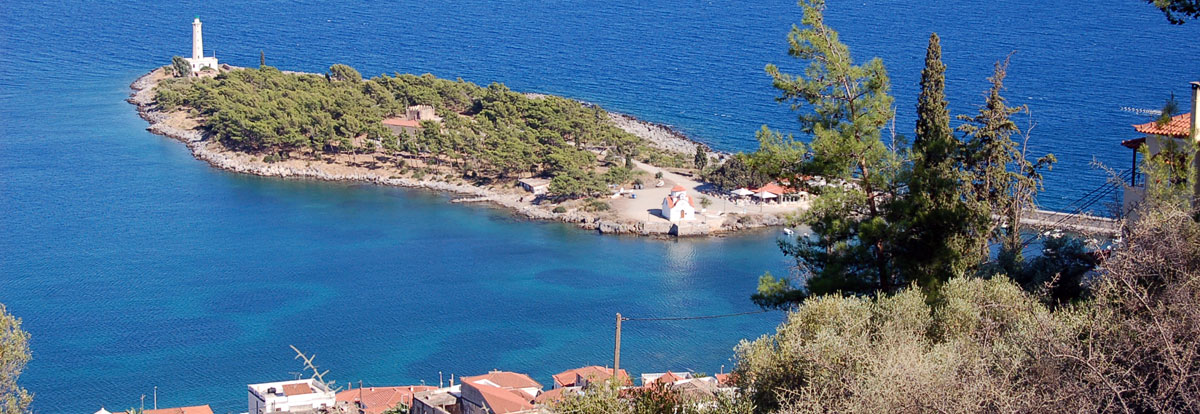
Marathonisi, Gytheio
Ancient Gytheio: The Harbour of Sparta
At the northern edge of the Laconian Gulf, where olive groves descend gently to the sea and Mount Taygetos rises in solemn grandeur, lies Gytheio — a town that, for more than three millennia, has served as the maritime heart of Laconia. Its name, Γύθειον, was said by ancient writers to mean “Land of the Gods” (from Gytheion, “home of the gods”), and indeed, myth and history intertwine in this small but vital port.
According to legend, Gytheio was founded by Heracles and Apollo after their reconciliation from an earlier quarrel — a symbolic origin for a harbour that would forever link the heroic and the divine. In another myth, Paris of Troy and Helen fled to a small island just off the coast, later known as Marathonisi, to consummate their fateful love before sailing for Troy — an episode that would echo across the centuries as one of the sparks of the Trojan War.
Historically, Gytheio was the seaport of Sparta, serving as its maritime window to the Aegean and the Mediterranean. While the Spartans themselves were famed for their discipline and land-based might, they relied on Gytheio for shipbuilding, trade, and contact with the wider Greek world. Excavations have uncovered ancient shipyards, warehouses, and a theatre from the Hellenistic period, testifying to the city’s importance as a bustling hub of commerce and naval activity.
In the 5th century BC, during the Peloponnesian War, Gytheio became a critical naval base. The Spartans fortified it heavily and used it to launch operations against Athens and its allies. However, after Sparta’s defeat at sea in the later years of the war, Gytheio was briefly occupied by the Athenians. It was recaptured and restored, only to fall again into decline after the loss of Sparta’s power in the 4th century BC.
Roman Prosperity and Destruction
Under Roman rule, Gytheio experienced a remarkable revival. The Romans, great admirers of Spartan virtue, granted the Laconians autonomy under the League of Free Laconians, and Gytheio became its leading city. During this period, it flourished as a prosperous trading port, exporting olive oil, wine, and purple dye made from murex shells — a prized Laconian product since antiquity. The Roman theatre, parts of which survive near the modern town, reflects the wealth and cosmopolitan air of this era.
However, in AD 375, a powerful earthquake destroyed much of the ancient city. The shoreline shifted, and parts of old Gytheio were submerged under the sea, where submerged ruins can still be seen on calm days. This natural disaster marked the end of the city’s classical era, and Gytheio would not regain its former glory for many centuries.
Byzantine and Medieval Eras: A Coastal Outpost
During the Byzantine period, Gytheio remained inhabited but was overshadowed by Mystras and the inland strongholds that guarded Laconia from the mountains. Its harbour still served local trade, especially olive oil and salt, but it never regained the maritime prominence it once enjoyed. The Byzantines fortified parts of the coastline and kept a small garrison here, aware of the strategic importance of controlling the Laconian Gulf.
When the Franks conquered the Peloponnese after the Fourth Crusade (1204), Gytheio was included in the Principality of Achaea. Later, in the 14th and 15th centuries, the region fell again under Byzantine rule, as part of the Despotate of the Morea, governed from Mystras. It was during this time that the Mani peninsula, with Gytheio as its northern gateway, began to develop its distinctive semi-independent character — a world apart, proud, warlike, and resistant to foreign rule.
The Ottoman Period and the Rise of Mani
When the Ottomans invaded the Peloponnese in 1460, Gytheio was destroyed once again and largely abandoned. The Maniates, fiercely independent and protected by their mountains, did not submit easily to Ottoman authority. Gytheio, lying outside the fortified Mani heartland, was often raided, burned, and rebuilt. The harbour occasionally served as an anchorage for Ottoman or pirate vessels, but there was no lasting urban settlement for several centuries.
In the 17th and 18th centuries, Mani became a semi-autonomous region, and Gytheio’s natural bay was occasionally used by the captains of Mani, smugglers, and corsairs. The small island of Marathonisi served as a lookout point and refuge during these turbulent times. Ruins of old fortifications on the island hint at these years of constant vigilance, when the line between pirate and freedom fighter was often blurred.
The War of Independence and the Birth of Modern Gytheio
In the early 19th century, Gytheio became once again a focal point of history. During the Greek War of Independence (1821–1829), Mani played a decisive role as one of the first regions to rise against Ottoman rule. Gytheio’s bay served as an anchorage for the fleet of Mani, whose small ships harassed Ottoman supply lines. In 1826, Ottoman forces under Ibrahim Pasha landed in the area and burned what remained of the old town, but they were driven back by the local fighters.
After independence, in the 1830s, the new Greek state sought to rebuild the port. Gytheio was officially refounded, laid out on a neoclassical urban plan, and developed into the administrative and commercial centre of Mani. Its picturesque waterfront, with two-storey mansions and tiled roofs, dates mostly from this era, reflecting the optimism of the early modern Greek kingdom. It quickly became the main outlet for Mani’s olive oil and citrus trade, linking the rugged interior with the wider world.
Gytheio in the 20th Century
Across the narrow strait from the town lies Marathonisi, the small rocky island forever linked with myth and memory. Archaeological traces show habitation since antiquity, and its association with Paris and Helen gave it a timeless romantic aura. In the 19th century, a small lighthouse was built there to guide ships entering the harbour — a beacon that still operates today. The island’s strategic position made it a natural sentinel of Gytheio, symbolizing its maritime spirit across the ages.
In the early 20th century, Gytheio remained a lively port town, exporting olive oil, soap, and citrus fruits, while fishing and sponge diving also supported the local economy. During World War II, it was occupied first by the Italians and then by the Germans; the surrounding Mani villages became centres of resistance. After the war, many inhabitants emigrated to Athens, Piraeus, and abroad, but Gytheio retained its character — quiet, proud, and slightly apart from the modern rush.
What to See in and around Gytheio
Though much of ancient Gytheio lies beneath the sea, the modern visitor can still trace the outlines of its long history. The ancient theatre, located on the northern edge of town near the modern road to Areopoli, is the most prominent remnant of classical Gytheio. Built of local stone in the Hellenistic period and later repaired by the Romans, it could seat several thousand spectators and once hosted festivals dedicated to Dionysus. The semicircular cavea, the orchestra, and parts of the stage building survive, offering a sense of scale and atmosphere unique in Laconia.
A short walk from the theatre brings you to the Roman baths and foundations of warehouses once used for olive oil storage and trade — reminders that Gytheio’s wealth always came from the land as much as the sea. In the shallow waters of the harbour, one can still discern submerged ancient walls and mosaics, vestiges of the city swallowed by the earthquake of AD 375.
The modern town itself, laid out in the 1830s, retains a distinct neoclassical charm: pastel-coloured mansions with tiled roofs, wrought-iron balconies, and marble lintels overlook the fishing boats along the quay. Walking along the seafront toward Marathonisi, you cross a short causeway to the small island. There stands the stone lighthouse, built in 1873 during the reign of King George I, a graceful octagonal tower of local marble 22 metres high, still guiding ships today. The views from the lighthouse steps embrace the entire Laconian Gulf — from Taygetos to Cape Malea.
Above the town, the slopes of Mount Larysion (modern Koumaro) offer panoramic views and scattered remains of Byzantine chapels and Venetian watchtowers, reminders of the centuries when Gytheio watched the sea for enemies and traders alike. A short drive south leads to the beaches of Mavrovouni and Vathy, long arcs of sand where sea turtles nest in summer — living links between the ancient and the natural worlds.
For those venturing inland, the road climbs to Areopoli and the heart of Mani, where the austere stone towers and the scent of thyme evoke another chapter of Laconia’s unbroken story. Gytheio, once the harbour of Sparta, remains today the living harbour of Mani — poised between history and the eternal blue.

