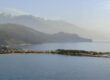


Chania harbour, from E
On the north-western shore of Crete, facing the open Cretan Sea, lies Chania, a city shaped by successive civilisations and anchored in maritime life. Its harbour has received Minoan merchants, Roman officials, Venetian admirals, Ottoman governors and modern travellers. Few cities in the eastern Mediterranean display such visible continuity of occupation. Chania is more than picturesque; it is a living archive of trade, conquest and cultural exchange, where stone and sea define identity.
Minoan Kydonia – Bronze Age Foundations
Beneath the old town of Chania lie the remains of Kydonia, one of the principal Minoan centres of western Crete. Flourishing particularly between c. 2000 and 1450 BC, Kydonia stood among the important urban hubs of the island. Excavations on Kastelli Hill have revealed substantial buildings, storage facilities and Linear A tablets, indicating organised administration and long-distance trade.
Kydonia’s position was strategic: fertile plains inland, a natural harbour seaward, and proximity to routes linking the Aegean with the wider Mediterranean. From its earliest phase, the settlement’s prosperity depended upon agriculture, craftsmanship and maritime exchange.
Classical, Hellenistic and Roman Periods
After the Bronze Age collapse, Kydonia endured into the historical Greek era. By the 5th century BC it was one of the strongest city-states of Crete, often involved in shifting alliances and regional conflicts. Hellenistic Crete was politically fragmented, yet Kydonia maintained influence through military strength and maritime capacity.
In 69 BC, Roman forces incorporated Crete into the Roman world. Kydonia retained a degree of autonomy and continued to thrive. Public buildings, baths and road connections strengthened its role as a regional centre. Under Rome, sea routes stabilised and commerce expanded, demonstrating the city’s adaptability within wider imperial systems.
Byzantine Period and Arab Occupation
With the division of the Roman Empire, Crete became part of Byzantium. In AD 824, Arab forces from al-Andalus conquered the island, transforming it into a base for piracy. The harbour of Chania inevitably played a role within this new maritime order.
The Byzantine reconquest in AD 961 restored imperial administration. Churches were rebuilt, fortifications strengthened and civic life revived. Though documentation from this period is limited, Chania remained an important coastal stronghold — evidence of its strategic indispensability across changing regimes.
Venetian Chania (La Canea) – Fortified Prosperity
After the Fourth Crusade, Crete passed to Venetian control. Chania, known as La Canea, became the administrative capital of western Crete. The Venetians reshaped the harbour, constructing arsenals (neoria) for shipbuilding and repair. Defensive walls encircled the city, reflecting advances in artillery-era fortification.
The Firka Fortress guarded the harbour entrance, while the lighthouse—rebuilt later in Ottoman times in its distinctive Egyptian-influenced form—remains the city’s maritime symbol. Within the walls, public buildings and elegant residences reflected Renaissance urban planning.
Venetian rule integrated Chania into a network stretching from the Adriatic to the Levant. The harbour functioned as a centre of maritime trade, military logistics and administrative governance, shaping the city’s enduring layout.
Ottoman Era – Transformation and Continuity
In 1645, Ottoman forces captured Chania after a prolonged siege. Churches were converted into mosques; new baths, fountains and residences altered the skyline. Yet the Venetian urban framework remained largely intact.
Throughout the 19th century, Chania played a central administrative role during the Cretan revolts against Ottoman rule. The coexistence of Muslim and Christian communities defined daily life, often under strain. Architecturally and socially, the city became a palimpsest of layered identities — Venetian foundations, Ottoman additions, Cretan continuity.
The Cretan State, Union and the 20th Century
In 1898, the Autonomous Cretan State was established under international supervision, with Chania as its capital. In 1913, the Greek flag was raised at Firka Fortress, marking the formal union of Crete with Greece.
During the Battle of Crete in May 1941, Chania and the nearby Maleme airfield became focal points of the German airborne invasion. The occupation that followed left deep scars but reinforced the city’s association with strategic geography and resilience.
Modern Chania
Today, Chania balances tourism, commerce and local life. The old harbour remains among the most recognisable in Greece, yet beyond its façade lies a functioning urban centre with markets, schools and maritime activity. Approaching from the sea, the line of the lighthouse and fortifications still signals safe landfall — a continuity stretching back millennia.
Chania’s identity rests upon endurance. Empires have shifted, but the harbour remains constant — a maritime threshold between Crete and the wider world.
Sightseeing
- Venetian Harbour and Lighthouse – One of the few surviving examples of Renaissance harbour architecture still integrated within a living urban environment. The lighthouse, rebuilt in its present Ottoman-era Egyptian-influenced form, remains the enduring maritime symbol of the city and a clear landfall mark when approaching from seaward.
- Firka Fortress – The fort that once guarded the harbour entrance and the site where the Greek flag was raised in 1913, sealing the Union of Crete with Greece. Today it houses maritime exhibitions and offers commanding views across the harbour and the Cretan Sea.
- Archaeological Museum of Chania – Exhibits spanning from Minoan Kydonia through the Roman and Byzantine periods, documenting the city’s continuous habitation and long historical trajectory.
- Old Town Quarters (Topanas, Splantzia) – Districts where Venetian urban planning and Ottoman architectural elements coexist within a compact area, revealing successive layers of civic evolution. Narrow lanes and interior courtyards preserve the atmosphere of earlier centuries.
- Samaria Gorge and the White Mountains (Lefka Ori) – The mountainous hinterland complements Chania’s maritime identity. Samaria Gorge, one of the longest in Europe, and the dramatic massif of the White Mountains connect coast and interior in a unified Cretan landscape of impressive scale.
Flavours
- Cretan Olive Oil – Produced from Koroneiki olives grown in the fertile plains west and south of the city, the oil is characterised by low acidity and intense aroma, forming the foundation of local cuisine.
- Graviera Chanion – A protected Cretan cheese made primarily from sheep’s milk, aged to develop a slightly sweet and nutty character.
- Apaki – Lean pork marinated in vinegar and smoked with aromatic herbs, a preservation method rooted in mountain tradition.
- Dakos – Barley rusks topped with fresh tomato, mizithra cheese and olive oil, reflecting the agricultural simplicity of the Cretan diet.
- Sfakian Pies – Thin pastries filled with soft cheese and lightly fried, often served with thyme honey from the White Mountains.
- Tsikoudia (Raki) – Distilled from grape pomace after the autumn harvest, consumed as a gesture of hospitality and communal bonding.