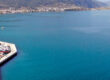


Atalanti harbour, from E
Atalanti, lying at the foot of Mount Chlomon and overseeing the fertile plains of northern Locris, is one of the region’s oldest and most historically layered towns. Although today it appears as a quiet provincial centre, its roots reach deep into antiquity, unfolding through myth, classical warfare, Byzantine resilience, and the dramatic upheavals of the Greek Revolution. Throughout its long timeline, Atalanti has stood at a strategic gateway between central Greece and the northern approaches of the Corinthian Gulf, a vantage that shaped its fortunes and its identity.
Ancient Lokris: Origins and Myth
The wider region of Locris emerges in early Greek myth as the land of the Locrians, a people considered among the oldest Hellenic tribes. Atalanti itself, mentioned as Atalanteia or Opountian Atalanti, was associated with the nearby city of Opous, the capital of the Eastern Locrians. The Locrians appear in Homer’s Iliad, contributing ships under the command of Ajax the Lesser, famed for his agility and quarrelsome temperament. Their lands stretched between Thermopylae and the coasts of the Euboean Gulf, controlling an important passage along the main north–south corridor of ancient Greece.
Atalanti’s name is often connected—though poetically rather than historically—with Atalante, the legendary huntress of Greek mythology, famed for her unmatched speed, precision with the bow, and fierce independence. Exposed on a mountainside as an infant and raised by a she-bear, she grew into a fearless woman who rejected marriage, swore lifelong devotion to Artemis, and lived as a tracker and warrior in the wilderness. She was one of the central figures of the Calydonian Boar Hunt, where her skill allowed her to wound the monstrous boar before any of the male heroes, earning their admiration and jealousy. In another myth, she challenged her suitors to footraces, vowing to marry only the man who could outrun her—an impossible feat until Hippomenes used three golden apples from Aphrodite to distract her. Although the mythical Atalante has no historical link to the region of Atalanti, her spirit of swiftness, bravery, and autonomy made her name a poetic association for the land and a symbol of heroic femininity in the ancient world.
Archaeological findings in the broader Lokrian plain support continuous habitation from the Mycenaean Age (around 1400–1100 BC) onward. The strategic position between mountain and sea made it ideal for agriculture and communication. Classical Atalanti, along with Opous, appears frequently in historical references concerning the shifting alliances between the Locrians, Athens, and Thebes.
Classical and Hellenistic Periods
During the 5th and 4th centuries BC, the Locrians oscillated between alliances with Athens and their powerful neighbour, Thebes. The region never developed into a major polis-state like Corinth or Athens, but its position along the central Greek road network made it valuable in warfare. Several skirmishes and troop movements recorded in the Peloponnesian War passed through Lokris, including Spartan detachments marching northwards or Athenian movements toward Boeotia.
Atalanti flourished modestly as an agricultural settlement that supported Opous, which minted coins and maintained a more formal civic identity. Yet inscriptions and small-scale ruins around modern Atalanti reveal the presence of sanctuaries, public works, and burial grounds from the Hellenistic period, indicating that the town maintained a stable and continuous urban life.
With the arrival of the Macedonian hegemony, Atalanti and the Locrians came under the broader orbit of the Antigonid kingdom. Although not recorded as a battleground in the great Macedonian–Hellenistic conflicts, the region supplied grain, manpower, and access routes for armies moving between Thessaly and central Greece.
Roman and Early Christian Era
The Roman conquest in 197 BC brought relative stability, and the Locrians were incorporated into the Roman province of Achaia. Atalanti, though small, benefitted from the peace of the imperial period: villas, agricultural estates, and improved road networks helped integrate the community into the Mediterranean economy. Local marble, timber, and olive products were traded through nearby coastal stations.
Christianity arrived early in the region due to the proximity of major Roman roads. By the 4th and 5th centuries AD, small basilicas and cemeteries attest to the gradual Christianisation of the Lokrian countryside. Atalanti—then a modest but organised settlement—entered the Byzantine period as a stable rural community watching over the coastal plain.
Byzantine Atalanti and Medieval Turmoil
In Byzantine times, the town appears in ecclesiastical documents as Talanti. Its position remained agriculturally important, feeding the cities of central Greece, but also vulnerable to raids. During the 7th–10th centuries, Slavic migrations, pirate incursions, and Bulgar campaigns troubled the region. Nevertheless, a number of rural churches dating to the Middle Byzantine period (9th–12th centuries) survive in the area, reflecting a prosperous countryside protected by fortified hilltop settlements.
After the Fourth Crusade (1204), Lokris fell into Frankish hands and later passed to Catalan mercenaries before being absorbed into the Duchy of Athens. Throughout this era, Atalanti was mentioned as an agricultural hub with a fortified nucleus supporting the feudal estates of the plains. Venetian and later Ottoman raids in the 15th century repeatedly struck the area, culminating in the gradual establishment of Ottoman rule around 1470.
Ottoman Period: A Multicultural Town
Under the Ottomans, Atalanti was known as Talandi and grew to become an important regional centre. The fertile plains encouraged the settlement of Greeks, Arvanites, and some Turkish families, creating a multiethnic society typical of rural central Greece. Ottoman records describe vineyards, grain fields, and walnut groves forming the backbone of the economy.
The 17th and 18th centuries brought relative prosperity. Several churches were repaired or rebuilt, schools emerged, and Atalanti began to resemble a small provincial market town. Its residents developed strong ties with Euboea across the water, and many families traded goods via the coast at Skala Atalantis.
The Greek Revolution
Atalanti entered the Greek War of Independence (1821) with determination but faced enormous hardships. The local fighters aligned with the uprising early, prompting severe Ottoman reprisals. The town was repeatedly attacked, burned, and depopulated. For a time, Atalanti stood nearly deserted, its inhabitants scattered in the mountains or across the sea to Evvoia and the islands.
A turning point came with the intervention of Lord Byron’s Philhellenic Committee and the resettlement efforts following independence. Between 1830 and 1835, Atalanti became the designated home of a group of Thessalian refugees and Macedonian families who fled Ottoman reprisals. This influx reshaped the town’s demographic identity, creating a new civic community built upon the ashes of the struggle.
Under King Otto, Atalanti was reorganised as a municipal centre, and new streets, churches, and administrative buildings were constructed. The plain was drained and re-cultivated, giving rise to the agricultural wealth that still defines the area today.
Modern Era
A catastrophic earthquake in 1894 struck Atalanti and much of eastern Lokris, levelling houses and killing hundreds. The disaster changed the urban layout, as reconstruction led to wider streets, safer masonry, and a modernised town plan. The early 20th century brought further movements of population—especially Asia Minor refugees in 1922—who added new crafts, foods, and customs to the cultural landscape.
During the Second World War, Atalanti was active in the Greek Resistance, and the surrounding mountains sheltered numerous partisan groups. Post-war reconstruction and agricultural development, coupled with the opening of the modern national road network, helped integrate the town more closely with Athens and Lamia.
Sightseeing
Church of Agios Athanasios (Town Centre)
A 19th-century church built during the early years of the Greek state. Its interior icons and stonework reflect the transition from Ottoman-era craftsmanship to the new national aesthetic.
Atalanti Archaeological Collection
A small but valuable exhibition showcasing finds from the wider Lokrian plain: pottery, inscriptions, figurines, and burial offerings tracing local life from the Mycenaean period to Roman times.
Castelli Hill (Ancient Fortification Site)
A short walk above town leads to remnants of fortification walls attributed to Classical Lokris. The hill offers sweeping views over the Atalanti plain and the Euboean Gulf.
Skala Atalantis
The coastal extension of the town, known for its small harbour, seaside tavernas, and calm waterfront. Ideal for evening strolls and excursions to the nearby islets.
The Atalanti Islands (Lichadonisia of Lokris)
A tiny archipelago opposite Skala Atalantis, home to beaches, turquoise waters, and marine life. Accessible seasonally by boat. Perfect for swimming, snorkelling, and photography.
Thermal Springs of Livanates (nearby)
A short drive east, these warm springs were known in antiquity and remain a popular spot for therapeutic bathing.
Opous Archaeological Zone (near modern Atalanti)
Scattered remains of ancient Opous—walls, towers, and foundations—provide a glimpse into the classical capital of the Locrians.
Flavours
Atalanti’s cuisine is deeply tied to its fertile plain and coastal access. Expect dishes shaped by olive groves, vineyards, and centuries of rural tradition.
Lokrian Olive Oil
Rich, fruity, and aromatic—one of the town’s proudest products. Used generously in salads, baked dishes, and slow-cooked meats.
Local Wines and Retsina
Atalanti hosts several vineyards producing crisp whites and light reds. Traditional retsina from the region is mild and fragrant.
Goat and Lamb Stews
Slow-cooked with herbs from Mount Chlomon, often served with potatoes or local pasta.
Gkogklies” Handmade Pasta
A rustic Lokrian specialty, usually served with browned butter or tomato sauce.
Fresh Seafood at Skala Atalantis
Small fish, octopus, and calamari dominate the seaside tavernas, paired perfectly with local wine.
Citrus Sweets & Spoon Preserves
Oranges and lemons from the plain are transformed into fragrant spoon desserts and marmalades.
Walnut Desserts
Walnut groves in the plain supply the ingredients for classic Greek sweets like karidopita (walnut cake) and local variations.